Insight Blog
Agility’s perspectives on transforming the employee's experience throughout remote transformation using connected enterprise tools.
32 minutes reading time
(6367 words)
How Marketing Managers Use Effective Advertising Strategies for Strategic Business Planning in 2026

How Marketing Managers Use Effective Advertising Strategies for Strategic Business Planning in 2026
Discover how marketing managers use effective advertising strategies for strategic business planning, smarter targeting, AI-driven campaigns, and long-term business growth in 2026.
How Marketing Managers Use Effective Advertising Strategies for Strategic Business Planning in 2026

Advertising is no longer just about clicks and impressions.
In 2026, businesses are treating effective advertising strategies as a core part of strategic business planning to drive growth, improve customer acquisition, and increase long-term revenue.
Marketing managers are under pressure to deliver measurable ROI from every campaign.
According to Gartner, marketing budgets remain around 7.7% of company revenue, forcing businesses to focus on smarter planning, better targeting, and performance-driven advertising strategies.
7.7%
of company revenue
According to Gartner, marketing budgets remain around 7.7% of company revenue, forcing businesses to focus on smarter planning, better targeting, and performance-driven advertising strategies.
Source: Gartner CMO Spend Survey
At the same time, AI and predictive analytics are reshaping strategic marketing planning.
Recent industry reports show that nearly 78% of marketers now use AI tools to improve campaign performance, audience targeting, and advertising automation.
This shift means businesses can no longer rely on disconnected campaigns or short-term tactics.
Instead, modern marketing managers are aligning advertising with wider business goals to improve efficiency, strengthen brand visibility, and support sustainable business growth.
Key Takeaways
- Modern advertising strategies are now a core part of strategic business planning, helping businesses align marketing with long-term growth goals.
- Marketing managers are using data-driven advertising, audience segmentation, and AI-powered insights to improve campaign performance and ROI.
- Omnichannel advertising across search, social media, video, email, and remarketing channels creates more consistent customer experiences.
- Businesses that rely only on short-term advertising wins often struggle with customer retention, brand growth, and long-term profitability.
- Strategic advertising planning helps organisations optimise budgets, forecast performance, improve targeting, and support measurable business outcomes.
What is Strategic Business Planning?

What is Strategic Business Planning
The strategic meaning behind business planning is creating a long-term roadmap that helps organisations achieve specific goals, improve decision-making, and stay competitive.
Strategic business planning examples include expanding into new markets, improving customer retention, increasing operational efficiency, or investing in digital transformation initiatives.
For many companies, especially startups and growing organisations, strategic planning for small business helps prioritise resources, define clear objectives, and align marketing, sales, and operational activities with overall business growth goals.
A strong strategic plan allows businesses to adapt faster to changing market conditions and customer expectations.
Why Every Business Needs a Strategic Plan
A strategic plan acts as a roadmap for long-term business growth, helping organisations evaluate strengths, weaknesses, opportunities, and future direction.
It provides businesses with a clearer structure for improving performance, managing resources, and adapting to changing market conditions.
Through the strategic planning process, companies gain a better understanding of their goals, target audience, and competitive position.
This is especially important when planning modern advertising campaigns, including digital strategies such as social media advertising, display advertising, and even analysing popunder ads examples to understand different customer acquisition methods and online advertising trends.
A strong strategic plan also supports budgeting, forecasting, risk management, and performance measurement. Most importantly, it helps businesses define their long-term vision while creating a framework for smarter, data-driven business decisions.
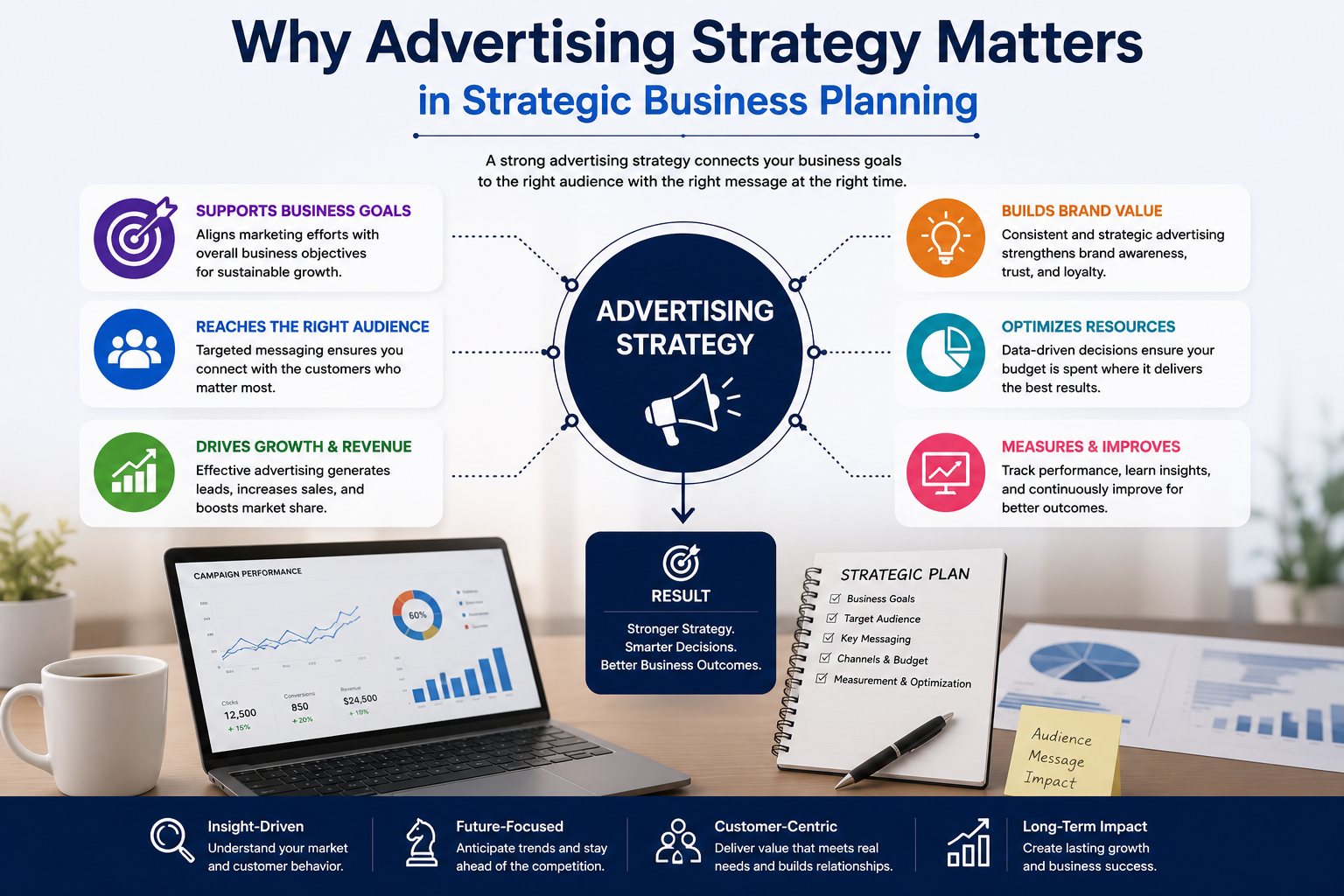
Why Advertising Strategy Matters in Strategic Business Planning
Modern businesses can no longer treat advertising as a standalone marketing activity.
In 2026, successful organisations are integrating advertising directly into their broader strategic business planning efforts to improve growth, visibility, customer retention, and long-term profitability.
A well-planned advertising strategy helps businesses make smarter decisions, allocate budgets more effectively, and stay competitive in rapidly changing markets.
Why Advertising Strategy Matters in Strategic Business Planning
The Role of Advertising in Long-Term Business Growth
Advertising plays a major role in helping businesses build awareness, attract new customers, and maintain consistent market visibility over time.
Instead of relying only on short-term campaigns, modern marketing managers are creating long-term advertising strategies that support wider business objectives and sustainable growth.
Strong advertising strategies also help businesses stay relevant in competitive industries where customer attention is becoming harder to capture.
Key ways advertising supports business growth include:
- Increasing brand visibility across digital channels
- Building long-term customer trust and recognition
- Supporting product launches and market expansion
- Driving recurring customer engagement
- Creating consistent lead generation opportunities
Why Disconnected Campaigns Waste Marketing Budgets
Many businesses struggle with fragmented advertising campaigns spread across multiple platforms without a unified strategy.
This often leads to inconsistent messaging, duplicated efforts, poor audience targeting, and wasted advertising spend.
Without proper strategic planning, marketing teams may focus too heavily on isolated campaign performance instead of overall business impact.
This creates inefficiencies that reduce ROI and make performance harder to measure accurately.
Common problems caused by disconnected campaigns include:
- Inconsistent customer experiences across channels
- Duplicate advertising costs and wasted spend
- Poor communication between marketing teams
- Difficulty tracking campaign performance
- Lower conversion rates due to mixed messaging
How Strategic Advertising Improves Customer Acquisition and Retention
Effective advertising is not only about attracting new customers.
Modern advertising strategies also help businesses improve customer retention, strengthen loyalty, and increase customer lifetime value.
By using data-driven targeting, personalised messaging, and omnichannel advertising, businesses can create more relevant customer experiences that improve engagement and conversions.
Marketing managers are increasingly using strategic advertising to support every stage of the customer journey.
Benefits of strategic advertising include:
- Better audience targeting and segmentation
- Higher quality leads and improved conversions
- Increased customer engagement and loyalty
- More personalised customer experiences
- Stronger long-term customer relationships
The Connection Between Advertising, Branding, and Revenue Forecasting
Advertising directly impacts how customers perceive a brand, which influences purchasing decisions, customer trust, and long-term revenue potential.
Businesses with strong branding and consistent advertising often perform better in highly competitive markets.
Modern businesses are also using advertising performance data to improve revenue forecasting and business planning.
By analysing campaign trends, customer behaviour, and conversion data, marketing managers can make more informed financial and growth decisions.
Advertising insights now help businesses:
- Forecast future sales and customer demand
- Improve budget allocation and resource planning
- Strengthen overall brand positioning
- Identify high-performing marketing channels
- Make data-driven business decisions faster
The Biggest Advertising Challenges Marketing Managers Face Today

The Biggest Advertising Challenges Marketing Managers Face Today
Modern marketing managers face increasing pressure to deliver stronger results with tighter budgets and growing competition across digital channels.
Consumer behaviour is changing rapidly, while AI-driven search, privacy regulations, and rising advertising costs continue to reshape the marketing landscape.
Many businesses also struggle with fragmented tools, disconnected data, and difficulties measuring campaign performance accurately across multiple platforms.
Some of the biggest advertising challenges businesses face today include:
- Rising customer acquisition costs
- Declining engagement rates across digital platforms
- Difficulty measuring true advertising ROI
- Managing disconnected marketing tools and platforms
- Adapting to AI-powered search and changing customer behaviour
Rising Customer Acquisition Costs Across Digital Channels
Customer acquisition costs continue to increase as more businesses compete for visibility across search engines, social media, video platforms, and display advertising networks.
Paid advertising is becoming more expensive, especially in competitive industries where bidding wars drive up CPC and CPM costs.
Marketing managers must now focus on smarter audience targeting, better conversion optimisation, and long-term customer value rather than simply increasing ad spend.
Key factors driving higher acquisition costs include:
- Increased competition in digital advertising
- Rising CPC rates on Google and social platforms
- Ad fatigue reducing campaign performance
- Stricter data privacy and tracking limitations
- Growing demand for personalised advertising experiences
Advertising Fatigue and Declining Engagement
Consumers are exposed to thousands of advertisements every day, making it harder for brands to capture attention and maintain engagement.
Repetitive messaging, overused creatives, and poor targeting often lead to advertising fatigue, causing audiences to ignore or block ads completely.
Modern businesses must focus on creating more engaging, personalised, and value-driven advertising experiences to improve campaign effectiveness.
Common signs of advertising fatigue include:
- Lower click-through rates (CTR)
- Declining conversion rates
- Reduced social media engagement
- Increased ad skipping and banner blindness
- Higher customer acquisition costs over time
Measuring ROI Across Multiple Platforms
One of the biggest challenges in modern advertising is accurately measuring ROI across multiple channels and customer touchpoints. Customers often interact with brands through search engines, social media, email campaigns, video ads, and websites before making a purchase decision.
Without proper attribution tracking and analytics, businesses struggle to identify which campaigns are truly driving results.
Common ROI measurement challenges include:
- Inconsistent reporting across platforms
- Limited cross-channel attribution visibility
- Difficulty tracking customer journeys
- Data gaps caused by privacy restrictions
- Overreliance on vanity metrics instead of revenue impact
Managing Fragmented Marketing Tools and Data Silos
Many marketing teams use multiple disconnected platforms for email marketing, analytics, CRM, advertising, automation, and customer engagement.
This creates data silos that make campaign management slower, less efficient, and more difficult to optimise.
Disconnected tools also reduce collaboration between departments and limit access to real-time insights.
Problems caused by fragmented marketing systems include:
- Duplicate customer data
- Inconsistent reporting and analytics
- Poor campaign coordination
- Slower decision-making processes
- Reduced marketing efficiency and visibility
Adapting to Changing Consumer Behaviour and AI-Driven Search
AI-powered search engines, personalised recommendations, and changing online behaviour are transforming how customers discover brands and make purchasing decisions.
Traditional advertising strategies are becoming less effective as consumers expect faster, more relevant, and highly personalised experiences.
Marketing managers must now adapt their advertising strategies to match evolving digital behaviours and AI-driven discovery platforms.
Key changes businesses must adapt to include:
- AI-generated search results and recommendations
- Increased use of voice and conversational search
- Shorter customer attention spans
- Higher expectations for personalisation
- Growing preference for video and interactive content
Effective Advertising Strategies Marketing Managers Are Using Today
Modern advertising strategies are becoming more data-driven, personalised, and AI-powered as businesses compete for customer attention across multiple digital channels.
Marketing managers are moving away from isolated campaigns and focusing on advertising methods that improve targeting, engagement, and long-term business growth.
According to HubSpot, businesses using data-driven marketing and personalisation generate significantly higher engagement and conversion rates compared to companies relying on broad targeting methods.
In 2026, successful advertising strategies focus heavily on automation, audience intent, and omnichannel customer experiences.
Data-Driven Advertising and Audience Segmentation
Modern businesses are using customer data to create highly targeted advertising campaigns instead of relying only on age or location demographics.
Marketing managers now segment audiences based on behaviour, interests, engagement history, and purchasing intent to improve campaign performance and reduce wasted ad spend.
For example, an eCommerce company may show different ads to repeat customers, abandoned-cart users, and first-time visitors to increase relevance and conversions.
Research from McKinsey shows that businesses using advanced audience segmentation can improve marketing efficiency by up to 20%.
Many companies now use first-party data, CRM systems, website analytics, and AI-powered insights to build more accurate audience profiles and improve advertising ROI.
Omnichannel Advertising Strategies for Modern Buyers
Consumers interact with brands across multiple channels before making a purchase decision.
A customer may discover a business through Google Search, later engage with a LinkedIn post, watch a YouTube advertisement, and finally convert through an email campaign or retargeting ad. This shift has made omnichannel advertising a key part of strategic business planning.
For example, SaaS businesses commonly combine Google Ads for search intent, LinkedIn campaigns for B2B awareness, and retargeting campaigns for lead nurturing.
According to Salesforce, customers expect consistent experiences across all digital touchpoints.
Businesses using omnichannel advertising strategies often experience better customer engagement, stronger brand trust, and improved conversion tracking compared to companies running disconnected campaigns.
Personalised Advertising Campaigns That Improve Conversions
Personalisation has become one of the most effective advertising strategies businesses use in 2026.
Consumers now expect brands to deliver relevant content, tailored product recommendations, and customised messaging based on their behaviour and preferences. Generic advertising campaigns are becoming less effective as audiences demand more relevant experiences.
According to Salesforce, nearly 73% of customers expect businesses to understand their needs and expectations.
Marketing managers are using AI-powered advertising tools, customer data platforms, and predictive analytics to personalise campaigns at scale. Examples include dynamic product ads, location-based promotions, personalised email campaigns, and retargeting ads showing previously viewed products or services.
These strategies help improve engagement, increase conversions, and strengthen customer loyalty.
Content-Led Advertising Strategies for Long-Term Engagement
Many businesses are investing more heavily in content-led advertising instead of relying purely on direct-response campaigns.
Educational content, thought leadership, industry insights, videos, and SEO-focused blog articles help brands build authority while attracting long-term engagement and organic traffic.
For example, B2B companies often publish detailed guides, webinars, and case studies to educate potential customers before using retargeting ads later in the sales funnel.
This strategy builds trust and keeps businesses visible during the customer research stage. According to Demand Metric, content marketing generates significantly more leads than traditional outbound marketing while costing less over time.
Businesses using content-led advertising strategies often reduce dependency on expensive paid acquisition campaigns.
Retargeting Strategies That Reduce Lost Opportunities
Most website visitors do not convert during their first interaction with a business.
Retargeting strategies help businesses reconnect with users who previously visited a website, viewed products, or interacted with advertising campaigns but left without taking action. This approach improves conversion opportunities and reduces customer acquisition waste.
For example, eCommerce brands frequently use retargeting campaigns for abandoned shopping carts, while SaaS businesses often retarget users who visited pricing pages or requested product demos.
Studies consistently show that retargeting campaigns outperform cold advertising campaigns because the audience already recognises the brand.
Marketing managers are now combining website retargeting, video engagement campaigns, and email remarketing to create more effective customer re-engagement strategies.
AI-Powered Advertising Optimisation and Automation
AI is transforming how businesses create, manage, and optimise advertising campaigns.
Modern AI-powered tools can analyse customer behaviour, predict conversion patterns, automate bidding strategies, and generate advertising creatives faster than traditional manual processes.
This allows marketing teams to improve efficiency while reducing wasted ad spend.
Recent industry reports show that nearly 80% of marketers now use AI tools to support campaign management and advertising optimisation. Businesses are using AI for predictive audience targeting, automated campaign testing, AI-generated ad copy, and real-time performance analysis.
Companies adopting AI-powered advertising strategies are often able to scale campaigns faster while improving targeting accuracy, campaign performance, and overall marketing ROI.
How Marketing Managers Align Advertising With Business Goals
Modern marketing managers align advertising with business goals by translating high-level corporate objectives into SMART goals that are Specific, Measurable, Achievable, Relevant, and Time-bound.
Instead of running campaigns based purely on impressions or clicks, businesses now focus on advertising strategies that directly support revenue growth, customer retention, market expansion, and long-term profitability.
This approach helps marketing teams justify advertising spend while improving accountability and measurable business impact.
Aligning Campaigns With Revenue Targets
Successful businesses no longer separate advertising performance from financial performance.
Marketing managers now build campaigns around revenue targets, pipeline growth, and customer acquisition goals instead of vanity metrics like impressions or social engagement.
For example, a SaaS company targeting annual recurring revenue growth may focus heavily on high-intent search advertising and conversion-focused landing pages designed to generate qualified demo bookings.
According to Gartner, executive leadership teams increasingly expect marketing departments to prove direct revenue contribution from advertising spend.
This has pushed businesses to connect advertising strategy directly with sales forecasting and growth planning.
Common revenue-focused advertising goals include:
- Increasing qualified lead generation
- Improving conversion rates
- Lowering customer acquisition costs
- Increasing customer lifetime value
- Supporting predictable revenue growth
Using Advertising to Support Product Launches
Advertising plays a major role in modern product launch strategies by helping businesses generate awareness, create demand, and accelerate market visibility.
Marketing managers often use a combination of paid search campaigns, influencer partnerships, social media advertising, video marketing, and email campaigns to maximise product exposure during launch periods.
For example, technology brands frequently use pre-launch advertising campaigns to build waiting lists and capture early customer interest before products officially launch.
This approach allows businesses to collect valuable audience insights while creating momentum ahead of release dates.
Businesses using coordinated product launch advertising strategies often benefit from:
- Faster customer awareness
- Higher launch engagement
- Increased early-stage conversions
- Better audience feedback collection
- Improved launch-day visibility
Strategic Advertising for Customer Retention
Modern advertising strategies are no longer focused only on attracting new customers. Businesses are increasingly investing in retention-based advertising designed to improve customer loyalty, encourage repeat purchases, and reduce churn.
Research consistently shows that retaining existing customers is significantly more cost-effective than acquiring new ones.
For example, subscription-based businesses often use personalised advertising campaigns, email remarketing, and loyalty promotions to keep existing customers engaged after the initial purchase.
Streaming services and SaaS platforms commonly use retargeting campaigns to promote upgrades, feature adoption, and account renewals.
Retention-focused advertising strategies often include personalised customer messaging, loyalty campaigns, behavioural retargeting, and AI-powered product recommendations designed to improve long-term customer engagement.
Building Advertising KPIs Around Business Objectives
Modern marketing managers are replacing generic advertising metrics with KPIs directly tied to business performance.
Instead of measuring only clicks or impressions, businesses now focus on conversion rates, customer acquisition costs, revenue attribution, and return on ad spend to evaluate advertising success more accurately.
For example, an eCommerce company may prioritise
repeat purchases and average order value, while a B2B organisation may focus on qualified lead generation and sales pipeline growth. This data-driven approach helps businesses make smarter advertising decisions and optimise budgets more effectively.
Important advertising KPIs businesses commonly track include:
- Return on ad spend (ROAS)
- Customer acquisition cost (CAC)
- Lead-to-customer conversion rates
- Customer retention rates
- Revenue generated per campaign
Forecasting Advertising Performance More Accurately
Forecasting has become a major part of strategic business planning as businesses look for more predictable growth and improved marketing efficiency.
Marketing managers now use historical performance data, predictive analytics, AI-powered insights, and customer behaviour trends to estimate campaign performance before launching advertising initiatives.
For example, retailers may analyse previous seasonal advertising data to forecast demand during peak shopping periods, while SaaS businesses may predict conversion trends based on historical demo performance and customer engagement data.
Modern forecasting strategies help businesses:
- Predict advertising ROI more accurately
- Allocate budgets more effectively
- Identify high-performing channels faster
- Reduce wasted advertising spend
- Improve long-term marketing planning
The Role of Data and Analytics in Modern Advertising Strategy
Data and analytics have become the foundation of modern advertising strategy in 2026.
Businesses are no longer relying on assumptions or broad targeting to make marketing decisions. Instead, marketing managers use real-time customer insights, behavioural analytics, and AI-powered reporting to improve targeting, optimise campaigns, and increase advertising ROI.
According to Deloitte, businesses using advanced analytics in marketing are significantly more likely to outperform competitors in customer engagement and revenue growth.
Modern advertising strategies now focus heavily on audience intelligence, predictive insights, and measurable performance tracking to support long-term strategic business planning.
Why First-Party Data Is Becoming Essential
As privacy regulations tighten and third-party cookies continue to disappear, businesses are placing greater importance on first-party data collection.
First-party data comes directly from customer interactions such as website activity, CRM systems, purchases, subscriptions, surveys, and email engagement.
Marketing managers use this data to create more accurate customer profiles and improve targeted campaigns and audience segmentation.
For example, an eCommerce company can analyse customer browsing behaviour and purchase history to create personalised advertising campaigns for repeat buyers or abandoned-cart users.
Businesses using strong first-party data strategies often benefit from better audience targeting, improved customer trust, and more accurate campaign performance insights while reducing dependency on external advertising platforms.
Using Predictive Analytics to Improve Campaign Planning
Predictive analytics allows businesses to use historical data, AI models, and customer behaviour trends to forecast future advertising performance.
Marketing managers now use predictive analytics to estimate conversion rates, identify high-performing channels, and improve campaign timing before launching new advertising initiatives.
For example, retailers often use predictive analytics to forecast seasonal demand and adjust advertising budgets ahead of peak shopping periods.
SaaS businesses may analyse demo requests and engagement trends to predict customer acquisition performance.
This approach helps businesses make smarter advertising decisions while improving marketing efficiency and optimising marketing budgets.
Predictive analytics also reduces wasted advertising spend by identifying which campaigns are most likely to deliver strong ROI before significant investment is made.
Tracking Customer Journeys Across Channels
Modern customers interact with brands across multiple digital touchpoints before making purchasing decisions.
A customer may first discover a business through Google Search, later engage with a social media campaign, and finally convert through email marketing or retargeting advertisements.
Tracking customer journeys allows marketing managers to understand how users move across channels and which touchpoints contribute most to conversions. This insight helps businesses improve campaign coordination, customer targeting, and overall advertising performance.
For example, businesses using omnichannel tracking tools can identify whether video campaigns drive awareness while search advertising generates final conversions.
This level of visibility helps improve targeted campaigns and audience segmentation while creating more consistent customer experiences across platforms.
Understanding Attribution Models and Performance Metrics
Attribution models help businesses understand which advertising channels, campaigns, or customer interactions contribute most to conversions and revenue generation.
Without proper attribution tracking, businesses risk investing heavily in underperforming campaigns while overlooking channels that drive valuable customer actions.
Marketing managers now use advanced attribution models to measure campaign effectiveness more accurately across search engines, social media, display advertising, email marketing, and video campaigns. This allows businesses to optimise budgets based on actual performance instead of assumptions.
Modern performance metrics also focus heavily on enhancing customer experiences rather than measuring only clicks or impressions.
Businesses increasingly track engagement quality, customer retention, repeat purchases, and lifetime value to evaluate the long-term impact of advertising strategies.
Digital Advertising Channels Marketing Managers Should Prioritise
Modern businesses must carefully choose which advertising channels deserve the most investment and attention.
Consumer behaviour continues to shift rapidly across search engines, social media platforms, video content, email marketing, and mobile experiences.
Marketing managers who diversify advertising channels while maintaining consistent messaging often achieve stronger brand visibility, higher engagement, and improved conversion performance.
According to Statista, global digital advertising spending continues to grow significantly as businesses move away from traditional advertising methods and focus more heavily on data-driven online campaigns.
In 2026, successful advertising strategies focus on using the right channels for specific customer behaviours, buyer intent, and long-term business objectives rather than relying on one platform alone.
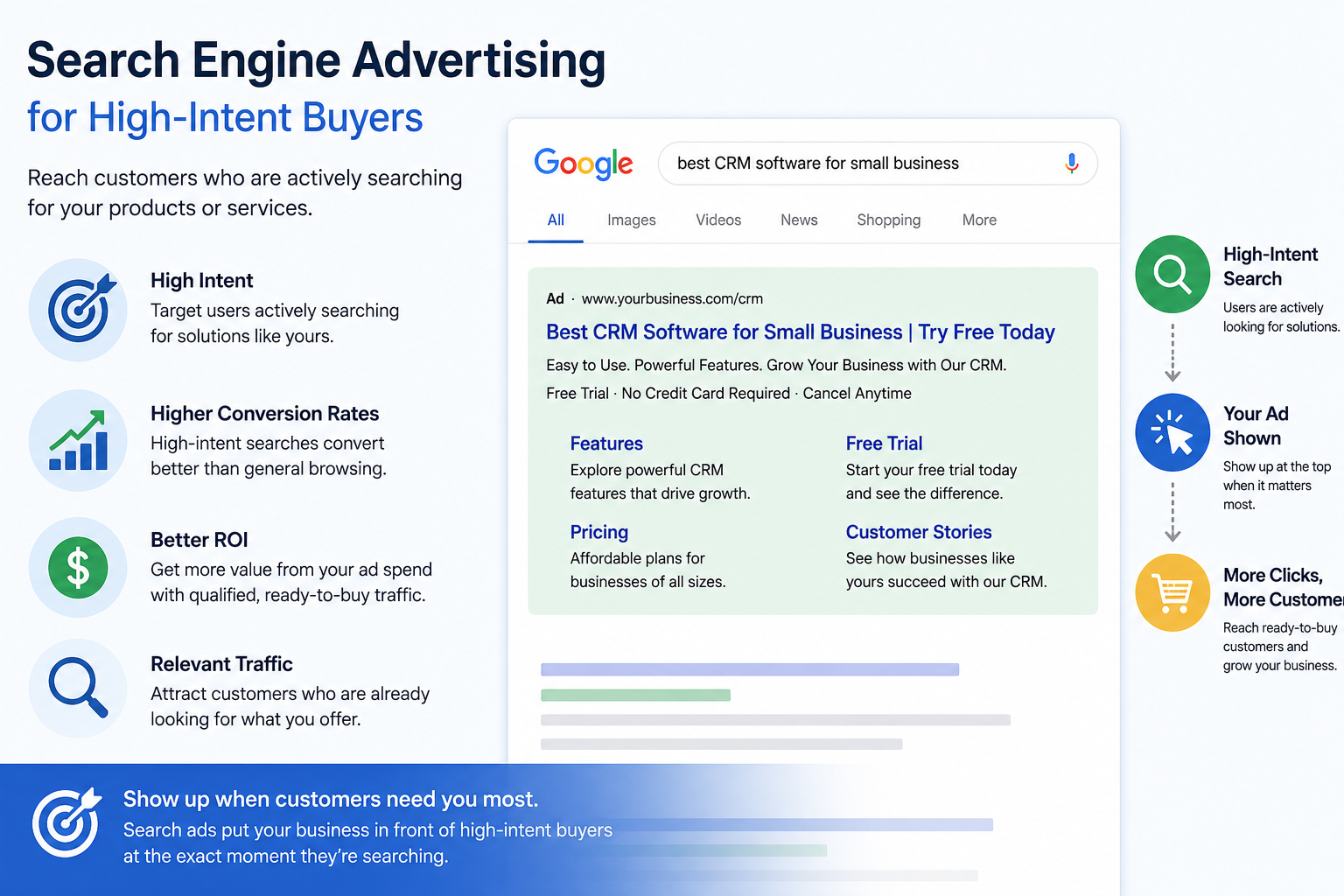
Search Engine Advertising for High-Intent Buyers
Search Engine Advertising for High-Intent Buyers
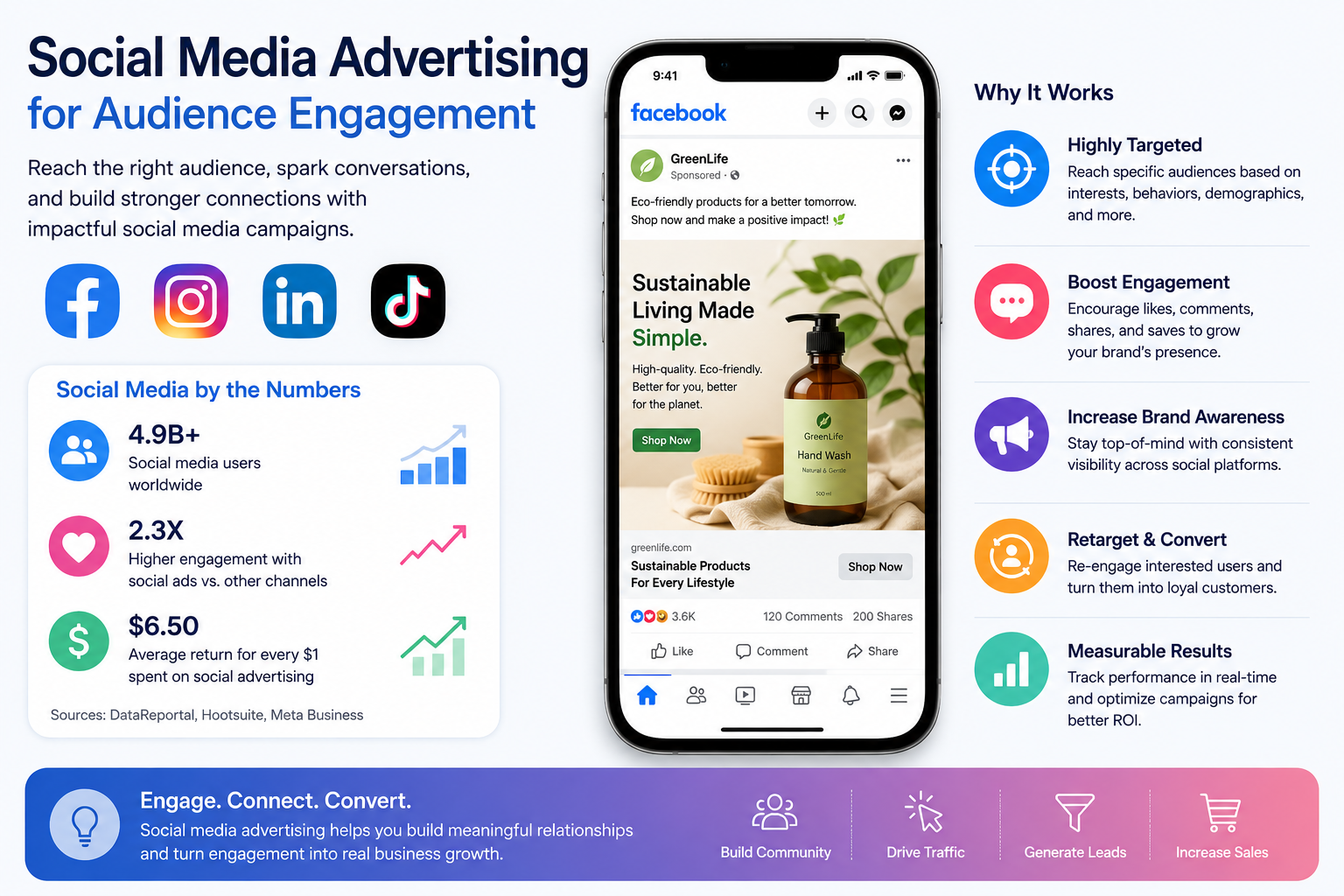
Social Media Advertising for Audience Engagement
Social Media Advertising for Audience Engagement
Video Advertising and Short-Form Content Growth
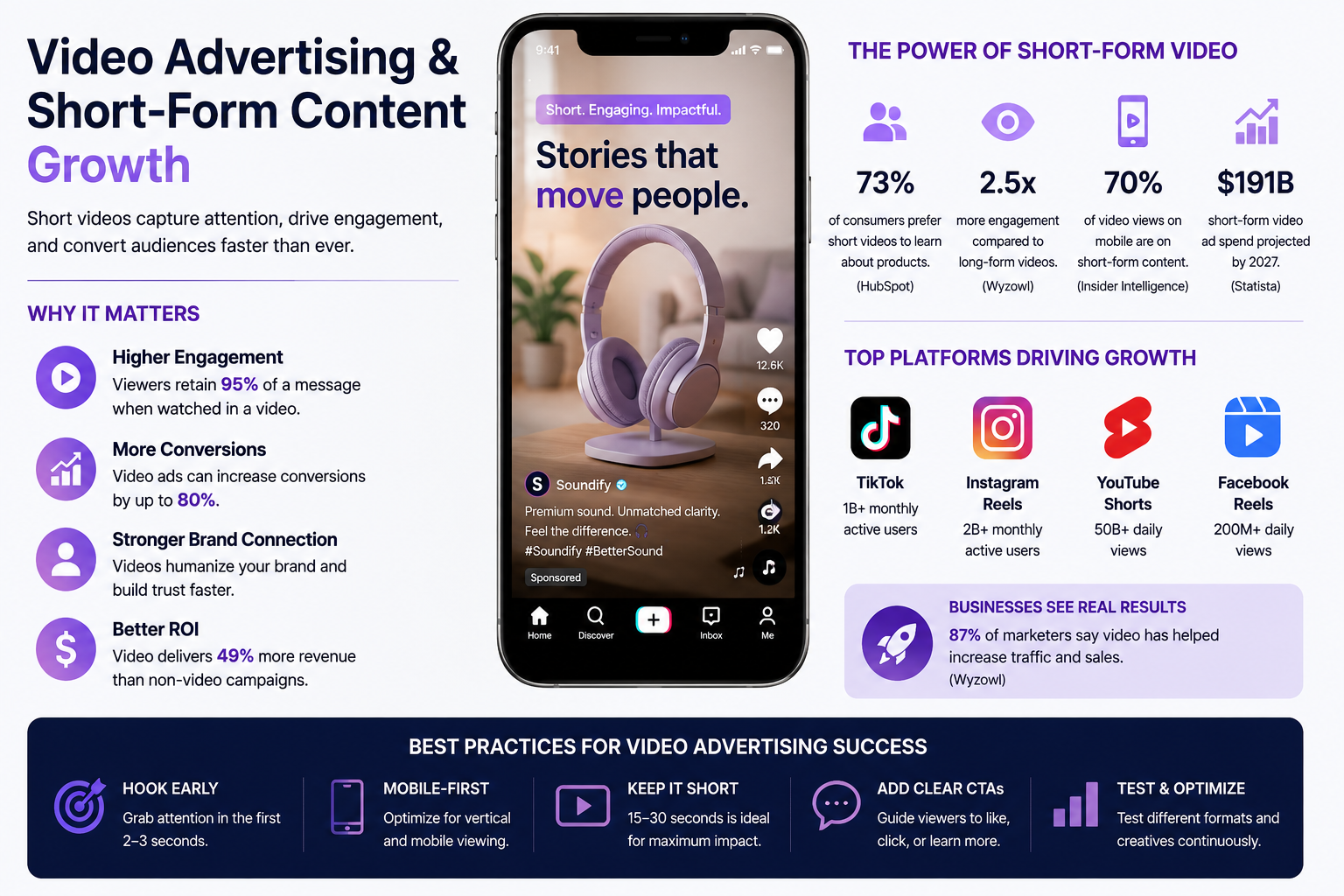
Video Advertising and Short-Form Content Growth
Native Advertising and Sponsored Content Strategies
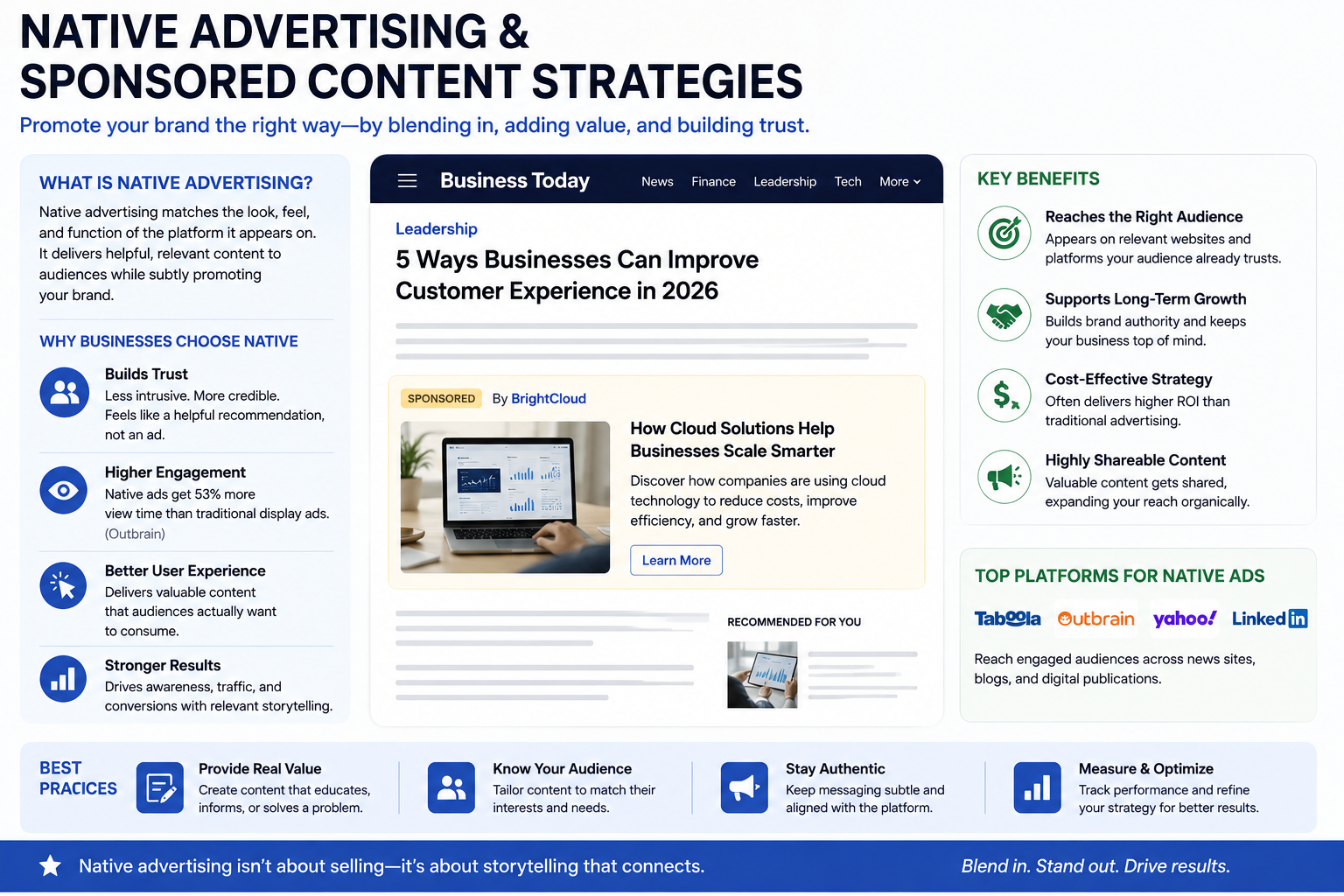
Native Advertising and Sponsored Content Strategies
Email Advertising and Remarketing Campaigns
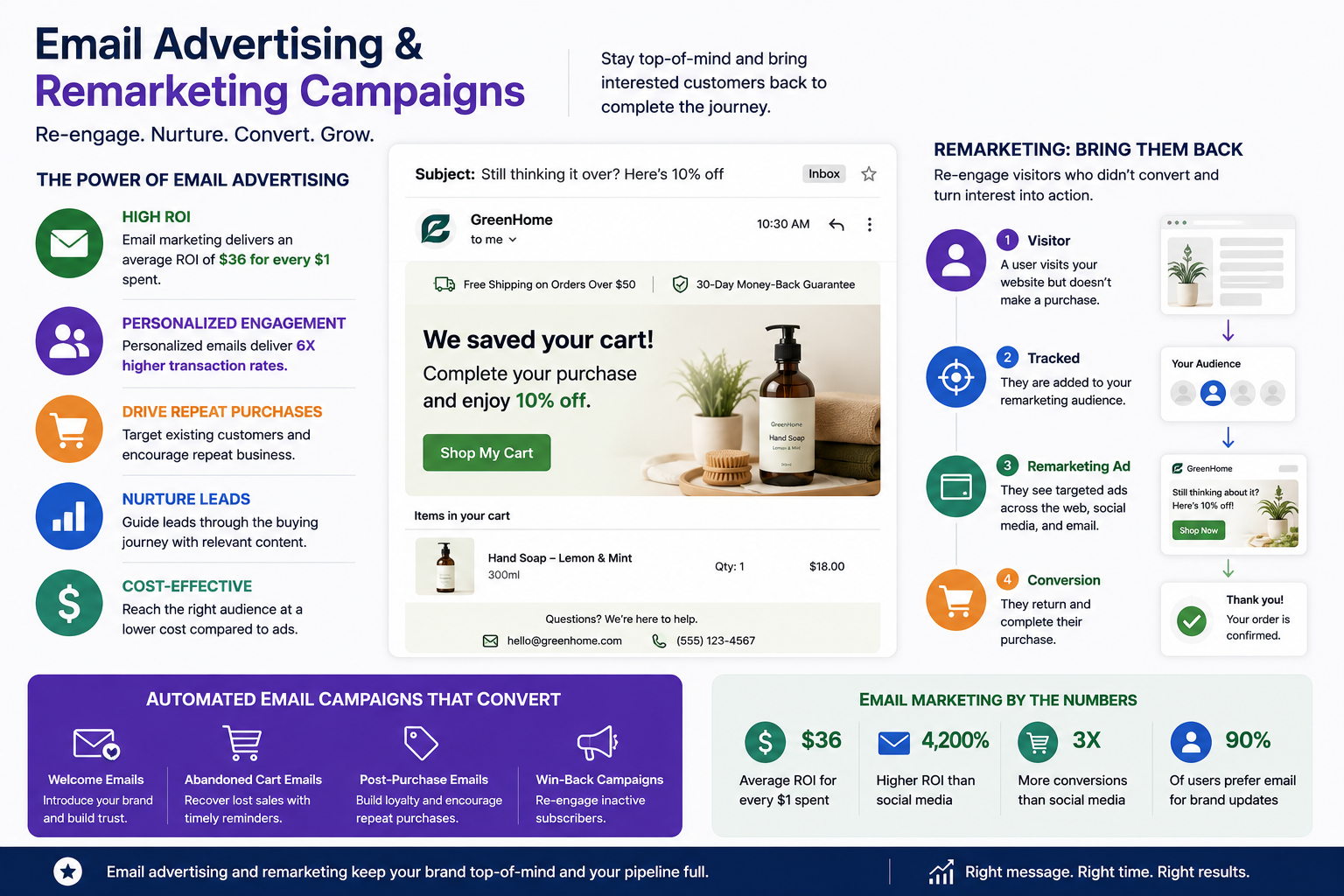
Email Advertising and Remarketing Campaigns
Common Advertising Strategy Mistakes Businesses Make
Many businesses invest heavily in advertising but still struggle to achieve consistent growth and measurable ROI.
In most cases, the problem is not the advertising budget itself but the lack of strategic planning behind campaign execution.
Modern advertising requires businesses to combine data, creativity, customer understanding, and long-term planning instead of relying on short-term tactics or isolated campaigns.
As digital competition continues to increase in 2026, marketing managers must avoid common advertising mistakes that reduce campaign performance, waste budgets, and limit long-term business growth.
Businesses that continuously optimise their advertising strategies and adapt to customer behaviour trends are more likely to outperform competitors in highly competitive markets.
Focusing Only on Short-Term Campaign Wins
One of the most common mistakes businesses make is focusing too heavily on short-term campaign results instead of long-term brand growth.
Most organisations prioritise immediate clicks, impressions, or quick sales without building sustainable customer relationships or long-term market visibility.
While short-term performance campaigns can generate fast results, they often fail to create lasting customer loyalty or brand authority.
For example, businesses that rely only on aggressive discount advertising may experience temporary spikes in traffic but struggle with customer retention and profitability over time.
Strong advertising strategies balance short-term conversions with long-term brand awareness, customer trust, and ongoing engagement.
Ignoring Customer Journey Mapping
Many businesses fail to understand how customers move through the buying process before making a purchase decision.
Modern consumers often interact with multiple touchpoints such as search engines, social media, email campaigns, reviews, and video content before converting.
Ignoring customer journey mapping can lead to disconnected advertising campaigns and inconsistent customer experiences.
For example, a customer may discover a brand through a social media advertisement but later search Google for reviews before purchasing. Businesses that fail to support each stage of this journey risk losing potential conversions.
Marketing managers who map customer journeys more effectively can create advertising campaigns that deliver the right message at the right time.
Poor Audience Targeting and Segmentation
Broad targeting remains one of the biggest reasons advertising campaigns underperform.
Many businesses still create generic campaigns designed to appeal to everyone instead of using audience segmentation and behavioural data to target specific customer groups.
This often results in wasted advertising spend and lower engagement rates.
Modern businesses now use customer data, website analytics, CRM systems, and AI-powered insights to improve audience segmentation and campaign relevance.
For example, eCommerce businesses commonly target repeat customers differently from first-time visitors or abandoned-cart users.
Personalised advertising strategies usually perform significantly better than broad untargeted campaigns because they align more closely with customer intent and behaviour.
Underinvesting in Creative Testing
Even well-targeted advertising campaigns can fail if the creative content does not engage the audience effectively.
Many businesses spend heavily on advertising placement while neglecting creative testing, messaging optimisation, and content quality. In highly competitive digital environments, poor visuals and weak messaging can dramatically reduce campaign performance.
Successful marketing managers regularly test different headlines, video formats, images, calls-to-action, and ad copy variations to identify which creatives produce the strongest engagement and conversions.
For example, short-form video content often outperforms static image ads on social media platforms due to changing consumer behaviour and shorter attention spans.
Relying Too Heavily on One Advertising Platform
Depending too heavily on a single advertising platform creates significant risk for businesses.
Changes to algorithms, advertising costs, privacy regulations, or platform policies can quickly impact campaign performance and customer reach. Businesses relying only on one traffic source often struggle when performance suddenly declines.
For example, businesses relying entirely on Facebook advertising may experience major disruptions if advertising costs rise or audience targeting capabilities change.
Modern marketing managers reduce this risk by diversifying advertising strategies across search engines, social media, video platforms, email marketing, and content-driven campaigns.
A diversified advertising strategy creates more stability while improving long-term business resilience.
How AI Is Changing Advertising Strategy
Artificial intelligence is changing how businesses create, manage, and optimise advertising campaigns.
Marketing managers now use AI-powered tools to improve targeting, automate campaigns, personalise customer experiences, and analyse performance in real time.
According to recent industry reports, nearly 80% of marketers now use AI tools to support advertising and digital marketing activities.
AI helps businesses reduce wasted advertising spend while improving campaign efficiency and scalability. However, successful companies still balance automation with human creativity and strategic planning.
AI-Generated Advertising Content and Copywriting
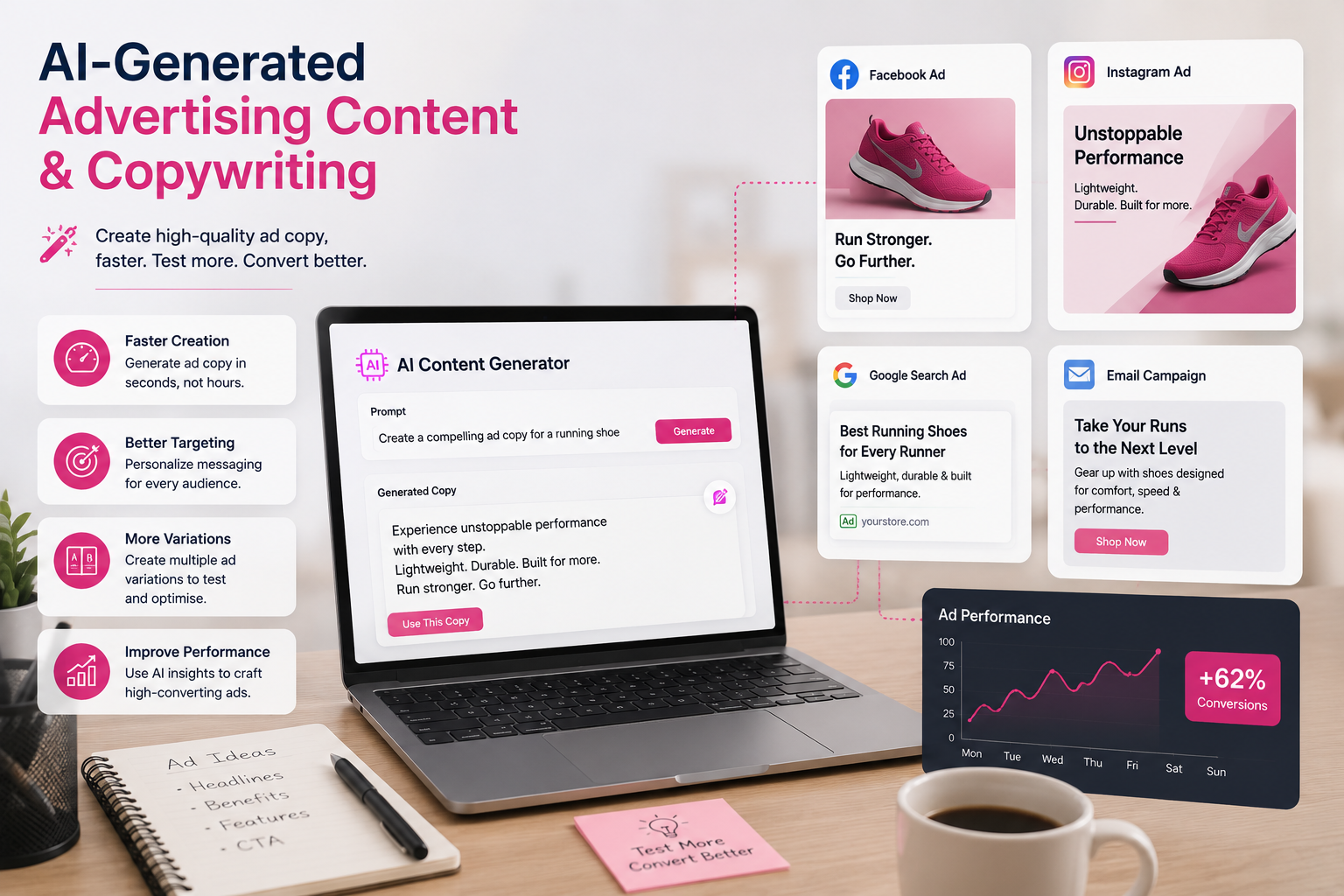
AI-Generated Advertising Content and Copywriting
AI tools now help businesses generate advertising copy, social media content, email campaigns, and PPC ads much faster than traditional methods. Marketing managers can quickly create multiple ad variations for testing and personalisation.
For example, eCommerce businesses often use AI-generated product ads tailored to different audience segments. This improves campaign speed while reducing content production costs.
Common benefits include:
- Faster campaign creation
- Improved ad testing
- Personalised messaging
- Better scalability
Automated Campaign Optimisation
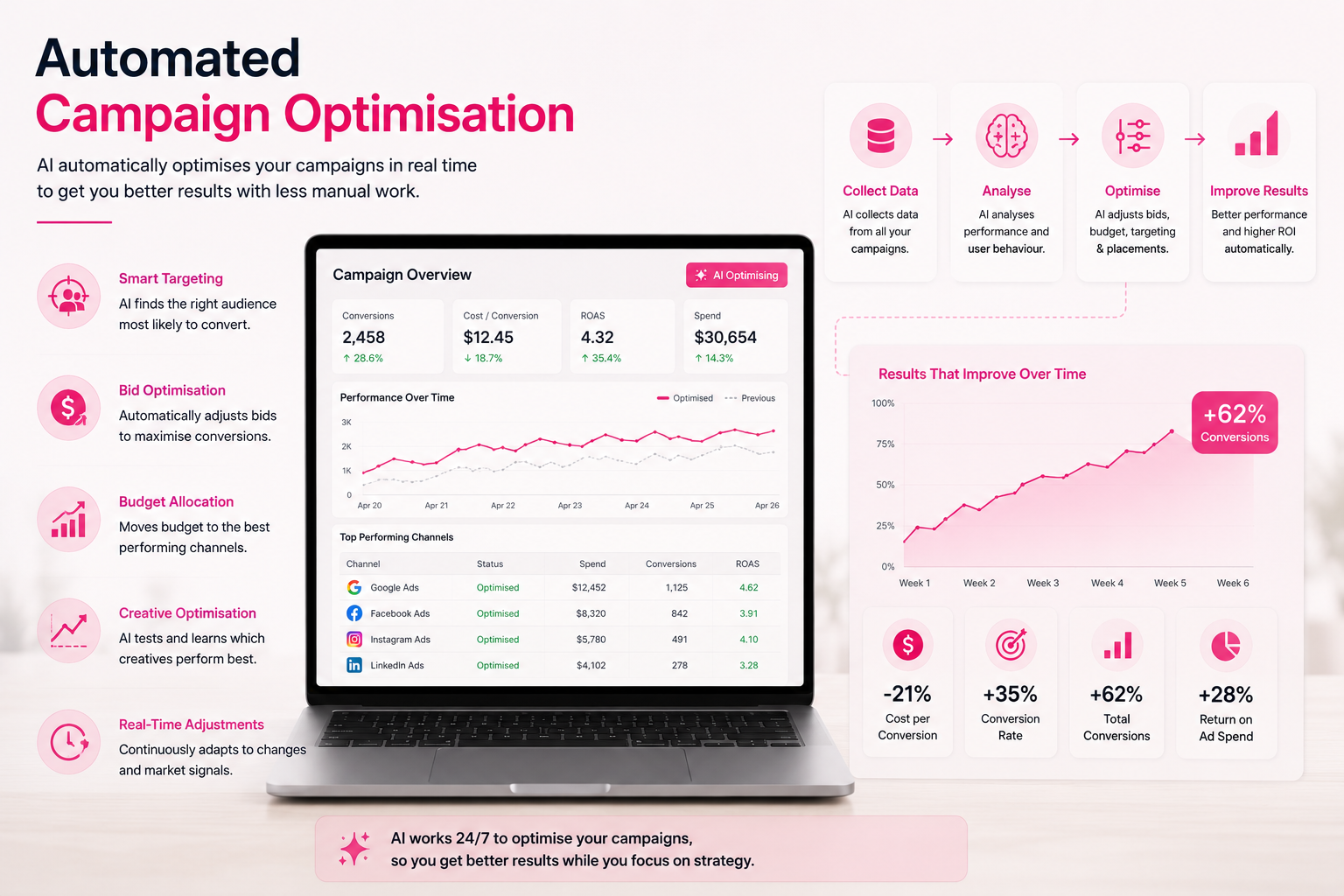
Automated Campaign Optimisation
Modern advertising platforms use AI to automatically adjust bids, targeting, and budget allocation based on performance data.
Google Ads Smart Bidding is a strong example of AI-driven optimisation improving conversion performance in real time.
Businesses using automated optimisation often benefit from:
- Better conversion rates
- Reduced wasted spend
- Faster campaign scaling
- Improved advertising efficiency
Predictive Customer Targeting
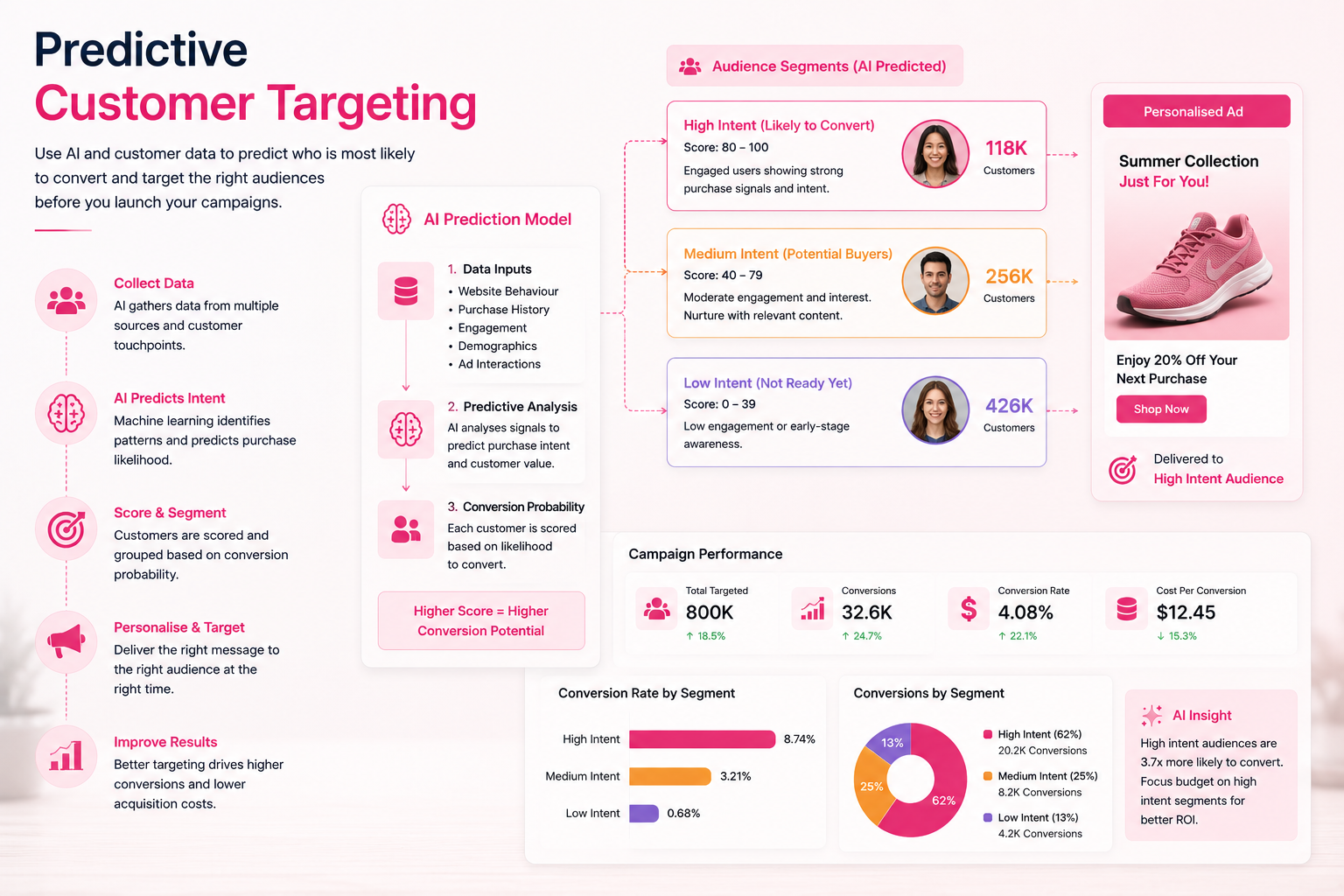
Predictive Customer Targeting
Predictive targeting uses AI and customer data to identify audiences most likely to convert.
Businesses now target users based on behaviour, engagement history, and purchase intent instead of relying only on demographics.
For example, streaming services and online stores use predictive AI to recommend products and personalise advertising campaigns, helping improve engagement and customer retention.
AI-Powered Performance Analysis
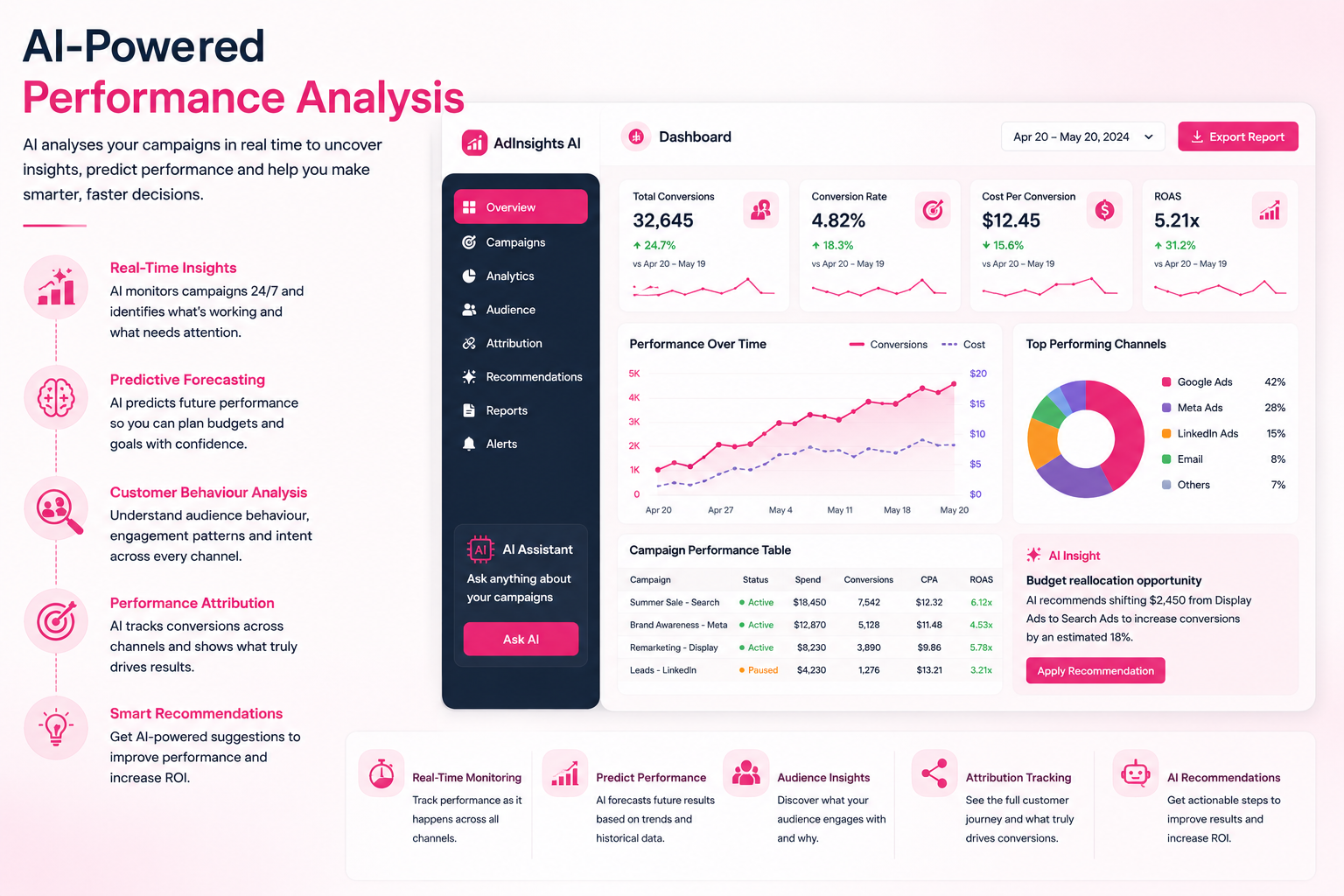
AI-Powered Performance Analysis
AI-powered analytics tools help businesses track campaign performance, customer behaviour, and advertising ROI in real time. Marketing managers can quickly identify high-performing channels and optimise underperforming campaigns faster than manual reporting methods.
Modern AI analytics commonly support:
- Real-time reporting
- Performance forecasting
- Customer behaviour analysis
- Cross-channel tracking
The Risks of Over-Automation in Advertising
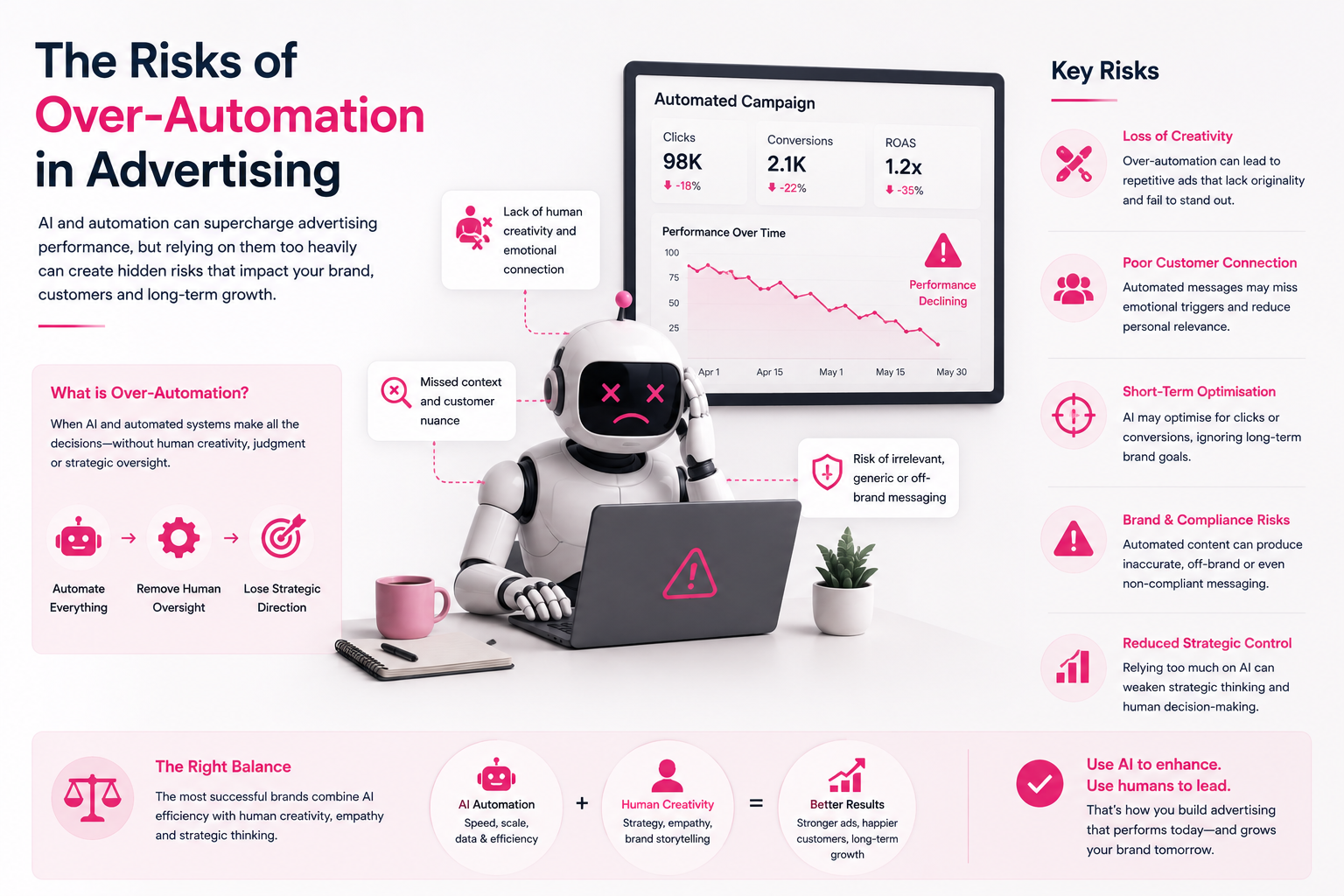
The Risks of Over-Automation in Advertising
While AI improves efficiency, businesses that rely too heavily on automation can lose creativity and brand authenticity. Automated campaigns may optimise only for clicks or conversions without considering customer relationships or long-term brand value.
Successful marketing managers combine AI-powered automation with human creativity, strategic thinking, and audience understanding to create stronger long-term advertising strategies.
Building a Strategic Advertising Plan for Long-Term Growth
Building a successful advertising strategy requires more than launching random campaigns across multiple platforms.
Modern businesses need a structured advertising plan that aligns with long-term business goals, customer behaviour, and measurable marketing performance.
In 2026, companies that focus on strategic advertising planning are better positioned to improve brand visibility, customer acquisition, and long-term ROI while reducing wasted advertising spend.
A strong strategic advertising plan combines audience targeting, campaign optimisation, performance analytics, and realistic budgeting to support sustainable business growth.
Marketing managers who continuously adapt advertising strategies based on customer data and performance insights are more likely to outperform competitors in highly competitive digital markets.
Defining Clear Business Objectives
Every successful advertising strategy starts with clear business objectives.
Marketing managers must align advertising campaigns with wider business goals such as increasing revenue, improving brand awareness, generating qualified leads, or strengthening customer retention.
Without clear objectives, businesses often struggle to measure campaign performance or justify advertising spend effectively.
Modern businesses increasingly use SMART goals that are Specific, Measurable, Achievable, Relevant, and Time-bound to improve strategic business planning.
For example, a SaaS company may focus on increasing demo bookings by 25% within six months through targeted digital advertising campaigns and conversion-focused landing pages.
Identifying Target Audiences and Buyer Intent
Understanding target audiences and buyer intent is one of the most important parts of building an effective advertising strategy.
Businesses that rely on broad targeting often waste advertising budgets by showing campaigns to users with little interest or purchase intent.
Modern marketing managers now use audience segmentation, customer analytics, first-party data, and AI-powered insights to identify high-intent buyers more accurately.
For example, eCommerce businesses frequently target repeat customers, abandoned-cart users, and high-value audiences with personalised advertising campaigns designed to improve conversions and customer engagement.
Choosing the Right Advertising Channels
Choosing the right digital advertising channels plays a major role in overall campaign success.
Different audiences engage with brands across different platforms, which means businesses must select channels based on customer behaviour, campaign goals, and buyer intent.
For example, Google Ads remains highly effective for high-intent search traffic, while LinkedIn advertising performs strongly for B2B lead generation and professional audience targeting.
Social media advertising, video marketing, email campaigns, and remarketing strategies also help businesses improve brand visibility and customer engagement across multiple touchpoints.
Setting Realistic Budgets and KPIs
Successful advertising strategies require realistic budgeting and measurable KPIs that align with business objectives.
Many businesses fail because they either overspend without proper tracking or set unrealistic expectations for campaign performance.
Modern marketing managers now focus heavily on performance-driven advertising metrics such as customer acquisition cost, conversion rates, return on ad spend, lead quality, and customer lifetime value.
Setting realistic budgets and tracking meaningful KPIs allows businesses to optimise campaigns more effectively while improving advertising ROI and long-term marketing efficiency.
Continuously Optimising Campaigns With Analytics
Advertising strategies should never remain static.
Consumer behaviour, market trends, and digital advertising platforms continue to evolve rapidly, making ongoing campaign optimisation essential for long-term growth.
Businesses that continuously analyse performance data can identify underperforming campaigns faster and improve targeting, messaging, and budget allocation more effectively.
AI-powered analytics and performance tracking tools now help marketing managers monitor customer engagement, forecast advertising trends, and optimise campaigns in real time.
This data-driven approach helps businesses improve conversion rates, reduce wasted advertising spend, and build stronger long-term advertising strategies based on measurable insights.
Final Thoughts
Effective advertising strategies are no longer just marketing activities — they are now a core part of strategic business planning and long-term business growth.
Modern marketing managers must combine creativity, data analytics, audience insights, and AI-powered optimisation to stay competitive in rapidly changing digital markets.
Businesses that align advertising with clear business objectives often achieve stronger customer engagement, better ROI, and more sustainable growth compared to companies relying on disconnected campaigns or short-term tactics.
As digital competition continues to increase in 2026, organisations that invest in smarter advertising strategies, performance tracking, and customer-focused marketing will be better positioned to outperform competitors and adapt to future market changes.
AI Summary
- Modern businesses now treat effective advertising strategies as a critical part of strategic business planning rather than isolated marketing campaigns.
- Marketing managers increasingly use data-driven advertising, AI-powered targeting, predictive analytics, and audience segmentation to improve campaign performance and advertising ROI.
- Omnichannel advertising across search engines, social media, video marketing, email campaigns, and remarketing platforms helps businesses create more consistent customer experiences.
- Businesses that focus only on short-term advertising wins often struggle with customer retention, brand loyalty, and long-term profitability in competitive digital markets.
- AI-powered advertising tools help businesses automate campaign optimisation, personalise customer experiences, forecast performance trends, and reduce wasted advertising spend.
- Strategic advertising planning improves budget allocation, campaign measurement, customer targeting, and long-term business growth by aligning marketing goals with wider business objectives.
Most Popular Posts

Effective communication among team members is vital for the productivity and success of any organization. Surprisingly, 60% of companies lack a long-term internal communication strategy, which p...


Businesses thrive on communication for efficiency, productivity and accomplishment. When the right information is passed from the right designation in the organization, it promotes positivity an...
Categories
Blog
(2926)
Business Management
(363)
Employee Engagement
(221)
Digital Transformation
(190)
Growth
(140)
Intranets
(133)
Remote Work
(63)
Sales
(52)
Collaboration
(47)
Customer Experience
(30)
Culture
(29)
Knowledge Management
(28)
Project management
(28)
Leadership
(20)
Comparisons
(9)
News
(1)

Related Posts

Most customer feedback tools promise better customer insights, improved customer experience, and smarter business decisions. Companies spend thousands on customer feedback management platforms, surveys, review systems, and feedback forms hoping...

Advertising is no longer just about clicks and impressions. In 2026, businesses are treating effective advertising strategies as a core part of strategic business planning to drive growth, improve customer acquisition, and increase long-term re...

Companies continue investing in internal collaboration tools for business, yet many employees still avoid using them consistently. The problem usually is not the lack of features — it is poor user experience. When collaboration platforms feel s...

Businesses adopting modern infrastructure often assume that moving entirely to the cloud will automatically improve scalability, reduce operational costs, and simplify IT management. While enterprise cloud services offer flexibility and rapid d...

What Is Portal Software? Have you ever wondered why so many businesses struggle with disconnected systems, scattered documents, outdated intranets, and poor communication between teams? Most organisations today rely on dozens of different tools...


Jill Romford
I am a digital nomad, lover of exploring new places and making friends.
I love to travel and I love the internet. I take pictures of my travels and share them on the internet using Instagram.
Traveler, entrepreneur, and community builder. I share my insights on digital marketing and social media while inspiring you to live your fullest life.
Ready to learn more? 👍
One platform to optimize, manage and track all of your teams. Your new digital workplace is a click away. 🚀
Free for 14 days, no credit card required.