Insight Blog
Agility’s perspectives on transforming the employee's experience throughout remote transformation using connected enterprise tools.
32 minutes reading time
(6385 words)
8 Website Mistakes That Quietly Cost You Your Ideal Customers in 2026

8 Website Mistakes That Quietly Cost You Your Ideal Customers in 2026
Discover 8 website mistakes that quietly drive away your ideal customers in 2026—and learn how to fix them to improve trust, traffic, and conversions.
8 Website Mistakes That Quietly Cost You Your Ideal Customers in 2026

How effective is your website at converting leads into customers?
Your website is often the first interaction potential customers have with your business, and those first few seconds can determine whether someone continues exploring or leaves to find a competitor.
While many businesses invest time and money into building a website, small design and usability issues can quietly push away the very customers they want to attract.
Research from Stanford University shows that 75% of users judge a company's credibility based on its website design. In other words, visitors form an opinion about your professionalism and trustworthiness almost instantly.
75%
of users
Research from Stanford University shows that 75% of users judge a company’s credibility based on its website design, meaning visitors form opinions about professionalism and trustworthiness almost instantly.
Source: Stanford Web Credibility Research
If your website looks outdated, loads slowly, or makes it difficult to understand what you offer, potential customers may leave before they ever consider contacting you.
The challenge is that these issues often go unnoticed.
A website might still receive traffic from search engines or marketing campaigns, but if visitors aren't engaging, filling out forms, or requesting demos, something in the experience may be creating friction.
In this guide, we'll break down eight common website mistakes that quietly cost businesses their ideal customers in 2026 — and more importantly, how you can fix them to improve trust, engagement, and conversions.
Key Takeaways
- Website design, usability, and clarity strongly influence whether visitors trust your brand and continue exploring your site.
- Consumers form opinions about a company’s credibility within seconds, making visual design and user experience critical for conversions.
- Common issues such as cluttered design, poor functionality, slow loading speeds, and weak messaging can quietly drive ideal customers away.
- Personalized calls to action, relevant social proof, and targeted landing pages help visitors recognize that your solution fits their needs.
- Improving website clarity, performance, and customer-centric design can significantly increase engagement, trust, and conversion rates.
Signs Your Website Might Be Losing Customers
Your website might look polished and professional, but that doesn't necessarily mean it's performing well.
Many businesses assume their website is working simply because it exists and receives some traffic. In reality, small usability issues, confusing messaging, or poor design decisions can quietly drive potential customers away before they ever contact you.
Research from Stanford University found that 75% of consumers judge a company's credibility based on its website design, and users form a first impression in as little as 0.05 seconds. If your website fails to build trust quickly, visitors often leave before exploring what you offer.
These problems are surprisingly common. Many business websites contain simple but costly design mistakes — issues that make visitors lose confidence, click away, or choose a competitor instead.
Before diving into the most common website mistakes, here are some warning signs your site may be losing customers without you realising it:
- You receive traffic but very few enquiries, demo requests, or sales
- Visitors leave your website within the first 20–30 seconds
- Your bounce rate is consistently above 60%
- Customers frequently ask questions your website should already answer
- Competitors with similar services appear to convert more visitors
If any of these signals sound familiar, your website may be suffering from hidden conversion problems.
The good news is that most of these issues are fixable. By addressing common website mistakes and improving both design and usability, businesses can significantly improve credibility, search visibility, and conversion rates.
In the sections below, we'll break down the most common website mistakes that quietly cost businesses customers — and exactly how to fix them.
0.05s
first impression
Research from Stanford University found that 75% of consumers judge a company's credibility based on its website design, and visitors form a first impression in as little as 0.05 seconds. If your website fails to build trust instantly, many users leave before exploring what you offer.
Source: Stanford Web Credibility Research
Fixing design mistakes is important, but design alone doesn't guarantee visibility.
To attract consistent traffic and high-quality leads, your website should combine strong design with effective SEO strategy.
When user experience and search optimisation work together, your site becomes far more effective at attracting and converting the right audience.
If you want to ensure your website is not only visually strong but also discoverable in search engines, it's worth pairing these improvements with a comprehensive Local SEO checklist.
This helps businesses improve rankings, increase visibility, and attract more qualified visitors who are already searching for their services.
Mistake #1: Cluttered, Unattractive, or Non-User-Friendly Design
Website design is often overlooked in terms of its influence on conversion rates. Nevertheless, its role in helping businesses attract, engage, convert, and retain ideal customers can be described as integral. And there are several reasons for this being the case.
For starters, web visitors form instant impressions about a brand upon landing on its website. They form opinions about the company's competence, trustworthiness, and relevance. And even more, they (subconsciously) adjust their purchase intent based on that initial perception.
What's fascinating, however, isn't merely that people judge brands based on their online presence. But the majority of their first impressions are formed based on aesthetic elements.
With this in mind, one of the biggest website mistakes that may cost you your ideal customers could be the fact that your site simply doesn't look good (or professional) enough to position your brand as a competent and credible entity in your industry.
Fortunately, there are several strategies for improving, design-wise, when aiming to boost sales.
The first of these tactics is to focus on aesthetic attractiveness. While tastes differ, research suggests that most consumers enjoy interacting with polished, simple websites that are consistent with the brand's visual identity.
Secondly, optimize your digital presentation for a solid user experience. Sure, the roles of UX and UI design are often overlooked in conversion optimization. Nevertheless, data clearly shows that elements such as navigation, loading speed, responsive design, personalization, and ease of checkout significantly elevate conversions.
Finally, it's worth noting that the number of elements on a site has just as much influence over visitors' purchase intent as attractiveness or UX design. While details can and do inspire buying decisions, they shouldn't create clutter. Website clutter significantly increases the risk of creating excessive cognitive load, causing visitors to experience decision fatigue and leave the buyer's journey.
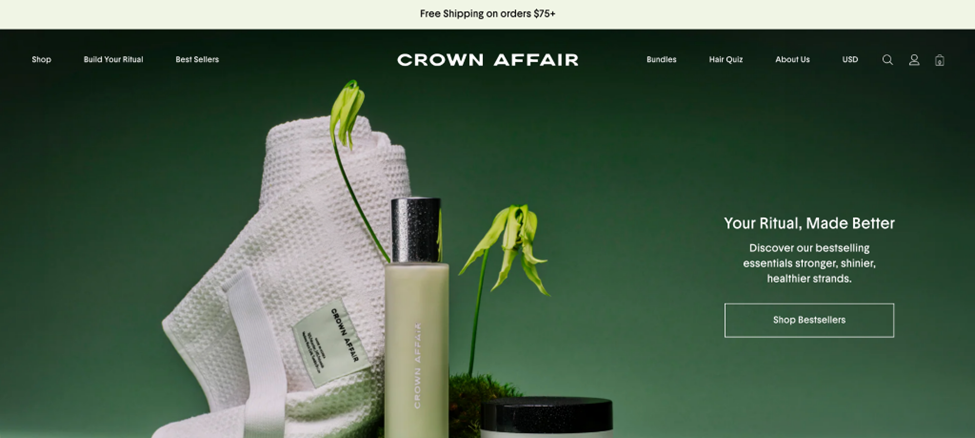
So, what does a conversion-ready website look like?
The Crown Affair homepage is a perfect example of what a beautiful, user-friendly website looks like and how simple on-page elements, such as relevant value propositions and clear CTAs, help engage visitors and draw them into the sales funnel.
Source: crownaffair.com
Related Website Optimization Guides You Should Explore Next
If you're working to improve website conversions and eliminate common design mistakes, these guides explore user experience, performance optimization, and strategies for turning visitors into customers.
- How to Improve Website User Experience (UX) for Higher Conversions
- Website Conversion Rate Optimization: Complete Guide
- How to Build High-Converting Landing Pages
- How to Improve Website Loading Speed
- Website Design Best Practices for Businesses
- How to Create Effective Calls to Action That Convert
- Social Proof Examples That Increase Website Trust
- How to Build Trust on Your Website
- Website Navigation Best Practices
- How to Optimize Landing Pages for SEO
Mistake #2: Non-Personalized CTAs
In 2026, consumers are no longer satisfied with generic brand interactions.
According to research, 71% of people expect brands to deliver personalized experiences. 76% become frustrated when that doesn't happen. And even business clients prefer tailored content and interactions.
Ultimately, this demand for personalization isn't much of a surprise, especially seeing that it boosts customer experience and makes buying decisions significantly easier for clients.
However, while the value of personalization is clear — especially to sales and marketing teams — most organizations fail to harness the power of personalization in web design.
Prioritizing customer-centricity throughout your website (and this means with all on-page elements) doesn't just allow you to demonstrate your understanding of your target audience's wants and unique needs. It's just as effective at ensuring your prospects want to interact with your business. This is particularly important in light of the fact that 81% of people ignore marketing messages that appear irrelevant to their personal experiences.
When optimizing for higher conversion rates, identify the areas of your website where personalization promises to generate the highest returns. In most cases, this will include your primary conversion elements, i.e., your calls to action.
By personalizing CTAs (or at least ensuring they relate to your ideal customers' experience), you can simplify your prospects' buying journey. Moreover, you can show them early on that entering your sales funnel is a good method for them to address and resolve their pain points.
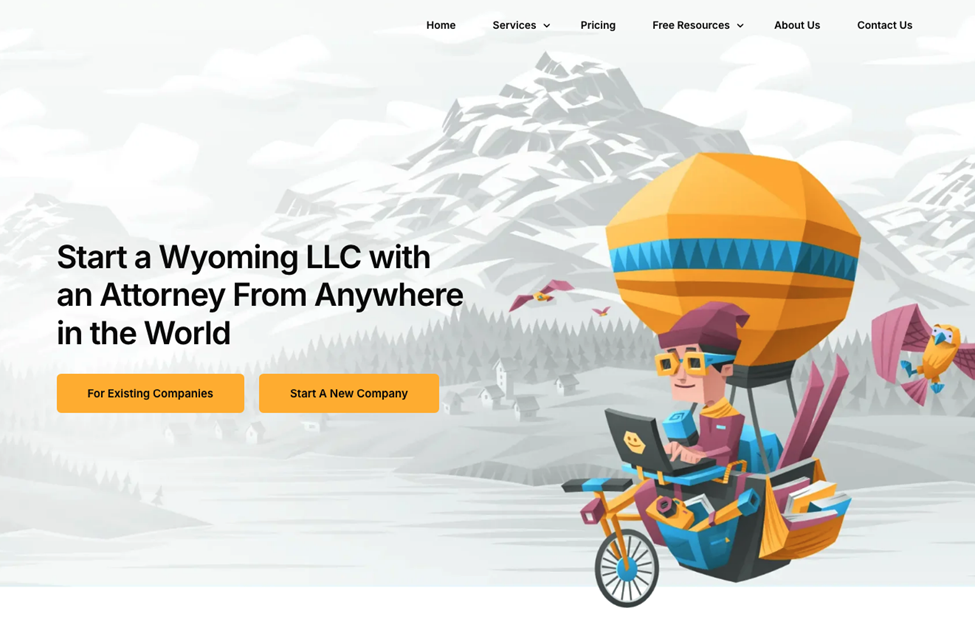
For example, check out Start in Wyoming. You'll notice that the business features two distinct CTAs on its homepage.
One is intended for customers who want to start a company from scratch, while the other targets business owners who need to optimize their operations. These two customer personas are widely differentc, and their needs diverge as well.
To ensure that both audience segments recognize that Start in Wyoming offers a solution to their specific needs, the business ensures that those needs are reflected in the CTA copy, creating a much smoother customer experience and a significantly higher purchase intent.
Source: startinwyoming.com
Mistake #3: Poor Site Functionality
We've already mentioned the importance of website design in converting new customers. Nevertheless, it's worth reflecting on a specific aspect of UX design: site functionality.
Just explore some of the primary causes of user frustration when interacting with brands. You'll discover that poor site functionality ranks high among the most irritating factors impacting browsing experience, along with slow load times, unstable performance, and lack of responsiveness.
In fact, take a look at what causes web visitors to abandon their carts, and you'll discover that 18% do so due to a long or complex checkout process, 15% because of site crashes, and 19% because of the lack of guest checkout options.
So, if you're trying to eliminate website mistakes that cost you your ideal customers, explore opportunities to help your prospects resolve their pain points.
You can accomplish this with intuitive navigation menus, interactive resources and tools, or even by incorporating sought-after UI elements into your online presence.
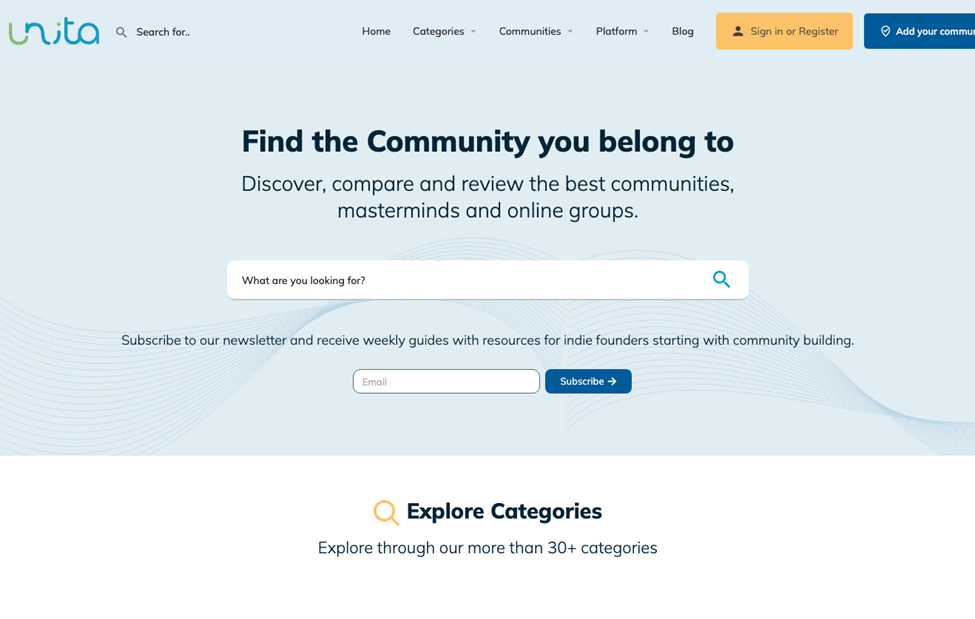
For example, research shows that 69% of web visitors go straight for the search bar when landing on a website. So, this type of feature should get a prominent spot in your online presence — particularly if you stock a large inventory or offer a wide variety of services to potential customers.
For instance, Unita understands that there's very little chance it can highlight all of the different communities listed on its platform. So, instead of forcing web visitors to scroll through multiple pages (or get lost in a complex navigation menu), this brand positions its search bar right in the centre of its hero section.
It does so knowing full well that this is a great method to boost on-site engagement, maximize the chances of prospects finding what they need, and an effective strategy to convert more customers.
Source: unita.co
Mistake #4: Lack of Clarity and Expectation Management
In many cases, the primary reason your website is failing to convert new customers boils down to a lack of clarity and expectation management.
Essentially, consumers are strongly prioritizing value for money in 2026.
Research suggests that 4 in 10 Americans are value seekers — people who exhibit cost-conscious buying behaviors. What's fascinating, however, is that value is not necessarily related to price. Instead, the factors that encourage consumers to spend their hard-earned money include product quality, customer-centricity, and trustworthiness.
Do you want to ensure your site's effectiveness at engaging visitors and guiding leads into your sales funnel? In that case, you have to do a good job at communicating what unique value your business offers (and under what conditions).
Naturally, this process starts with your value propositions. But it doesn't end there.
Price and buying condition transparency, attention to detail, and easy-to-comprehend sections on how your solution works are all crucial for convincing your ideal customers that they are in the right place to resolve their pain points.
Furthermore, these website elements are also a crucial first step toward successful expectation management — a key aspect of customer satisfaction and, consequently, brand loyalty.
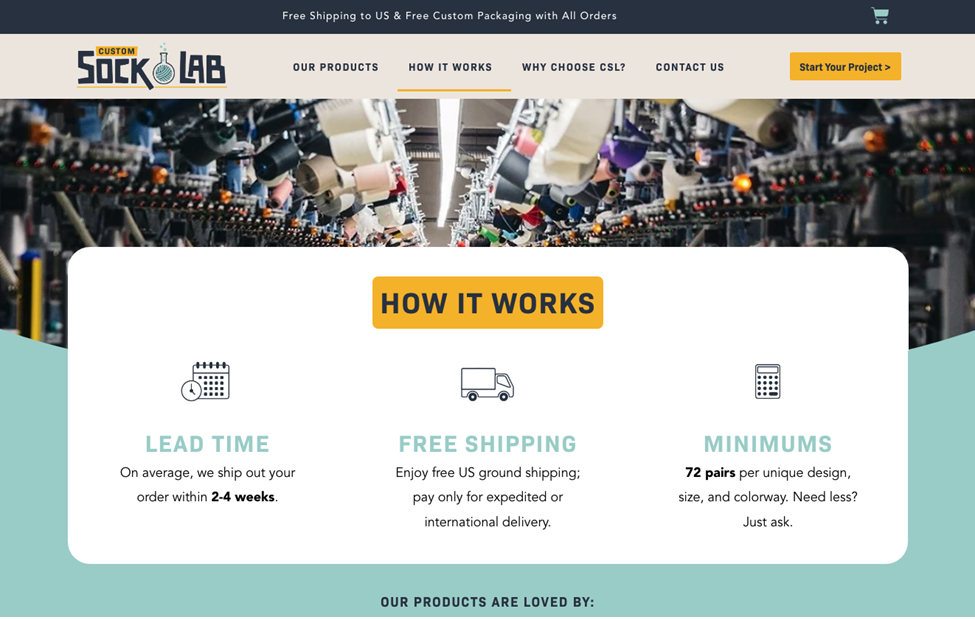
Check out how Custom Sock Lab optimizes this area of customer experience to elevate its ideal customers' purchase intent.
On the How It Works page, this brand provides clear and direct lead times, shipping prices, and minimum order information.
It does so knowing that all of these elements play a role in determining whether its services are the right choice for potential customers. The outcome of such an approach isn't just a higher purchase intent.
This website optimization strategy also empowers consumers with relevant information, effectively addressing (and removing) their main conversion barriers and making them feel more comfortable while moving through Custom Sock Lab's sales funnel.
Source: customsocklab.com
Mistake #5: Insufficient Relevant Social Proof
The fact that brand credibility and competence are crucial conversion drivers within the typical buyer's journey — regardless of whether you're targeting end consumers or professional customers — isn't big news.
In fact, research clearly shows that 88% of people consider brand trust to be a key purchase-influencing factor.
Data suggests that 95% of consumers regularly read reviews as part of their shopping journey. And studies show that business buyers, who prioritize ROI above all, are being very selective with where they collect pre-purchase information. In fact, about one-third now treat peer reviews as a primary source of information during their buying journeys (compared to vendor websites and traditional analyst firms).
However, even if you do showcase plenty of social proof throughout your website, you still may be risking your chances of converting ideal customers. Particularly if that social proof isn't relevant to your target audience's wants and needs.
With this in mind, one of the biggest conversion obstacles you need to remove from your online presence is the lack of pertinent customer feedback that builds trust, establishes authority, and (most importantly) shows your ideal prospects that they're in the right place to remove their unique pain points.
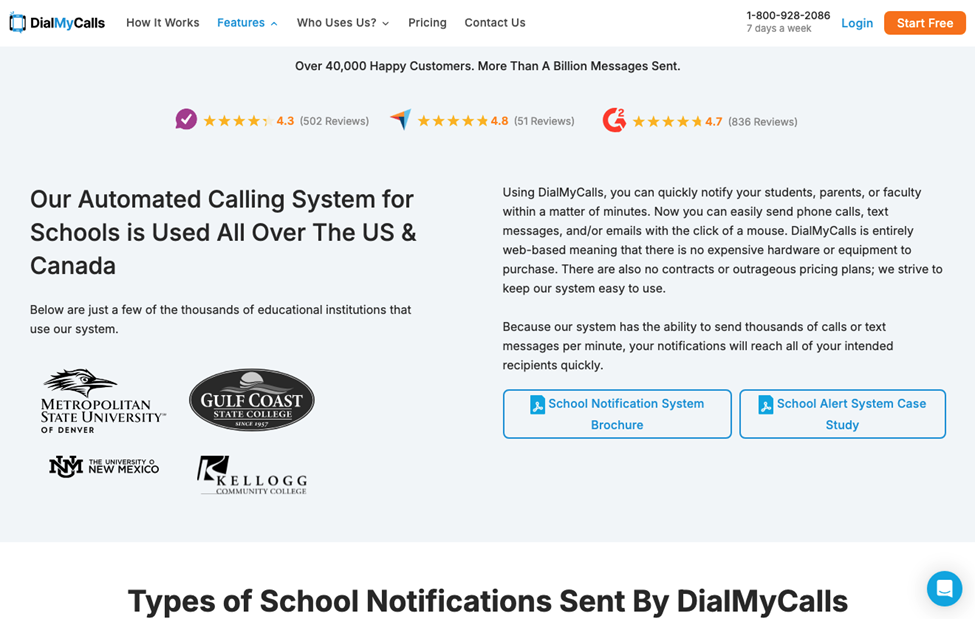
For example, check out the DialMyCalls School Notifications landing page. You'll realize that the social proof shown isn't just a bunch of generic customer feedback. Yes, the business does show off some universal customer ratings (embedded from highly credible resources like Captera and G2).
Nevertheless, the main emphasis in terms of trust-building content is on UGC made by users operating in the education industry, which is precisely the right design choice, seeing that this page targets customers populating this same vertical.
Source: dialmycalls.com
Mistake #6: Poorly Targeted Landing Pages
Finally, as you aim to optimize your website to attract, engage, and convert your ideal customers, remember that approximately one-quarter of website traffic still comes from search engines.
In other words, building a strong online presence and producing and distributing high-quality content through a variety of relevant channels is an excellent method to reach your target audience. Nevertheless, there's still a high likelihood that your prospects will organically discover your business while researching solutions to their specific needs through search engines.
That's why well-targeted landing pages are such an important element within a successful conversion strategy.
When made right, they don't just allow your business to appear toward the top of SERPs (which maximizes your chances of generating valuable incoming traffic). If they're successful at addressing your web visitors' pain points and offering relevant solutions, they also have a much higher likelihood of drawing prospects into your sales funnel and slowly nurturing them into customers.
Of course, optimizing landing pages for discovery and high engagement rates doesn't simply come down to targeting the right keywords or other SEO strategies (despite the importance of this marketing approach in generating organic website traffic).
Instead, it's equally important to ensure your audience has an easy time identifying relevant value once they're on your website. This is where customer-centric optimization comes into play.
In addition to emphasizing suitable keywords, do your best to prioritize clarity and readability. Furthermore, optimize on-site content for scanning and easy consumption, particularly knowing that most web users don't read word-for-word when interacting with text-based digital resources.
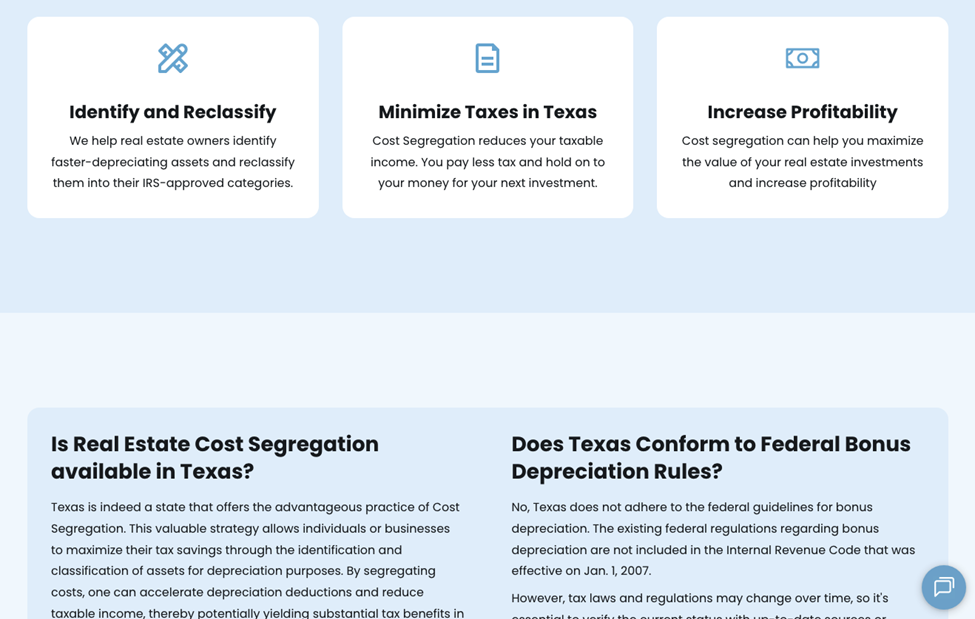
For inspiration on how to accomplish all of this, check out R.E. Cost Seg's Texas Cost Segregation page. This brand understands that customers from Texas have very specific challenges that they want to overcome. So, to ensure they recognize the benefits of RE Cost Seg's offer, the business uses UX and readability optimization to make it super easy for prospects to extract value from the on-page content. This includes highly focused value propositions and CTAs that target a super-specific segment of the brand's audience.
What's fascinating about this approach is that RE Cost Seg repeats the same strategy for all of its targeted audience segments, making it almost effortless to attract and engage a wide variety of customer personas while still ensuring that all web visitors get relevant browsing experiences that are conducive to conversions.
Source: recostseg.com
Mistake #7: Your Website Doesn't Clearly Explain What You Do
One of the most common website mistakes is assuming visitors already understand your business.
Many companies design their websites around internal language, branding slogans, or vague marketing phrases instead of clearly explaining what they actually offer.
The problem is that website visitors don't spend time trying to figure things out. Studies show that users decide whether a website is relevant within just a few seconds. If your homepage fails to communicate value immediately, most people will simply leave and continue searching for a competitor that is easier to understand.
This issue often happens when businesses focus too heavily on design or brand messaging instead of clarity. Headlines like "Transforming Digital Experiences" or "Innovative Solutions for the Modern World" may sound impressive, but they rarely tell visitors what the company actually does.
When your website doesn't clearly explain your offer, several problems occur:
- Visitors become confused and leave quickly
- Your bounce rate increases
- Potential customers lose confidence in your credibility
- Search engines struggle to understand your content and rank it properly
In other words, even if you attract traffic to your website, unclear messaging can prevent those visitors from becoming leads or customers.
Your homepage should communicate your value instantly.
Within the first few seconds, visitors should clearly understand three things:
- What your business does
- Who your product or service is for
- What problem you help solve
Strong websites often achieve this through a simple headline and supporting sentence that directly explains the benefit.
For example, instead of using vague marketing language, focus on clarity and outcomes:
"Empowering businesses through innovative digital transformation."
"An all-in-one digital workplace platform that helps teams communicate, share knowledge, and collaborate in one place."
Clear messaging removes confusion, builds trust quickly, and helps visitors understand why they should continue exploring your website. When people immediately recognize that your solution matches their problem, they are far more likely to stay, learn more, and take the next step.
Mistake #8: Your Website Loads Too Slowly
Website speed problems are usually caused by a combination of technical issues that build up over time. Many websites use large images, uncompressed media files, excessive plugins, and multiple third-party scripts that all need to load before the page appears to the user.
Outdated hosting infrastructure can also slow things down, especially when a website receives traffic spikes or runs complex content management systems. In some cases, poor website development practices — such as loading unnecessary JavaScript or CSS files — add extra delays that significantly affect performance.
Because these issues are often invisible to business owners, many websites appear to function normally while still loading far slower than users expect.
Website speed has a direct impact on both user behaviour and search visibility.
Research from Google shows that 53 percent of mobile users abandon a website if it takes longer than three seconds to load. In practice, this means that even small delays can cause potential customers to leave before they ever see your offer.
Slow websites often experience:
- higher bounce rates
- fewer enquiries and conversions
- lower engagement with website content
- reduced rankings in search engines
Over time, poor performance can quietly reduce the effectiveness of your entire website, even if your design and messaging are strong. Businesses that lack the in-house resources to handle ongoing fixes like these can simplify website management with Theo, which takes care of speed, hosting, and technical upkeep on an ongoing basis.
Improving website speed usually requires a combination of technical optimizations and better resource management.
Common ways to improve performance include:
- compressing and properly sizing images before uploading them
- reducing unnecessary scripts, plugins, and third-party tools
- optimizing your website hosting infrastructure
- implementing browser caching and performance optimization tools
- using a Content Delivery Network (CDN) to deliver assets faster globally
A fast website improves the user experience, increases the likelihood that visitors stay on your pages, and helps search engines rank your site more favorably.
In short, improving speed doesn't just make your website feel better — it directly contributes to better visibility, stronger engagement, and more potential customers.
Why These Website Mistakes Often Go Unnoticed
One of the biggest challenges with website performance is that problems are not always obvious.
Many businesses assume their website is working well simply because it receives steady traffic or appears visually polished.
However, traffic alone is not a reliable indicator of success.
A website can attract thousands of visitors every month and still fail to convert those visitors into enquiries, leads, or customers. In many cases, the real issue lies in how effectively the site communicates value and guides users toward taking action.
When visitors land on a page, they quickly evaluate whether the content is relevant, trustworthy, and easy to understand.
If the messaging is unclear, the navigation is confusing, or key information is difficult to find, users will often leave without interacting further. Because these behaviors happen quietly, businesses may not immediately recognize that something is wrong.
Over time, small usability problems — such as slow loading speeds, weak calls to action, cluttered design, or missing social proof — can gradually reduce conversion rates.
These issues may persist for months or even years before they are identified, silently limiting the number of potential customers a website generates.
For this reason, regularly reviewing your website from a visitor's perspective is essential.
By identifying friction points early and making targeted improvements, businesses can transform a website from a simple online presence into a much more effective tool for attracting and converting ideal customers.
Turn Website Mistakes Into Growth: Your Action Plan
Every business website can improve. By fixing these web design mistakes, you'll attract more visitors, earn their trust faster, and convert them into paying customers.
Week 1: Foundation
Test website speed using PageSpeed Insights or GTmetrix
Check mobile responsiveness across multiple devices
Install Google Analytics and Google Search Console
Test contact forms and lead capture submissions
Week 2: Design & UX Improvements
Remove visual clutter and unnecessary page elements
Improve visual consistency across fonts, colors, and branding
Simplify navigation menus so users can easily find information
Ensure important calls to action appear above the fold
Week 3: Messaging & Clarity
Rewrite homepage headline so visitors immediately understand what you do
Add a clear value proposition explaining the problem your product solves
Remove vague marketing buzzwords and replace with simple language
Create a clear "How It Works" section explaining your solution
Week 4: Personalization & CTAs
Replace generic calls to action with messaging tailored to specific customer needs
Create separate CTAs for different audience segments or use cases
Test different CTA wording to improve click-through rates
Ensure CTAs guide users clearly toward the next step in the buying journey
Week 5: Social Proof & Trust
Add testimonials and customer reviews relevant to your target audience
Highlight recognizable client logos and success stories
Embed reviews from trusted platforms like G2, Capterra, or Google
Include case studies that show measurable results
Week 6: Landing Page Optimization
Create landing pages targeting specific industries or use cases
Align page content with the exact search intent of visitors
Improve readability using bullet points, headings, and shorter paragraphs
Add clear value propositions and focused CTAs on each landing page
Week 7: Site Functionality
Improve navigation so users can quickly locate important pages
Add a visible search bar to help visitors find content quickly
Reduce friction in checkout, signups, or form submissions
Test the site regularly to identify crashes or broken links
Week 8: Performance Optimization
Compress large images and media files
Remove unnecessary scripts and plugins
Enable caching and implement a CDN
Retest page speed to confirm improvements
Final Thoughts
Even though many website mistakes may be minimizing your ability to convert your ideal customers, the simple fact is that removing these conversion obstacles from your online presence doesn't have to be difficult.
For the best possible results, you first need to identify any factors stopping you from securing new clients. From there, you can start addressing any conversion killers one by one.
Or, if you prefer to improve your site's conversion performance across all planes, you can begin the optimization process with the tactics outlined in this guide, which is guaranteed to deliver results and make it easier to grow your business without having to increase your marketing spend.
AI Summary
- Many business websites fail to convert visitors not because of traffic problems, but due to usability, design, and messaging issues that quietly push potential customers away.
- Research shows that users form opinions about a company’s credibility within seconds, making website design and user experience critical for building trust.
- Common problems such as cluttered layouts, poor functionality, slow loading speeds, and unclear messaging can significantly reduce engagement and conversion rates.
- Personalized calls to action, relevant social proof, and well-targeted landing pages help visitors recognize that a solution fits their specific needs.
- Improving clarity, site performance, and customer-focused design makes it easier for visitors to navigate your site and move confidently through the buying journey.
- Businesses that regularly audit and improve their websites can transform them from simple online brochures into powerful tools for attracting and converting ideal customers.
Frequently Asked Questions
What are the most common website mistakes that cost businesses customers?
The most common website mistakes include cluttered design, slow loading speeds, poor navigation, weak calls to action, unclear messaging, lack of social proof, poorly targeted landing pages, and poor site functionality. These issues reduce trust and make it harder for visitors to convert into customers.
Why do visitors leave a website without converting?
Visitors often leave websites when they experience slow loading pages, confusing layouts, unclear value propositions, or a lack of trust signals such as reviews and testimonials. If users cannot quickly understand what a business offers, they are likely to abandon the site and search for alternatives.
How does website design affect customer trust?
Website design plays a major role in credibility. Studies show that many users judge a company's trustworthiness based on its website design. A modern, clean, and user-friendly website helps build confidence, while outdated or cluttered designs can drive potential customers away.
What is the biggest reason websites fail to convert visitors?
One of the biggest reasons websites fail to convert visitors is unclear messaging. If visitors cannot immediately understand what your business does, who it helps, and why it matters, they are unlikely to continue exploring or take action.
How can businesses improve website conversions?
Businesses can improve website conversions by simplifying navigation, improving page speed, adding relevant social proof, personalizing calls to action, creating targeted landing pages, and clearly communicating their value proposition.
How fast should a website load to avoid losing visitors?
Ideally, websites should load within three seconds. Research shows that many users abandon websites that take longer to load, which makes page speed optimization critical for both user experience and conversion rates.
Most Popular Posts

Effective communication among team members is vital for the productivity and success of any organization. Surprisingly, 60% of companies lack a long-term internal communication strategy, which p...


Businesses thrive on communication for efficiency, productivity and accomplishment. When the right information is passed from the right designation in the organization, it promotes positivity an...

Categories
Blog
(3196)
Business Management
(395)
Employee Engagement
(235)
Digital Transformation
(218)
Growth
(150)
Intranets
(141)
Internal communications
(106)
Remote Work
(68)
Sales
(53)
Collaboration
(52)
Customer Experience
(32)
Culture
(30)
Knowledge Management
(29)
Project management
(29)
Leadership
(20)
Comparisons
(9)
News
(1)

Related Posts

Could AI produce your next workplace video faster—and still deliver a message your employees can trust? As more businesses use video for onboarding, training and leadership updates, one question keeps coming up: will AI replace video editors in...

Could the best machine learning systems help your employees spend less time sorting requests, updating spreadsheets and chasing information—and more time doing useful work? That's the opportunity, but finding the right system starts with knowin...

What would happen to your team's work and customer information if an employee's MacBook disappeared today? If you're wondering how to protect your Mac physically, the answer goes beyond buying a case. A MacBook used at home, on a train or in a ...

Welcome to AgilityPortal's guide to the best VPN for Remote teams. How do you give employees secure access to company systems when they work from home, the office and everywhere in between? It's a question more businesses need to answer: 28% of worki...

Have you ever left a meeting thinking everyone agreed on the next step, only to discover a week later that each person remembered something different? Open source meeting transcription can help teams keep a searchable record of the conversation...


Jill Romford
I am a digital nomad, lover of exploring new places and making friends.
I love to travel and I love the internet. I take pictures of my travels and share them on the internet using Instagram.
Traveler, entrepreneur, and community builder. I share my insights on digital marketing and social media while inspiring you to live your fullest life.
Ready to learn more? 👍
One platform to optimize, manage and track all of your teams. Your new digital workplace is a click away. 🚀
Free for 14 days, no credit card required.