
Insight Blog
Agility’s perspectives on transforming the employee's experience throughout remote transformation using connected enterprise tools.
23 minutes reading time
(4618 words)
How to Track Intranet ROI with Simple Analytics Tools

How to Track Intranet ROI with Simple Analytics Tools
Learn how to track intranet ROI using simple analytics tools, employee engagement metrics, and intranet performance data that actually matter.
How to Track Intranet ROI with Simple Analytics Tools

If your company removed its intranet tomorrow, would employees even notice—or would they just go back to using email, chat apps, and shared drives instead?
That's the uncomfortable question many organisations are now facing.
Businesses invest thousands into digital workplaces, employee portals, and communication platforms, yet very few can clearly measure their actual intranet ROI.
In many cases, leadership teams only look at basic page views or login numbers, without understanding whether the platform is genuinely improving productivity, communication, or employee engagement.
The problem is bigger than most companies realise.
Research from IDC found that knowledge workers spend around 2.5 hours per day searching for information, highlighting how disconnected systems continue to drain productivity across modern workplaces.
2.5h
lost every day
Research from IDC found that knowledge workers spend around 2.5 hours per day searching for information, highlighting how disconnected workplace systems continue to drain productivity across modern businesses.
Source: IDC Future of Work Research
Meanwhile, data from Atlassian shows teams lose valuable time switching between tools, chasing updates, and asking coworkers for information they couldn't easily find themselves.
This is exactly why intranet analytics tools have become increasingly important.
Modern businesses are no longer just trying to measure intranet traffic—they want to understand employee behaviour, intranet adoption metrics, collaboration trends, and whether their internal portal is actually helping teams work smarter.
The reality is simple: if employees aren't actively using your intranet to communicate, find knowledge, collaborate, and stay informed, then the platform quickly becomes another expensive system nobody truly depends on.
That's why learning how to measure intranet success properly has become essential for HR leaders, internal communications teams, and digital workplace managers alike.
Key Takeaways
- Measuring intranet ROI requires more than page views and login counts; businesses need deeper employee engagement and adoption insights.
- Disconnected workplace tools create hidden productivity loss by forcing employees to search across multiple systems for information.
- Strong intranet analytics tools help organisations track search behaviour, collaboration trends, and content engagement more effectively.
- Metrics like repeat usage, search success rates, and employee participation provide a clearer picture of real intranet performance.
- Centralised digital workplace platforms make it easier to measure communication ROI, improve knowledge sharing, and identify operational gaps.
Most Companies Track Vanity Metrics Instead of Real Intranet ROI
A lot of businesses think their intranet is performing well simply because employees log in occasionally or view a few company announcements.
But those numbers rarely tell the full story.
Real intranet ROI comes from understanding whether employees are actually finding information faster, collaborating better, and becoming more engaged at work.
The issue is that many organisations still rely on vanity metrics instead of meaningful intranet performance metrics that reflect genuine business impact.
Companies like AgilityPortal, Atlassian, and Salesforce have all invested heavily in internal collaboration ecosystems because employee communication and knowledge sharing directly affect productivity, retention, and operational efficiency.
That means even a small improvement in intranet usability can translate into significant productivity gains across an organisation.
Page Views Alone Don't Show Whether Employees Find Value
One of the biggest mistakes companies make is assuming traffic equals success.
An employee opening the homepage for 10 seconds doesn't mean they found what they needed or had a positive experience.
This is where many internal portal analytics dashboards become misleading.
Common vanity metrics companies overvalue:
- Total page views
- Number of logins
- Announcement impressions
- Time spent on the homepage
- Employee directory visits
- Mobile app downloads
The problem is that these metrics often create what's known as "empty engagement." Employees may access the intranet because they have to—not because the platform genuinely helps them work better.
For example:
- Employees might log in only to download a payslip
- Teams may still rely on email instead of collaboration spaces
- Staff could be searching repeatedly because content is difficult to find
- Users may abandon searches without clicking any results
That's why other comapnies are increasingly focus on behavioural analytics, search success rates, and employee adoption trends instead of surface-level traffic numbers.
Low Employee Adoption Usually Signals a Bigger Workplace Problem
If employees avoid using the intranet, the issue is rarely just "low engagement."
In most cases, it points to deeper communication or usability problems inside the organisation.
Research from Gartner has repeatedly shown that poor digital adoption is one of the main reasons workplace transformation initiatives fail.
Low intranet adoption often happens when:
- Employees cannot find information quickly
- Search results are poor or outdated
- The platform feels too complicated
- Teams are forced to use too many disconnected tools
- Content becomes stale or irrelevant
- Mobile access is frustrating for frontline workers
This directly affects employee portal ROI because businesses continue paying for systems employees barely use.
Many organisations also underestimate how much poor usability impacts workplace trust.
If employees repeatedly fail to locate policies, updates, onboarding documents, or collaboration spaces, they eventually stop relying on the intranet altogether.
If Employees Still Use Email and Chat for Everything, the Intranet Is Failing
A modern intranet should reduce communication chaos—not add to it.
Yet many businesses still operate with:
- Endless email chains
- Duplicate documents
- Multiple chat platforms
- Separate file storage systems
- Unofficial "shadow IT" tools
- Department silos
When this happens, employees stop viewing the intranet as the central source of truth.
Instead, they rely on coworkers, meetings, or messaging apps to find answers.
According to Atlassian, around 56% of employees regularly interrupt colleagues or schedule meetings simply to locate information they couldn't find themselves.
That's a major productivity problem caused by fragmented communication systems.
56%
of employees
According to Atlassian, around 56% of employees regularly interrupt coworkers or schedule meetings simply to locate information they couldn't find themselves.
Source: Atlassian Workplace Collaboration Research
Strong digital workplace analytics should help organisations identify:
- Which departments rarely engage
- Where communication bottlenecks exist
- Which content employees actually use
- What employees search for most
- Which tools are being ignored
- Where collaboration breaks down
Companies like Slack, Microsoft, and Notion have all pushed toward centralised workplace ecosystems because fragmented communication slows decision-making and creates operational friction.
The reality is simple: if employees still default to email and chat for everything, your intranet probably isn't solving the problems it was meant to fix.
You Need to Measure Business Outcomes, Not Just Intranet Activity
Many businesses still measure intranet ROI using simple metrics like page views and login counts.
The problem is those numbers don't tell you whether employees are actually working more efficiently, collaborating better, or finding information faster.
Real intranet analytics should focus on business impact.
Faster Access to Information Saves More Money Than Most Leaders Realise
When employees constantly search through emails, chats, and shared drives, productivity drops quickly.
Research from Atlassian found employees can spend up to 25% of their workweek simply searching for answers or context.
That's why businesses should track metrics like:
- search success rates
- failed search queries
- document engagement
- time-to-information
Strong Employee Engagement Metrics Usually Correlate with Better Adoption
One of the clearest signs of successful employee portal ROI is employee engagement.
Companies like Workvivo and Staffbase focus heavily on engagement because active employees are far more likely to participate in discussions, consume updates, and collaborate across departments.
According to Gallup, highly engaged workplaces often experience stronger productivity and better retention rates.
Important employee engagement analytics include announcement engagement, comments, recognition activity, poll participation, and mobile engagement trends.
Poor Search Data Often Reveals Hidden Problems Inside Your Organisation
Search behaviour can reveal workplace problems many leadership teams never notice.
If employees repeatedly search for HR policies, onboarding guides, or company procedures but fail to find useful results, it usually points to poor content organisation or outdated knowledge.
Companies like Elastic, Google, and Microsoft invest heavily in enterprise search because information discovery directly affects productivity and employee experience.
Strong intranet usage analytics can help organisations identify communication bottlenecks, missing documentation, outdated content, and knowledge gaps before they become larger operational problems.
The reality is simple: if employees cannot quickly find information, your intranet is costing time instead of saving it.
The Best Intranet Analytics Tools Help You Understand Employee Behaviour
One of the biggest mistakes companies make is relying on generic traffic reports that don't explain how employees actually interact with the intranet.
Modern intranet analytics tools should help organisations understand behaviour, engagement, and adoption trends—not just clicks.
Companies like Microsoft, Google, Workvivo, and Staffbase all focus heavily on behavioural analytics because employee interaction data reveals whether the platform is genuinely helping teams work better.
User Adoption Reporting Helps You Identify Departments Falling Behind
Not every department uses an intranet the same way. Some teams may actively engage with updates and resources, while others barely log in at all.
This is where user adoption reporting becomes valuable.
It helps businesses identify which departments, office locations, or roles are engaging with the platform—and which ones are falling behind.
Strong adoption analytics can reveal:
- low-performing departments
- poor onboarding experiences
- communication gaps
- underused features
- teams relying on external tools instead
This type of visibility makes it easier to improve overall employee portal ROI.
Content Engagement Tracking Reveals What Employees Actually Care About
Many organisations publish content internally without knowing whether employees are actually consuming it.
Good content engagement tracking helps measure:
- document views
- announcement engagement
- comments and reactions
- video completion rates
- time spent on pages
For example, if an HR policy page receives almost no engagement, that may signal employees either cannot find it or don't understand its relevance.
Platforms like Microsoft SharePoint and Notion increasingly focus on content engagement because understanding employee behaviour helps improve communication strategies.
Tools like E-zeeinternet.com also offer a lightweight approach to analytics.
Their privacy-first visitor tracking tool uses no cookies and only a tiny 1KB script, making it easy to add to public-facing intranet pages or employee resource portals.
It won't replace a full enterprise analytics suite, but for teams that simply want to know whether a new knowledge base article, onboarding page, or company resource is getting traction, it's a fast and practical starting point.
Intranet Dashboard Software Makes ROI Easier to Visualise
One reason many businesses struggle to prove intranet ROI is because the data is scattered across multiple systems.
Modern intranet dashboard software helps centralise reporting into one clear view.
Leadership teams can quickly monitor engagement trends, adoption rates, search activity, and communication performance without digging through spreadsheets.
Strong dashboard reporting helps organisations:
- track intranet KPIs
- identify engagement drops
- measure communication reach
- monitor adoption trends
- justify future workplace investments
The simpler the reporting is to understand, the easier it becomes for leadership teams to connect intranet usage directly to business outcomes.
These Intranet Performance Metrics Matter More Than Most Companies Think
Many businesses still focus on basic metrics like total logins or page views when measuring intranet ROI.
But those numbers rarely explain whether employees actually trust the platform, collaborate effectively, or return to it consistently.
The most valuable intranet performance metrics usually reveal employee behaviour patterns that leadership teams often overlook.
Search Success Rate Can Reveal Whether Employees Trust Your Intranet
One of the clearest signs of a healthy intranet is whether employees can actually find what they need quickly.
If staff repeatedly search for company policies, onboarding guides, or HR documents but abandon the search without clicking anything, that's a major warning sign.
Poor search behaviour often points to:
- outdated content
- weak tagging structures
- poor navigation
- missing documentation
Companies like Elastic and Microsoft continue investing heavily in enterprise search because failed keyword queries directly impact employee productivity.
Strong intranet usage analytics should help organisations track search abandonment, failed searches, and the most commonly searched topics.
Repeat Usage Often Matters More Than Total Logins
A high login count doesn't automatically mean employees find value in the platform.
What matters more is recurring usage.
If employees regularly return to the intranet throughout the week to access knowledge, collaborate with teams, or engage with updates, it usually signals the platform has become part of their daily workflow.
This is why strong portal performance tracking focuses on active users instead of passive visits.
For example:
- Are employees returning daily?
- Which departments engage most often?
- Which features are ignored?
- Are mobile users more active than desktop users?
Companies like Workvivo and Staffbase place heavy emphasis on repeat engagement because long-term adoption matters far more than one-time visits.
Collaboration Metrics Can Expose Communication Silos Across Teams
Many organisations think communication problems are obvious—but workplace silos often go unnoticed until productivity starts slowing down.
Strong workplace collaboration analytics can reveal whether departments actually interact with one another or operate in isolation.
For example, businesses can track:
- cross-department engagement
- shared document activity
- team collaboration trends
- knowledge sharing behaviour
- discussion participation
Companies like Slack, Microsoft Teams, and Google Workspace all focus heavily on collaboration insights because disconnected teams create slower decision-making and duplicated work.
The reality is simple: if employees only communicate within their own department, valuable knowledge rarely spreads across the organisation.
Measuring Intranet ROI Becomes Easier When Everything Is Centralised
One of the biggest reasons companies struggle to measure intranet ROI is because workplace data is scattered across too many disconnected systems.
Employees might communicate in one tool, store files in another, manage projects somewhere else, and share updates through email or chat apps.
The result is fragmented reporting that makes it almost impossible to understand how employees actually work.
Disconnected Tools Make Accurate Analytics Almost Impossible
When businesses rely on too many workplace platforms, reporting quickly becomes unreliable.
For example:
- engagement data sits in one system
- documents live elsewhere
- communication happens across multiple channels
- analytics become duplicated or inconsistent
This creates major gaps when trying to measure internal communication ROI.
According to research from Asana, employees can spend up to 60% of their time on "work about work," including searching for updates, switching between tools, and chasing information.
The more fragmented the workplace becomes, the harder it is to track meaningful employee behaviour.
60%
of work time
According to research from Asana, employees can spend up to 60% of their time on "work about work", including searching for updates, switching between tools, and chasing information across disconnected systems.
Source: Asana Anatomy of Work Research
A Centralised Digital Workplace Creates Better Reporting Accuracy
A connected digital workplace makes analytics far easier to understand because communication, knowledge sharing, and collaboration happen in one place.
Instead of pulling reports from multiple systems, businesses can measure:
- employee engagement
- search behaviour
- collaboration trends
- content performance
- adoption rates
This creates a much clearer picture of overall digital workplace performance.
Better Visibility Helps Leadership Justify Future Workplace Investments
One of the biggest challenges leadership teams face is proving whether workplace technology investments are actually delivering value.
Strong enterprise intranet metrics help solve that problem.
When executives can clearly see:
- employee adoption trends
- communication reach
- engagement levels
- knowledge usage
- collaboration activity
…it becomes much easier to justify future investments in employee experience and digital workplace tools.
Companies that track workplace analytics properly are often able to identify operational issues earlier, improve communication strategies faster, and make smarter decisions backed by real employee behaviour data—not assumptions.
How AgilityPortal Helps Companies Track Intranet ROI More Effectively
Many organisations struggle to measure intranet ROI because their workplace data is spread across multiple disconnected systems.
Communication happens in one platform, documents sit somewhere else, and engagement analytics become difficult to track accurately.
That's where AgilityPortal takes a different approach.
Instead of forcing businesses to rely on separate tools for communication, collaboration, and knowledge sharing, AgilityPortal centralises everything into one connected digital workplace platform.
This makes it far easier to measure employee engagement, adoption, and overall workplace performance.
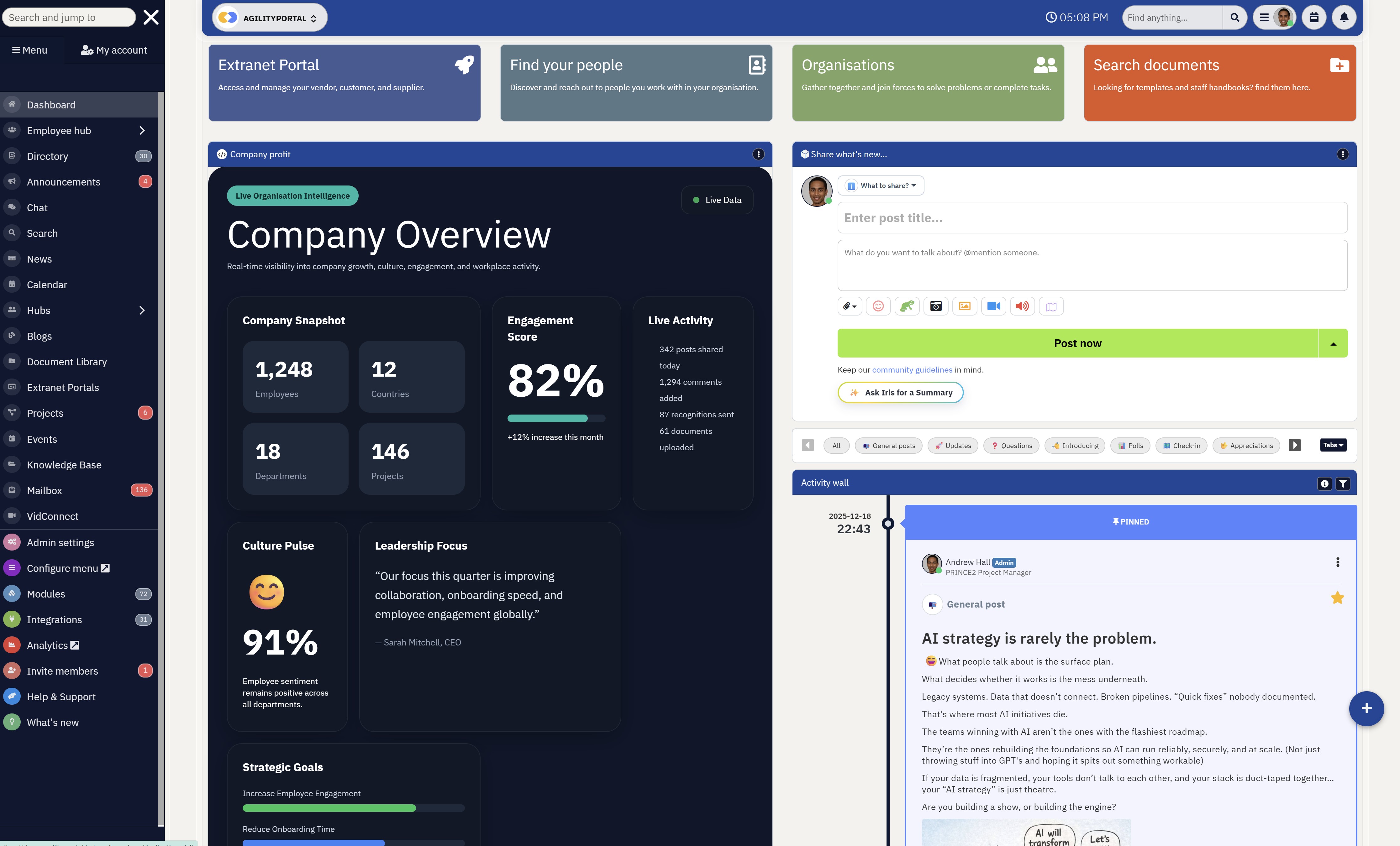
How AgilityPortal Helps Companies Track Intranet ROI More Effectively
Built-In Analytics Help Teams Measure Engagement Without Complex Setup
Built-In Analytics Help Teams Measure Engagement Without Complex Setup
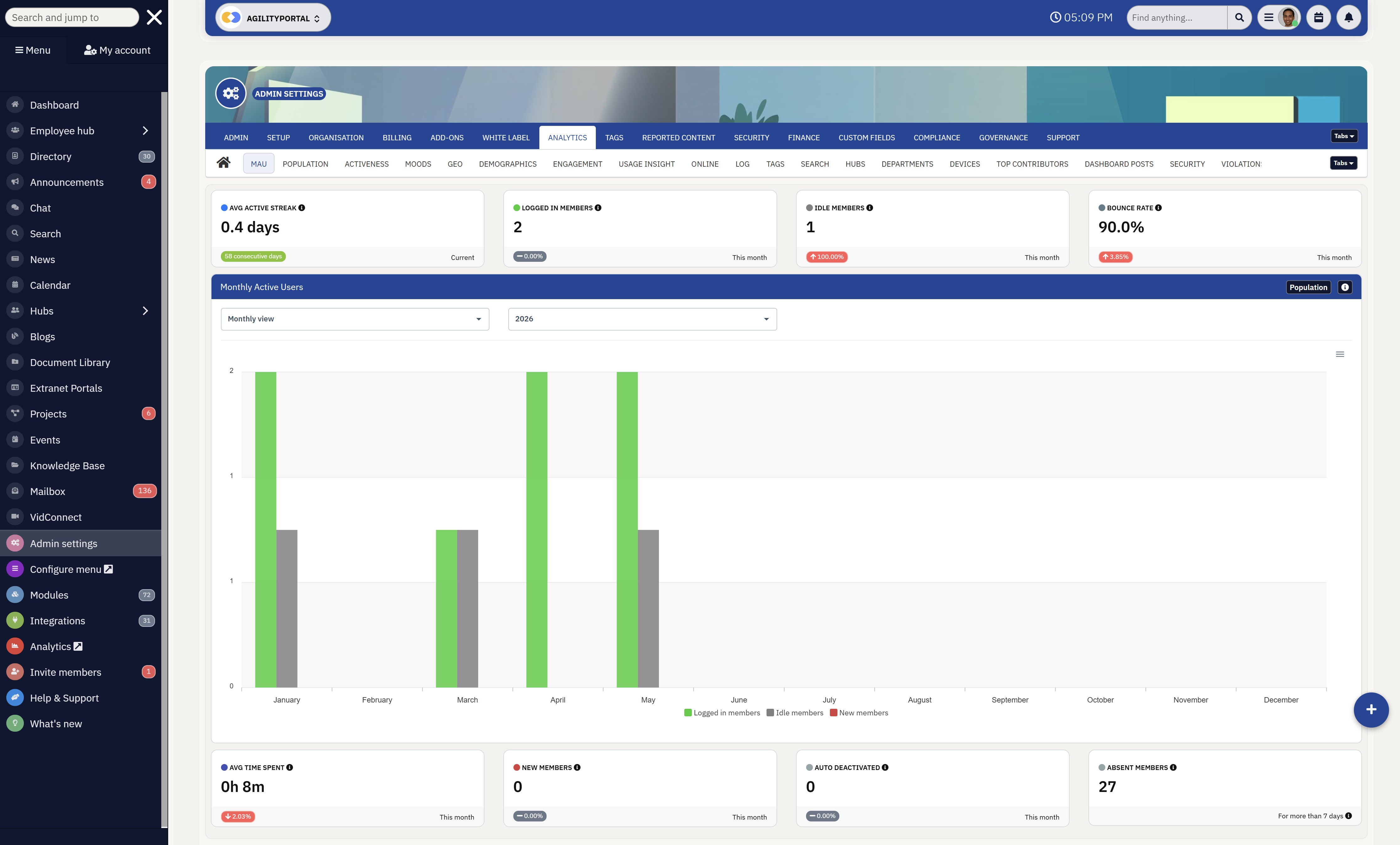
One of the biggest challenges with traditional intranet analytics tools is complexity. Many platforms require expensive third-party reporting software or advanced technical setup just to access meaningful data.
AgilityPortal simplifies this process with built-in analytics dashboards designed to help businesses track employee activity without needing complicated integrations.
Teams can monitor:
- engagement trends
- announcement performance
- search activity
- employee adoption rates
- content interactions
- collaboration activity
This gives HR teams, internal communications managers, and leadership teams a much clearer understanding of how employees are actually using the platform.
Employee Communication, Knowledge Sharing, and Collaboration Are Measured in One Place
Employee Communication, Knowledge Sharing, and Collaboration Are Measured in One Place
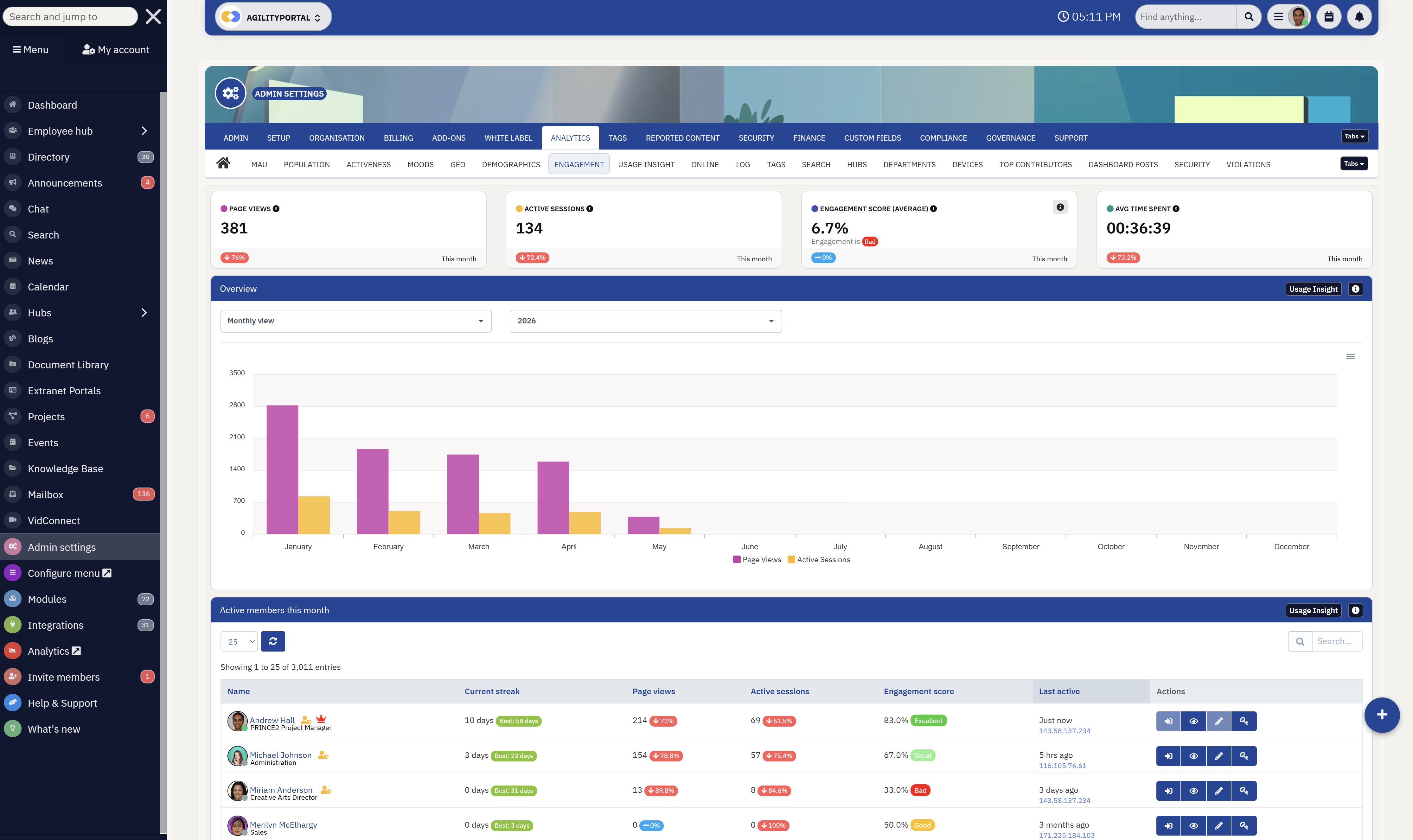
A major problem with disconnected workplace tools is fragmented reporting.
If communication happens in one app, files are stored elsewhere, and collaboration takes place in separate systems, businesses never get a complete picture of employee behaviour.
AgilityPortal centralises:
- employee communication
- document management
- company news
- collaboration spaces
- social engagement
- knowledge sharing
Because everything happens in one platform, businesses can measure real collaboration platform ROI more accurately.
This also helps organisations identify communication gaps, low-engagement departments, and underused resources much faster.
Simple Reporting Helps Leaders Make Faster Decisions
Simple Reporting Helps Leaders Make Faster Decisions
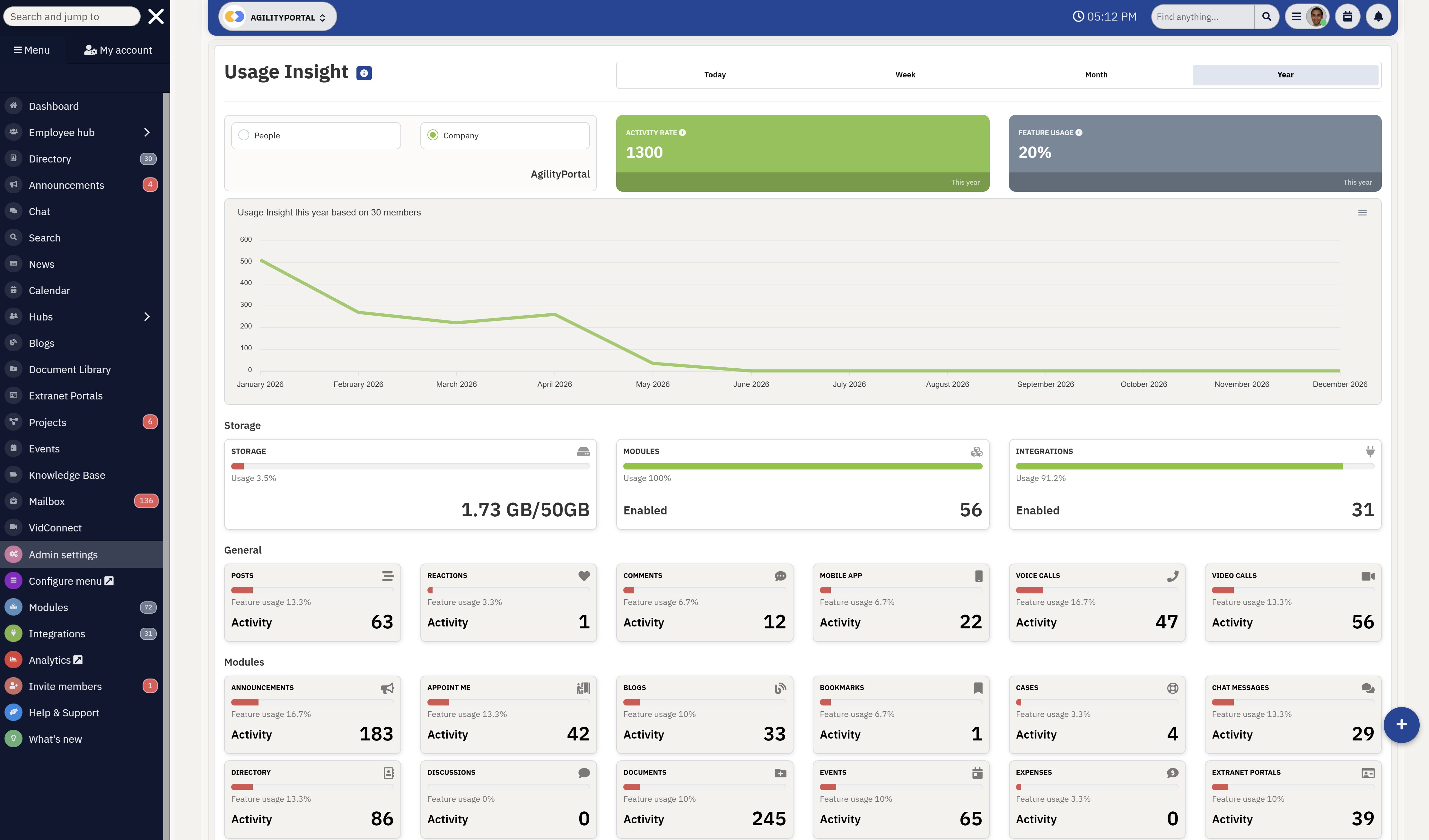
Good analytics should help leadership teams make decisions quickly—not overwhelm them with complicated spreadsheets and disconnected reports.
AgilityPortal focuses on simple, actionable reporting that helps organisations understand:
- what employees engage with most
- where communication breaks down
- which resources employees struggle to find
- how adoption changes over time
This allows businesses to improve communication strategies, optimise onboarding, and reduce time wasted searching for information.
The reality is simple: the easier analytics are to understand, the easier it becomes to improve employee engagement and prove real intranet ROI.
AgilityPortal
The All-in-One Digital Engagement Platform Built to Replace Tool Chaos
AgilityPortal is built for professional services firms that need more than another chat app or basic intranet. It brings internal communication, employee engagement, knowledge management, document sharing, and team collaboration into one secure digital workplace platform.
Instead of losing billable hours searching through emails, shared drives, and disconnected systems, teams get one central hub where people, knowledge, updates, and workflows stay connected.
Start your 14-day free trial — no credit card required. Built for teams that want less tool switching and more work done.Conclusion — If You Can't Measure Intranet ROI, You Can't Improve It
Many intranets fail for one simple reason: companies never properly measure whether the platform is actually helping employees work better.
Tracking page views and login counts alone is no longer enough.
Modern businesses need deeper insights into how employees communicate, collaborate, search for information, and engage with workplace content.
The reality is simple: if employees cannot easily find information, collaborate across departments, or engage with company communication, your intranet quickly becomes another underused system instead of a valuable workplace hub.
The companies seeing the highest intranet ROI are usually the ones measuring employee behaviour — not just counting clicks.
FAQ
What is intranet ROI?
Intranet ROI measures the business value an organisation gets from its intranet software compared to the cost of running and maintaining the platform.
This can include improved employee engagement, faster communication, better knowledge sharing, reduced time searching for information, and stronger collaboration across teams.
Many businesses now use an intranet roi calculator to estimate productivity savings and measure whether their intranet solutions are delivering measurable business outcomes.
How do you measure intranet success?
Successful intranet software should improve communication, collaboration, and employee productivity—not just generate page views.
Businesses typically measure:
- employee engagement
- search success rates
- content interaction
- repeat usage
- collaboration activity
- adoption across departments
Platforms like Interact Software and Microsoft increasingly focus on analytics because understanding employee behaviour helps improve long-term digital workplace adoption.
What are the best intranet analytics tools?
The best analytics tools help organisations track employee behaviour, communication trends, and workplace engagement in real time.
Popular platforms include:
- interact intranet
- connect intranet
- Microsoft SharePoint
- Staffbase
- Workvivo
- AgilityPortal
Some organisations also explore interact intranet ai capabilities to improve search experiences, automate recommendations, and personalise employee content delivery.
Which intranet metrics matter most?
The most valuable intranet metrics usually focus on employee behaviour rather than vanity traffic numbers.
Important metrics include:
- repeat employee usage
- failed searches
- engagement rates
- mobile adoption
- document interaction
- communication reach
These insights help organisations understand whether their intranet solutions are genuinely improving productivity and collaboration.
How can companies improve employee intranet adoption?
Employee adoption improves when the platform is easy to use, mobile-friendly, and centralises communication, knowledge, and collaboration into one place.
Companies often struggle when employees are forced to switch between disconnected systems. That's why many modern intranet software providers now focus heavily on search, usability, integrations, and employee experience.
Businesses comparing providers also commonly review interact intranet pricing alongside alternative workplace platforms to understand long-term scalability and ROI.
What is the difference between intranet analytics and employee engagement analytics?
Intranet analytics focus primarily on platform usage, such as page visits, searches, content interaction, and adoption trends.
Employee engagement analytics go deeper by measuring participation, communication behaviour, recognition activity, feedback, and collaboration across the organisation.
Together, these insights help businesses understand both platform performance and overall workplace engagement.
Why do most intranets fail to deliver ROI?
Most intranets fail because employees simply don't use them consistently.
Common reasons include:
- poor search functionality
- outdated content
- disconnected tools
- weak communication strategies
- difficult user experiences
- lack of leadership adoption
The most successful intranet solutions focus on usability, employee engagement, and centralised communication instead of acting as static document storage systems.
AI Summary
- Intranet ROI is no longer measured by page views alone—modern businesses need deeper insights into employee engagement, adoption, and collaboration behaviour.
- Disconnected workplace tools create hidden productivity loss by forcing employees to search across multiple systems for information, updates, and documents.
- Strong intranet analytics tools help organisations track search activity, content engagement, communication performance, and employee participation more effectively.
- Metrics like repeat usage, failed searches, and engagement trends often reveal workplace problems traditional reporting dashboards completely miss.
- Companies using centralised digital workplace platforms gain more accurate reporting, better visibility into employee behaviour, and clearer communication ROI.
- Successful intranet adoption depends on usability, accessibility, and employee experience—if staff avoid the platform, long-term ROI becomes difficult to achieve.
Most Popular Posts

Effective communication among team members is vital for the productivity and success of any organization. Surprisingly, 60% of companies lack a long-term internal communication strategy, which p...


Businesses thrive on communication for efficiency, productivity and accomplishment. When the right information is passed from the right designation in the organization, it promotes positivity an...
Categories
Blog
(2996)
Business Management
(378)
Employee Engagement
(223)
Digital Transformation
(192)
Growth
(143)
Intranets
(137)
Remote Work
(63)
Sales
(53)
Collaboration
(48)
Customer Experience
(30)
Culture
(30)
Knowledge Management
(28)
Project management
(28)
Leadership
(20)
Comparisons
(9)
News
(1)

Related Posts

The Amazon advertising agency landscape has changed dramatically over the past two years. With the introduction of AI-powered shopping experiences, Amazon Rufus, advanced attribution reporting, Sponsored Brands Video, and Amazon DSP enhancement...

Artificial intelligence (AI) and machine learning are no longer emerging technologies reserved for large enterprises with massive budgets. Today, organizations of all sizes are investing in AI-powered solutions to automate processes, improve de...

Law firms are under increasing pressure to deliver exceptional client service while controlling operational costs and managing growing administrative demands. Tasks such as document drafting, client intake, compliance tracking, legal research, ...

Choosing the right intranet software or business tool isn't easy. Today's buyers are faced with thousands of SaaS solutions, countless feature comparisons, and hundreds of online reviews. In fact, research from Gartner found that B2B buye...

For frontline employees, difficult conversations are not a matter of if—they are a matter of when. Whether dealing with frustrated customers, resolving workplace conflicts, addressing complaints, or delivering unwelcome news, frontline communic...


Jill Romford
I am a digital nomad, lover of exploring new places and making friends.
I love to travel and I love the internet. I take pictures of my travels and share them on the internet using Instagram.
Traveler, entrepreneur, and community builder. I share my insights on digital marketing and social media while inspiring you to live your fullest life.
Ready to learn more? 👍
One platform to optimize, manage and track all of your teams. Your new digital workplace is a click away. 🚀
Free for 14 days, no credit card required.