Insight Blog
Agility’s perspectives on transforming the employee's experience throughout remote transformation using connected enterprise tools.
24 minutes reading time
(4786 words)
The Hidden Role of Managed IT in Driving Frictionless Employee Engagement

The Hidden Role of Managed IT in Driving Frictionless Employee Engagement
Managed IT is the missing link to employee engagement. Learn how to reduce friction, boost productivity, and create a seamless digital workplace.
The Hidden Role of Managed IT in Driving Frictionless Employee Engagement

Ever wondered why employee engagement initiatives fail to gain real traction—even after investing in perks, platforms, and culture programs?
Research from Forrester shows that 73% of employees say valuing their time is the most important part of a positive work experience, yet many still spend large portions of their day dealing with slow systems and scattered tools.
This is where managed IT employee engagement becomes impossible to ignore.
Forward-thinking organisations are now realising that without reliable IT support for businesses and well-structured digital workplace solutions, even the best employee engagement tools fall short.
The real issue isn't a lack of effort—it's the hidden friction caused by disconnected systems, slow access, and poor internal experiences.
And here's the uncomfortable truth: companies that fail to address this gap aren't just losing efficiency—they're quietly losing their people.
73%
value their time most
According to Forrester, 73% of employees say valuing their time is the most important part of a positive work experience— yet many still deal with slow systems and disconnected tools daily.
Source: Forrester Research
Key Takeaways
- Managed IT plays a critical role in employee engagement by removing friction caused by slow systems, disconnected tools, and poor digital experiences.
- Employee engagement initiatives often fail not due to lack of effort, but because underlying workplace technology makes everyday tasks harder than they should be.
- A strong digital workplace strategy connects communication, documents, and workflows into a single, seamless experience that supports how employees actually work.
- Proactive IT management improves system performance, reduces downtime, and ensures employees can access the information they need without delays or interruptions.
- Businesses that align IT with employee experience see higher productivity, better collaboration, and stronger long-term engagement across teams.
The Real Problem: Engagement Fails Because Work Is Frustrating
Here's the part most companies get wrong: employees don't suddenly become disengaged—they're slowly worn down by daily friction.
In many organisations, teams are expected to navigate a maze of employee engagement tools, outdated systems, and disconnected platforms just to complete basic tasks. What looks like a motivation issue on the surface is often a workplace technology problem underneath.
Take a typical scenario.
An employee logs in to start their day:
- They open one system for communication
- Another for documents
- A third for project updates
- Then spend 10–15 minutes just trying to find the latest version of a file
This isn't rare—it's the norm.
According to Atlassian, employees lose up to 25% of their workweek searching for information or recreating work that already exists. That's not just inefficiency—it's frustration stacking up, day after day.

Engagement Fails Because Work Is Frustrating
25%
of the workweek lost
According to Atlassian, employees lose up to 25% of their workweek searching for information or recreating work that already exists. That’s not just inefficiency— it’s frustration stacking up, day after day.
Source: Atlassian
The Hidden Impact Most Leaders Miss
On paper, everything looks fine. Tools are in place. Systems exist.
But the experience tells a different story:
- Delayed tasks because employees can't find what they need
- Duplicate work created due to lack of visibility
- Constant interruptions asking colleagues for information
- Mental fatigue from switching between multiple platforms
Over time, this creates a dangerous pattern: employees stop going the extra mile—not because they don't care, but because the system makes it harder than it should be.
This is where managed IT employee engagement plays a critical role. Without structured IT infrastructure for remote teams and streamlined internal communication systems, friction becomes the default experience.
Real-World Example: The Cost of "Just One More Tool"
A mid-sized professional services firm introduced multiple employee productivity tools to improve collaboration. On paper, it looked like progress.
In reality:
- Employees were juggling 6+ platforms daily
- Key information was duplicated across systems
- Teams relied more on Slack messages than official documentation
The result? Confusion, inconsistency, and rising frustration.
Within six months, internal surveys showed a drop in engagement scores, even though the company had invested heavily in new tools.
The Psychological Trigger: "This Is Exactly What We're Dealing With"
Here's why this matters—and why this section tends to get shared:
When leaders recognise these patterns, it creates an instant moment of clarity:
"This isn't just us—this is a systemic problem."
That realisation is powerful.
Because once you see it, you can't unsee it:
- The wasted time
- The unnecessary complexity
- The silent productivity drain
And more importantly, it challenges a common assumption—that engagement is purely an HR responsibility.
If employees are spending hours fighting systems instead of doing meaningful work, no engagement initiative will stick.
You can't build a high-engagement culture on top of a broken work experience.
And until organisations address the friction caused by poor systems, disconnected tools, and reactive IT support for businesses, engagement will always feel like an uphill battle.
If this sounds familiar, it's probably not just your organisation. Most teams are dealing with the same hidden friction—but very few are talking about it openly.
What Is Managed IT (And Why It's Not Just "Tech Support")
Most people hear "managed IT" and immediately think of a helpdesk fixing broken laptops or resetting passwords.
That's outdated thinking—and it's exactly why so many businesses underestimate its impact.
In reality, managed IT employee engagement starts with something much bigger: creating a work environment where technology actually supports employees instead of slowing them down.
At its core, managed IT is about outsourcing the responsibility of your IT operations to specialists who don't just fix problems—but prevent them from happening in the first place.
From Reactive Support → Proactive Enablement
Traditional IT operates in a reactive way—something breaks, a ticket is raised, and employees wait. Managed IT flips that model entirely by focusing on prevention rather than response.
Systems are continuously monitored, maintained, and optimised so issues are resolved before they disrupt work. This creates a smoother, more reliable environment where employees aren't constantly interrupted by technical problems.
Over time, this shift reduces frustration and allows teams to stay focused, which is a critical factor in improving employee engagement.
That shift changes everything.
Instead of constant interruptions and downtime, employees experience:
- Faster systems that just work
- Fewer disruptions during the workday
- Seamless access to tools and information
And that directly feeds into improving employee engagement, because people can focus on meaningful work—not technical issues.
What Managed IT Actually Covers
Managed IT goes far beyond basic support.
It includes infrastructure management, system integrations, security, performance monitoring, and ongoing optimisation of the entire digital environment.
Instead of juggling disconnected employee productivity tools and internal communication systems, everything is aligned into a cohesive setup that supports how people actually work.
A strong managed IT setup goes far beyond basic support. It typically includes:
- Infrastructure management – ensuring systems run smoothly and scale with the business
- System integrations – connecting tools so employees aren't jumping between platforms
- Security and compliance – protecting data without slowing users down
- Uptime and monitoring – identifying issues before they impact teams
- Support for hybrid and remote teams – consistent access from anywhere
This is where many companies start to
This is where digital workplace solutions become effective—because the technology is no longer fragmented, it's structured to reduce friction and improve access.
Real-World Example: The Difference in Experience
Consider two similar organisations. One relies on traditional IT, where employees frequently deal with slow systems, downtime, and scattered tools.
The other uses a managed IT approach, where systems are integrated, monitored, and optimised in real time.
In the first scenario, employees lose time, repeat tasks, and depend heavily on colleagues for information. In the second, work flows naturally, access is instant, and collaboration feels seamless.
According to IBM, organisations with proactive IT management strategies can reduce downtime by up to 80%—a massive shift that directly impacts productivity and morale.
Why Businesses Are Rethinking IT Altogether
This is why more organisations are actively turning to independent directories that help them compare the best managed IT providers in Orlando and beyond.
The goal is no longer just to "fix IT issues," but to create a better overall work experience.
Businesses are starting to recognise that technology plays a central role in how employees communicate, collaborate, and perform. When IT is structured properly, it removes barriers instead of creating them.
There's a moment of realisation that many leaders experience when they see this clearly. It's the understanding that IT isn't just a background function—it's shaping every interaction employees have with their work.
Once that clicks, priorities shift quickly. Instead of adding more tools or pushing more initiatives, the focus moves to fixing the foundation. And that's where the biggest gains in engagement, productivity, and satisfaction actually happen.
The Hidden Link Between Managed IT and Employee Engagement
This is the part most businesses overlook. They invest in employee engagement tools, run surveys, and roll out initiatives—yet nothing really changes. The missing link isn't effort, it's experience.
More specifically, how employees experience technology every single day.
When systems are slow, tools are scattered, and information is hard to access, engagement doesn't stand a chance. On the flip side, when everything works seamlessly in the background, employees don't just work faster—they feel better about their work.
That's where managed IT employee engagement becomes a real advantage.
Faster Systems = Less Frustration
Speed is one of the most underestimated drivers of engagement. When systems lag, crash, or take too long to load, it creates micro-frustrations that build up over time.
An employee might lose a few seconds here and there, but across a full day, that adds up to a constant sense of interruption.
Now multiply that across an entire organisation.
According to Forrester, 73% of employees say valuing their time is one of the most important factors in a positive work experience. Slow systems do the opposite—they signal that time isn't valued.
With the right IT infrastructure for remote teams and proactive optimisation, those delays disappear.
Tasks feel smoother, workflows move faster, and employees stay in a state of flow instead of constantly restarting. That shift alone can dramatically improve how people feel about their workday.
73%
value their time most
According to Forrester, 73% of employees say valuing their time is one of the most important factors in a positive work experience. Slow systems do the opposite—they signal that time isn’t valued.
Source: Forrester Research
Fewer Tools = Less Chaos
Most companies think adding more tools will solve their problems. In reality, it often makes things worse.
Employees end up juggling multiple platforms for communication, documents, tasks, and updates.
Each tool has its own login, structure, and learning curve. The result is cognitive overload—people spend more time figuring out where to work than actually doing the work.
This is where digital workplace solutions supported by managed IT make a difference. Instead of layering tools on top of each other, systems are consolidated into a more unified environment. Everything is easier to navigate, easier to find, and easier to use.
The impact is immediate. Less confusion, fewer mistakes, and a clearer path to getting things done. It's not just about simplifying tech—it's about removing the mental clutter that drains energy throughout the day.
Reliable Access = Better Communication
Communication doesn't break down because people don't want to share information—it breaks down because they can't find it.
When documents are buried across systems, permissions are inconsistent, or platforms don't sync properly, employees default to asking colleagues for help. That leads to constant interruptions, repeated questions, and information being shared in silos.
Over time, this creates dependency instead of autonomy.
With structured internal communication systems and well-managed access, employees know exactly where to go. Information becomes searchable, reliable, and always available.
That reduces unnecessary back-and-forth and allows teams to move faster without waiting on others.
There's also a deeper impact here. When employees can access what they need without friction, they feel more in control of their work. That sense of autonomy is a key driver of engagement—but it's often blocked by poor systems rather than lack of motivation.
Industry Perspective: Why Experts Are Saying the Same Thing
This is not just theory; it is a clear trend reshaping the market. When analyzing how local IT firms adapt to these changes, Jumpfactor's take on providers in key regional markets highlights exactly what sets leaders apart.
The core observation is simple: modern businesses are no longer choosing IT partners based purely on basic troubleshooting. Instead, they are selecting partners who can actively drive operational efficiency, optimize user experiences, and support long-term scalability
That aligns directly with what high-performing organisations are already doing—treating IT as a core driver of employee experience, not just a backend function.
This is the moment that tends to hit leaders the hardest.
They realise the issue was never about effort, culture, or even tools—it was about how those tools were structured and supported.
"We've been trying to fix engagement on the surface… while ignoring the experience underneath."
And once that becomes clear, everything shifts.
Because improving engagement doesn't start with another initiative.
It starts with removing the friction employees deal with every single day.
If this sounds familiar, it's because most organisations are dealing with the same hidden problem—but very few are willing to admit it.
How Managed IT Creates a Frictionless Digital Workplace
Centralising Tools and Communication
One of the biggest barriers to improving employee engagement is tool fragmentation.
Employees are forced to switch between multiple employee engagement tools, messaging apps, document systems, and project platforms just to complete simple tasks.
This constant context switching doesn't just slow people down—it creates confusion, errors, and frustration.
A strong managed IT approach solves this by bringing everything into a more unified environment through digital workplace solutions.
Instead of scattered systems, employees get a central hub where communication, files, and updates live in one place.
The impact is immediate: less time searching, fewer missed messages, and a clearer, more structured way of working that actually supports productivity rather than disrupting it.
Automating Repetitive Workflows
Repetitive manual tasks are one of the fastest ways to drain energy and reduce engagement. Whether it's chasing approvals, updating documents, or sending routine communications, these tasks quietly eat into time that could be spent on more meaningful work.
Managed IT enables businesses to introduce automation into their workplace technology strategy, reducing the need for constant manual input.
Processes that once took hours can run in the background, triggered automatically based on actions or events. This not only improves efficiency but also enhances the overall employee experience.
When people aren't stuck doing repetitive admin work, they feel more productive, more focused, and ultimately more engaged in what they do.
Supporting Remote and Hybrid Teams
The shift to hybrid work has exposed major gaps in many organisations' IT infrastructure for remote teams.
Employees working from different locations often face inconsistent access to systems, slow connections, and limited visibility into what's happening across the business.
Managed IT addresses this by creating a consistent experience regardless of location. Systems are optimised for performance, access is standardised, and collaboration becomes seamless across teams.
This is where employee productivity tools and internal communication systems truly deliver value—when they are supported by a reliable IT foundation.
Employees no longer feel disconnected or out of sync, which plays a crucial role in maintaining engagement across distributed teams.
Ensuring Security Without Slowing People Down
Security is essential, but when implemented poorly, it becomes another source of friction.
Overly complex login processes, restricted access, and constant authentication requests can frustrate employees and slow down workflows.
Managed IT takes a more balanced approach, integrating security into the system without compromising usability.
Through smarter access controls, single sign-on, and continuous monitoring, businesses can protect their data while still delivering a smooth user experience.
This is one of the often-overlooked managed IT services benefits—security that works in the background instead of getting in the way.
When employees feel both secure and supported, it builds trust in the systems they use every day, reinforcing a more positive and productive work environment.
How to Choose the Right Managed IT Approach
Where Most Businesses Get It Wrong
The Smarter Way Forward
Shifting the Mindset: IT as an Employee Experience Driver
Most organisations have spent years treating IT as a background function—something that keeps systems running but doesn't directly impact people.
That thinking is starting to change. Forward-thinking businesses are now recognising that IT plays a central role in shaping how employees experience work every single day.
When systems are slow, disconnected, or unreliable, engagement drops, no matter how strong the culture initiatives are. On the other hand, when technology is seamless and supportive, employees naturally become more productive and more engaged.
This is where managed IT employee engagement becomes a strategic advantage, not just an operational necessity.
Focusing on Simplicity, Speed, and Accessibility
Instead of adding more tools or layering complexity, smarter organisations are focusing on simplifying the experience.
They prioritise systems that are fast, easy to use, and accessible from anywhere.
The goal isn't to overwhelm employees with features, but to remove friction from their day-to-day work.
By aligning digital workplace solutions with real workflows, businesses create an environment where employees can quickly find information, communicate effectively, and complete tasks without unnecessary delays.
This shift towards simplicity and speed has a direct impact on improving employee engagement, because people are no longer fighting the system—they're supported by it.
Moving Towards a Platform Approach
Rather than relying on a collection of disconnected tools, many organisations are now moving towards a more unified platform approach.
This means bringing communication, knowledge, and workflows into a single, structured environment that supports how teams actually work.
Instead of jumping between multiple employee productivity tools and fragmented internal communication systems, employees interact with one central hub that connects everything together. This approach doesn't just improve efficiency—it creates consistency, clarity, and a better overall experience.
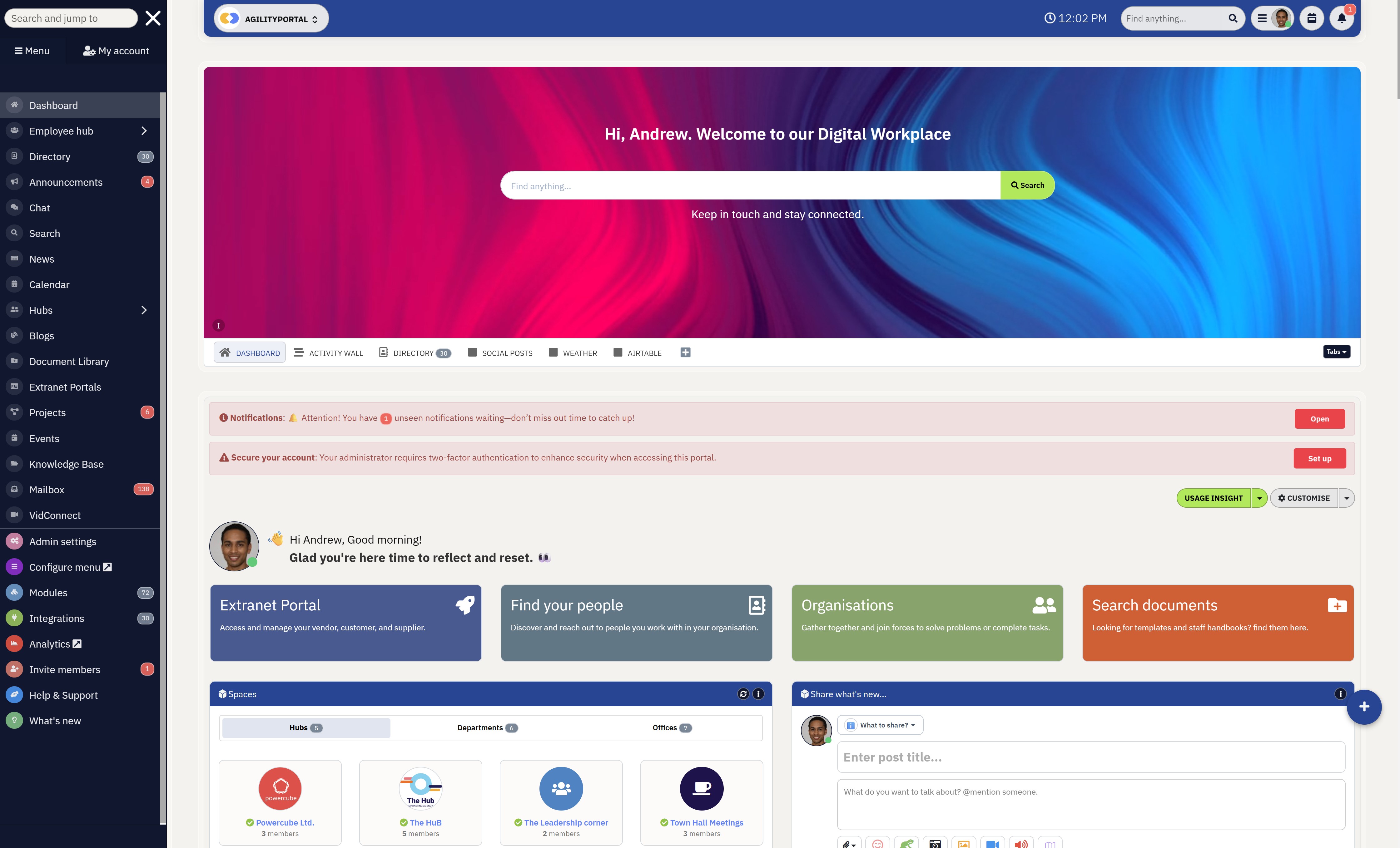
For businesses looking to move in this direction, platforms like AgilityPortal represent this shift clearly.
By combining communication, collaboration, and knowledge management into one system, organisations can reduce friction, improve visibility, and create a workplace that employees actually want to engage with.
Want to Eliminate Workplace Friction?
Want to Eliminate Workplace Friction?
At some point, most organisations hit the same realisation—no matter how many tools they introduce or how many initiatives they launch, nothing truly improves until the underlying experience of work gets fixed.
Employees don't need more systems; they need a better way to work within the systems they already use.
This is where platforms like AgilityPortal come into play. Instead of forcing teams to juggle multiple employee engagement tools, disconnected internal communication systems, and scattered document storage, everything is brought into one structured environment.
Communication, knowledge, and workflows are no longer separate—they're connected in a way that actually makes sense.
The impact is immediate and measurable. Employees spend less time searching for information and more time getting meaningful work done. Collaboration becomes smoother because everyone is working from the same source of truth.
Updates are visible, documents are easy to find, and communication flows naturally across teams, whether they're in the office or working remotely.
More importantly, it changes how employees feel about their work. When systems are simple, fast, and reliable, frustration drops and engagement rises without forcing it. This is the real shift—from managing tools to enabling people.
For organisations focused on improving employee engagement, the question isn't whether to invest in more technology. It's whether to finally remove the friction that's been holding their teams back all along.
AgilityPortal
A Frictionless Digital Workplace Built to Drive Real Employee Engagement
AgilityPortal isn’t just another intranet—it’s a complete digital workplace solution designed to eliminate friction and improve managed IT employee engagement. It brings communication, documents, and workflows into one connected platform so employees can work faster without switching between disconnected systems.
Instead of relying on scattered employee engagement tools and fragmented internal communication systems, teams get a central hub with real-time updates, searchable knowledge, and seamless collaboration—so work flows naturally and productivity improves across the board.
Start your 14-day free trial — no credit card required. Built for teams that want less friction and more productivity.Conclusion: Fix the Experience, and Engagement Follows
Most organisations don't have an engagement problem—they have a work experience problem.
They invest in culture, tools, and initiatives, yet overlook the one thing employees interact with every single day: their technology.
When systems are slow, disconnected, and difficult to use, frustration becomes part of the job. And no amount of engagement strategy can compensate for that.
That's why managed IT employee engagement is no longer optional—it's foundational.
When businesses shift their focus from adding more tools to improving how those tools actually work together, everything changes. Employees spend less time navigating systems and more time doing meaningful work. Communication becomes clearer, workflows become faster, and collaboration feels natural instead of forced.
The result isn't just better productivity—it's a better workplace.
And that's the real takeaway here:
engagement isn't something you build on top of work—it's something that emerges when work itself becomes easier.
For organisations serious about improving employee engagement, the next step isn't another initiative. It's removing the friction that's been holding their teams back all along.
AI Summary
- Employee engagement often fails not because of poor culture or lack of effort, but due to hidden friction caused by slow systems, disconnected tools, and inefficient workplace technology.
- Managed IT plays a key role in improving employee experience by ensuring systems are fast, reliable, and seamlessly integrated into daily workflows.
- When employees can easily access information, communicate effectively, and complete tasks without disruption, productivity naturally increases and frustration decreases.
- Organisations relying on multiple disconnected employee engagement tools and internal communication systems often create complexity instead of solving problems.
- Proactive IT strategies, including automation, system optimisation, and centralised platforms, help reduce downtime and eliminate repetitive manual work.
- Solutions like AgilityPortal bring communication, knowledge, and workflows into one place, helping businesses create a frictionless digital workplace that employees actually use.
Most Popular Posts

Effective communication among team members is vital for the productivity and success of any organization. Surprisingly, 60% of companies lack a long-term internal communication strategy, which p...


Businesses thrive on communication for efficiency, productivity and accomplishment. When the right information is passed from the right designation in the organization, it promotes positivity an...

Categories
Blog
(3158)
Business Management
(392)
Employee Engagement
(233)
Digital Transformation
(211)
Growth
(149)
Intranets
(139)
Internal communications
(106)
Remote Work
(67)
Sales
(53)
Collaboration
(52)
Customer Experience
(32)
Culture
(30)
Knowledge Management
(29)
Project management
(29)
Leadership
(20)
Comparisons
(9)
News
(1)
Related Posts

How many meetings have started late because someone could not find the link, could not connect to the meeting-room system, or simply could not hear the people sitting around the table? It happens more often than most businesses would like to ad...

If you'd asked me a few years ago what AI could actually do, I'd probably have said, "Answer questions and write a few paragraphs." That was impressive at the time, but it didn't take long before everything changed. Then AI stopped being just a...

Work chat apps have become the everyday communication layer for modern organisations. Teams use them to ask quick questions, share files, coordinate shifts, solve customer issues and keep projects moving without filling everyone's inbox. ...

The best productivity apps do not simply give employees another dashboard, notification stream or AI button to click. They make it easier to find information, understand priorities and complete work without switching between disconnected tools. That ...

How can remote workers stay connected and productive when tasks, updates, schedules and important information are spread across different teams and tools? Remote work is not always easy. It depends on strong coordination between teams, clear communic...
Jill Romford
I am a digital nomad, lover of exploring new places and making friends.
I love to travel and I love the internet. I take pictures of my travels and share them on the internet using Instagram.
Traveler, entrepreneur, and community builder. I share my insights on digital marketing and social media while inspiring you to live your fullest life.
Ready to learn more? 👍
One platform to optimize, manage and track all of your teams. Your new digital workplace is a click away. 🚀
Free for 14 days, no credit card required.