Insight Blog
Agility’s perspectives on transforming the employee's experience throughout remote transformation using connected enterprise tools.
18 minutes reading time
(3618 words)
Best Email Marketing Platforms for Startups (Stop Wasting Money and Start Converting Subscribers)

Best Email Marketing Platforms for Startups (Stop Wasting Money and Start Converting Subscribers)
Best email marketing platforms for startups compared. See pricing, automation, AI features, and tools that help you convert subscribers without wasting budget.
Best Email Marketing Platforms for Startups (Stop Wasting Money and Start Converting Subscribers)

Most startups don't fail at email because email is hard.
They fail because they overcomplicate it from day one.
Instead of starting with a simple email marketing plan, they jump straight into bloated platforms packed with features they won't touch for a year. The result?
Too much spend, too much setup, and not enough emails actually going out. That's how something meant to be easy email marketing turns into a chore no one on the team wants to own.
Here's the reality: startups don't need enterprise-grade tools, "best email campaigns" awards, or an army of automations on day one.
What they need is low cost email marketing that actually helps them talk to users, follow up on leads, and drive early revenue.
Tools like free email marketing software like Mailchimp, basic bulk email service for small business, or even lightweight email outreach tools are often more than enough at the start, if they're used properly.
And the data backs this up.
According to Campaign Monitor, email marketing delivers an average ROI of $36 for every $1 spent, making it one of the highest-return channels available to startups. The problem isn't email. It's choosing the wrong emailing software, setting it up once, and then wondering why nothing converts.
At the end of the day, the goal isn't just sending emails or blasting lists with bulk mailer software.
The goal is conversions, retention, and growth. The right platform helps you do all three without needing a dedicated email marketing manager or a big budget.
Early on, the smartest move is picking a tool that replaces multiple systems, keeps things simple, and actually gets used.
Read this article: : Top 6 AI-Powered Project Management Tools To Use In 2023
How We Picked the Tools
We focused on six decision points that startup founders told us matter most:
- Cost of entry and ability to grow without sudden price spikes
- Deliverability track record and built-in sender reputation safeguards
- Automation depth because manual blasting doesn't scale
- API and integration quality for stacking with your existing product or CRM
- Learning curve for non-technical teammates
- Support responsiveness when something breaks at 2 a.m.
With those filters, we landed on five platforms that consistently show up in founder Slack groups and investor tech stacks.
Below, we unpack what each one does best and where they fall short.
Before that let get into What Startups Should Actually Use Email Marketing For.
What Startups Should Actually Use Email Marketing For
If you strip away the hype, email marketing is really about one thing: staying in touch with people in a way that moves them to act.
Not blasting inboxes.
Not over-designed newsletters.
Just smart, intentional emails that support your growth. Here's where email really earns its keep for startups.
- Welcome and onboarding sequences - Your first emails set the tone. A simple welcome flow helps new users understand what you do, why it matters, and what they should do next. This is where some of the best email campaigns quietly win. Not because they're fancy, but because they guide people step by step. Good onboarding emails also double as email lead generation tools, turning curious sign-ups into engaged users.
- Lead nurturing and conversion - Most people don't buy the first time they hear about you, and that's normal. Email lets you stay top of mind without being pushy. A few well-timed messages that explain value, answer objections, or share a quick win can move someone from "just looking" to "ready to convert." This is where having even light sales email automation makes a big difference, especially when your team is small.
- Product updates and retention - Email isn't just for selling. It's one of the best ways to keep users engaged after they sign up. Product updates, feature tips, and small "did you know?" messages help people get more value out of what they're already paying for. Retention-focused emails are often overlooked, but they're a big reason why the best email campaigns don't feel spammy. They're useful.
- Sales follow-ups and outreach - Manual follow-ups don't scale, and they often get forgotten. Email fixes that. With basic sales email automation, startups can follow up consistently without sounding robotic. Whether it's a demo reminder, a pricing nudge, or a quick check-in, automated follow-ups help close deals while your team focuses on building the product.
- Nonprofit and community engagement use cases - For nonprofits and community-driven startups, email is about connection more than conversion. Updates, impact stories, event reminders, and donation drives all work better when they're personal and timely. Used well, email becomes one of the most effective email lead generation tools for building long-term trust, not just short-term clicks.
Basically email works best when it has a clear job to do.
Pick the use case first, then choose the tool that supports it. That's how startups avoid overpaying and start seeing real results.
Must-Have Features in the Best Email Marketing Platforms for Startups
When you're running a startup, you don't have time to babysit tools.
The best email marketing platforms earn their keep by doing the heavy lifting for you, quietly and reliably.
Anything that adds friction, complexity, or busywork is a liability, not a feature.
- Automation that actually helps, not just drip emails - This is where best automated email marketing really matters. You don't just want basic drip emails that fire on a timer. You want smart automation that reacts to behavior. Someone signs up, clicks a link, books a demo, or goes quiet for two weeks, the platform should know what to do next. That's the difference between "emails going out" and a proper best email sequence software setup that nudges people toward action without constant manual work.
- Email analytics that show real impact - Open rates are nice, but they don't pay the bills. Startups need email analytics that connect emails to outcomes. Who clicked? Who converted? Which email actually drove revenue or booked a call? According to HubSpot, marketers who use analytics to guide campaigns are more than twice as likely to report strong ROI. If a platform can't clearly show what's working and what's not, it's guessing, and so are you.
- Templates that don't scream "mass email" - Nobody wants emails that look like they came straight out of a 2015 template library. Good platforms offer flexible templates that feel personal and on-brand without needing a designer. The goal is fast setup with emails that look human, not generic. If your emails look like everyone else's, people treat them like everyone else's emails and ignore them.
- CRM and email in one place - This one's huge for startups. Having your CRM separate from your email tool creates blind spots. When email and CRM live together, you see the full picture. Who your contacts are, what they've done, and what they should receive next. It makes automation smarter, segmentation easier, and follow-ups more relevant. Less switching tools, fewer things falling through the cracks. Before any of that works well, though, your emails need to actually reach the inbox and a tool like Warmy handles exactly that, keeping your domain reputation healthy so your campaigns don't die in spam.
- SMS plus email, when it makes sense - You don't need SMS on day one, but having SMS and email marketing software in the same platform is a big advantage as you grow. Some messages just perform better via text, like reminders, confirmations, or time-sensitive updates. When SMS and email work together, campaigns feel coordinated instead of chaotic.
Bottom line: the best platforms don't overwhelm you with features.
They give you just enough automation, clear analytics, and simple workflows to move faster and convert more. If a tool makes email feel complicated, it's the wrong tool for a startup.
Free vs Paid: When "Free Email Marketing Tools" Make Sense (and When They Don't)
Free tools are tempting, especially when you're a startup watching every pound.
And to be fair, free email marketing software like Mailchimp or other free email campaign tools can be a solid starting point.
They're useful when you're validating an idea, building your first list, or just trying to get something out the door without overthinking it.
For very early-stage teams, a simple email blast software free plan can handle basic newsletters, product updates, or launch announcements just fine.
But here's where things quietly start to break. Free plans almost always cap the things that actually matter as you grow. Automation gets limited.
Email analytics become shallow.
Branding controls are restricted. And the moment you want smarter sequences, better targeting, or integrations with your CRM, you hit a wall. According to data from HubSpot, automated emails generate over 3x more revenue per recipient than one-off blasts, yet automation is usually the first thing free plans restrict.
The bigger issue isn't cost, it's momentum. Startups often outgrow free tools before they realise it. You end up juggling workarounds, exporting lists, or manually sending follow-ups that should be automated.
At that point, the "free" tool is costing you time, missed leads, and lost conversions. That's when free stops being lean and starts being a bottleneck.
So how do you know it's time to upgrade? If you're running real campaigns, not just announcements, if you need proper email analytics, if you're doing lead nurturing or sales follow-ups, or if email is tied directly to revenue, you've already outgrown free.
Paid tools don't just unlock features, they remove friction. And for startups, less friction usually means faster growth.
The takeaway is simple: start free if you need to, but don't stay free out of habit. The best email marketing platforms pay for themselves once email becomes more than "just sending updates."
Best Email Marketing Platforms for Startups (By Use Case)
| Platform | Best For | Starting Price |
| UniOne | Developers & transactional email | Free trial (6,000/mo), paid from ~$6 |
| ActiveCampaign | Automation & growth loops | From ~$15/mo (1,000 contacts) |
| Mailchimp | Brand building & multichannel | From ~$20/mo (500 contacts) |
| GetResponse | AI funnels & lean teams | From ~$16/mo |
| AWeber | Simple, reliable email | From ~$12.50/mo |
#1. Best for Early-Stage Startups on a Tight Budget
Best for Early-Stage Startups on a Tight Budget
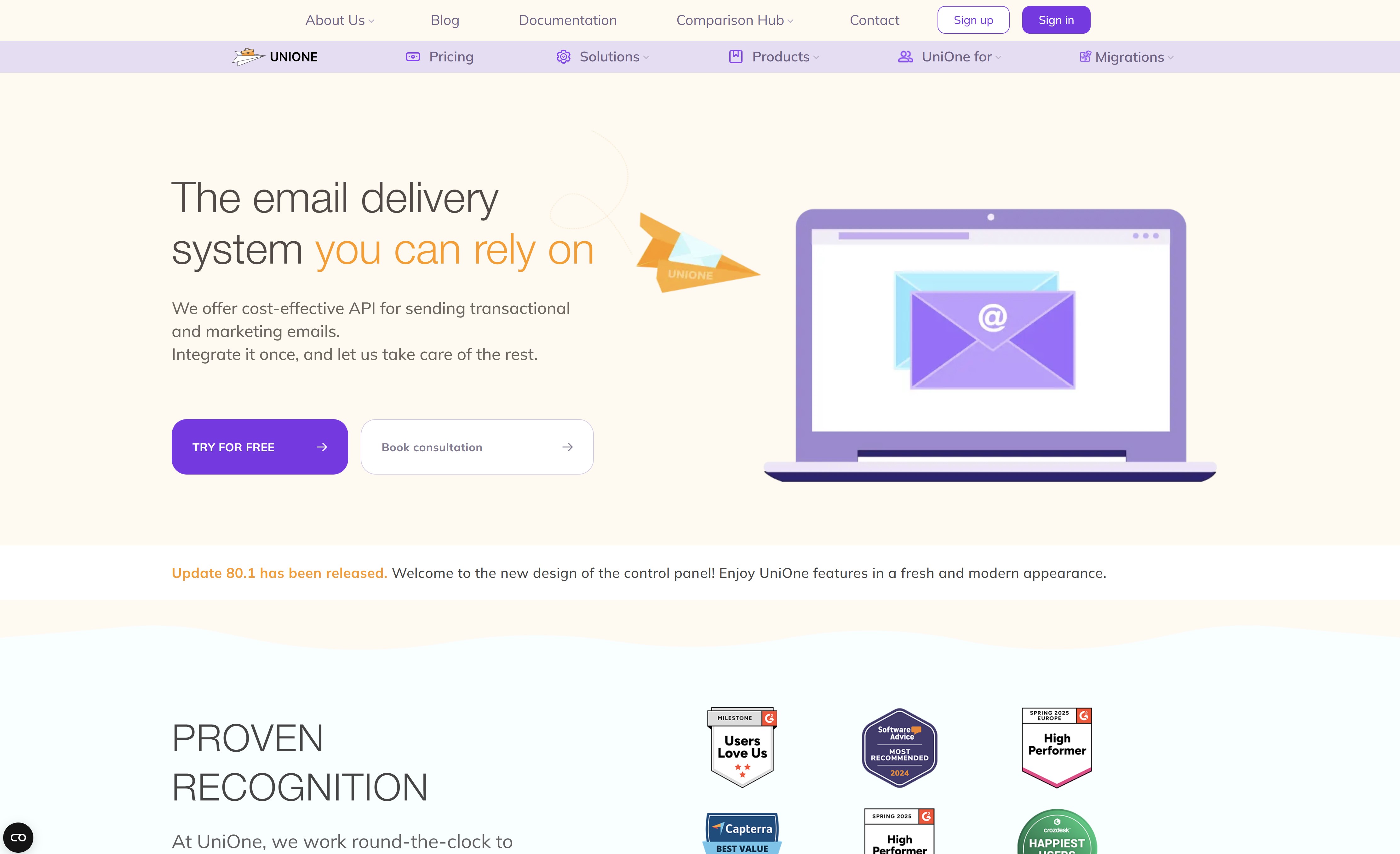
UniOne rarely tops mainstream "best of" lists, but engineers at high-growth email startups rave about its pure sending muscle.
If you're a startup that just needs emails to send fast and land in inboxes without drama, this is low cost email marketing done properly. Think of it as clean infrastructure rather than a bloated marketing suite.
At its core, UniOne is a powerful bulk email service for small business teams that don't want to overpay for features they won't use yet.
You plug it in via SMTP or API, hit send, and it just works.
Behind the scenes, it handles deliverability essentials like IP warm-up, DKIM, SPF, DMARC, and reputation monitoring, which saves founders from dealing with email headaches they shouldn't be touching at this stage.
Pricing is refreshingly startup-friendly.
There's a four-month free trial with up to 6,000 emails per month, and paid plans start at roughly $6 after that. Costs scale gradually as volume grows, so you're not punished for early traction.
For teams looking for practical mailing tools without surprise jumps in pricing, that matters a lot.
Notable perks:- 300+ mobile-ready templates to launch quickly without a designer
- Real-time analytics via dashboard or webhooks (opens, clicks, bounces)
- Tagging and dynamic content for basic personalization
- 24/7 human support from deliverability engineers, not bots
Limitations:
- UniOne doesn't try to be an all-in-one marketing platform. There's no visual automation builder, no subscriber list management, and no built-in CRM. You'll need your own database or CRM logic if you want complex workflows. For non-technical founders, that can feel limiting. For builders, it's often a plus.
Bottom line:
- If you're an early-stage startup that needs a reliable bulk email service for small business, wants to keep costs down, and prefers simple, powerful mailing tools over fancy dashboards, UniOne is a smart, no-nonsense choice. It's built for teams who'd rather ship product than wrestle with email software.
#2. ActiveCampaign – Automation Powerhouse for Growth Loops
#2. ActiveCampaign – Automation Powerhouse for Growth Loops
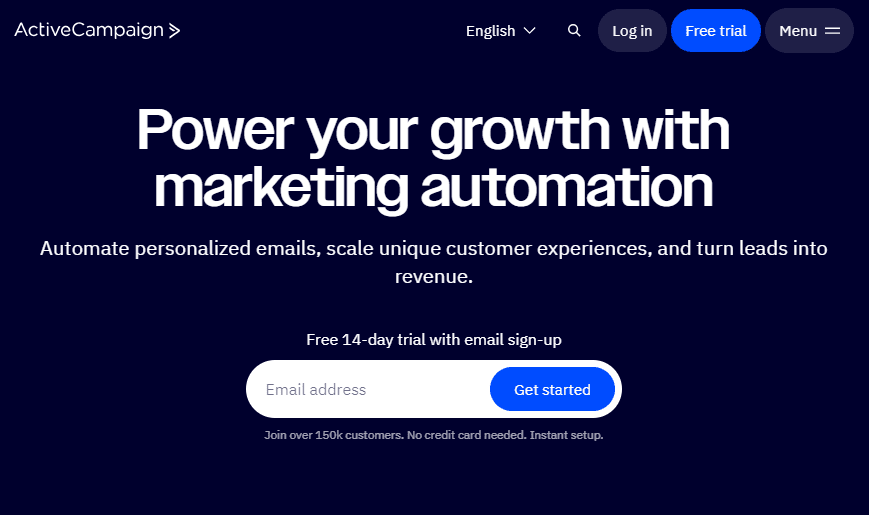
ActiveCampaign is what startups graduate to when basic newsletters and one-off campaigns stop cutting it.
It positions itself as a full customer experience platform, but let's be honest, the real reason teams choose it is automation.
The visual builder lets you drag triggers, conditions, and wait steps onto a canvas, making it one of the best email sequence software options for startups that want to scale without chaos.
This is where email stops being reactive and starts driving growth.
You can build onboarding journeys, re-engagement flows, upsell sequences, and lifecycle campaigns that respond to what users actually do.
For teams serious about best automated email marketing, ActiveCampaign gives you the control to turn email into a repeatable growth loop instead of a manual task.
Why startups love it:- Lead scoring that works seamlessly with a small business CRM with email marketing, helping sales focus on high-intent leads
- Conditional content blocks so one email can adapt across multiple segments without duplicating work
- Site and event tracking that triggers emails based on real user behavior, not guesswork
Pricing starts around $15 per month for 1,000 contacts, which feels reasonable until your list grows fast. Costs can climb with contact volume, and add-ons like SMS, advanced CRM features, and transactional email aren't included by default.
That said, for startups already investing in sales email automation, the ROI often justifies the spend.
Drawbacks:- ActiveCampaign isn't beginner-friendly. The interface can feel overwhelming, and if you don't set clear naming conventions and rules early, things get messy quickly. This isn't "plug and play" easy email marketing. It rewards teams that think through their flows before building them.
- Seed to Series B startups that want sophisticated nurturing, strong email analytics, and scalable automation without hiring a full marketing ops team. If email is central to your funnel and you're done with basic tools, ActiveCampaign is a serious step up.
#3. Best for Brand Building and Multichannel Reach
#3. Best for Brand Building and Multichannel Reach
Where Mailchimp shines is multichannel reach.
You're not just sending emails. You're running ads, tracking revenue, and managing contacts from one dashboard. For non-technical teams, that simplicity is a big win.
It's also why many people compare it with other programs like Mailchimp when they're looking for an all-in-one marketing hub.
Key strengths:- Customer Journey Builder for creating multi-step automations visually
- Hundreds of responsive templates, plus a built-in AI copy assistant
- Deep integrations with Shopify, Stripe, WooCommerce, and QuickBooks
- Advanced testing options on higher tiers to optimise subject lines, timing, and content
Mailchimp is also a solid choice if your team already uses design tools. Pairing it with Canva email marketing workflows makes it easy to produce on-brand campaigns fast, even without a designer.
Pricing starts at around $20 per month for 500 contacts on the Standard plan, with higher tiers unlocking advanced segmentation and testing. Costs can rise quickly as your list grows, and it's worth noting that Mailchimp counts unsubscribed and duplicate contacts toward your limit.
That pricing model catches a lot of startups out. For nonprofits, discounted plans exist, but Mailchimp pricing for nonprofits still needs careful monitoring to avoid unnecessary spend.
Downsides:- Power users often complain about UI lag and slower support compared to earlier years. It's also not the cheapest option if you're focused purely on automation or outreach. For teams prioritising advanced email analytics or complex sales workflows, Mailchimp can feel limiting.
Ideal user:
- Brand-focused startups that want email, ads, and basic CRM features in one place, without stitching together multiple tools. If you value polish, ease of use, and recognisable email marketing software, Mailchimp remains a dependable choice, just keep an eye on costs as you scale.
#4. Best for AI-Driven Funnels and Lean Marketing Teams
#4. Best for AI-Driven Funnels and Lean Marketing Teams
GetResponse doesn't always get the hype it deserves, but in 2024 it quietly became one of the most practical platforms for lean teams.
The big shift was its move into email marketing AI tools, especially the AI Email Generator. You tell it the goal, sales, webinar sign-ups, content promotion, and it generates subject lines and body copy that's surprisingly usable.
With light editing, it can easily cut writing time in half, which is gold when you don't have a dedicated marketer.
Standout capabilities:
- Funnel builder that ties landing pages, emails, and ads into a single flow
- Automation similar to ActiveCampaign, but easier to set up and manage
- Built-in webinars and on-demand videos, ideal for demos and education
- Optional SMS and web push add-ons to expand beyond email
From a pricing standpoint, it's strong value.
Plans start around $16 per month with a 30-day free trial, and many funnel features are included instead of hidden behind expensive upgrades.
As you move up tiers, you unlock deeper automation, e-commerce features, and smarter AI recommendations, without the sticker shock some platforms bring.
Trade-offs:- Design is functional but not as polished as Mailchimp, and email analytics aren't as granular as developer-first tools like UniOne. If you're obsessed with deliverability micro-metrics, you may want something more specialised. But for most startups, the reporting is more than enough to optimise campaigns.
- Founders and small teams who want no-code funnels, built-in email lead generation tools, and AI support to compensate for a small marketing headcount. If you like the idea of running email, funnels, and basic campaigns in one place without complexity, GetResponse hits a very practical sweet spot.
#5. Best for Simple, Reliable Email Without the Noise
#5. Best for Simple, Reliable Email Without the Noise
AWeber has been around since 1998, and that longevity shows in the places that matter most: deliverability, stability, and ease of use.
While newer tools chase AI features and flashy dashboards, AWeber sticks to the basics and does them well.
For bootstrapped startups that want dependable emailing software without a steep learning curve, that's a feature, not a flaw.
Why it still makes sense in 2025:- Unlimited email automations even on the Lite plan, starting around $12.50 per month
- Built-in landing and page builder with payment buttons, useful for pre-sales or beta access
- Device and inbox previews to catch layout issues before sending
- 750+ integrations, including WordPress, Zapier, and major CRMs
One of AWeber's biggest strengths is how forgiving it is for small teams.
You don't need an email marketing manager to get value out of it, and you don't need weeks of setup time.
You can be up and running quickly, sending campaigns, and building basic automations without overthinking your stack.
Pain points:- The trade-off for simplicity is depth. Email analytics are basic, covering opens, clicks, and bounces, but not much beyond that. If you want detailed cohort analysis or revenue attribution, you'll need to export data into external tools like Looker or similar platforms.
- Bootstrapped startups and small teams who want reliable sending, a gentle learning curve, and enough automation to nurture leads without over-engineering. If you value stability and simplicity over cutting-edge features, AWeber is still a solid, trustworthy choice.
Read this article: : Top 6 AI-Powered Project Management Tools To Use In 2023
Email + CRM: Why Startups Should Stop Separating the Two
If your email tool and CRM don't talk to each other, you're flying blind.
A lot of startups start out with one tool for emails and another for contacts, deals, or leads, and at first it feels fine.
But as soon as volume picks up, that split becomes a problem. You lose context, miss follow-ups, and end up sending generic messages to people who expect relevance.
That's why using a small business CRM with email marketing baked in isn't a "nice to have" anymore. It's table stakes.
- Why disconnected tools kill visibility - When email lives in one system and customer data lives in another, no one has the full picture. Marketing can't see what sales is doing. Sales doesn't know which emails a lead opened or ignored. Important signals get buried, and decisions turn into guesses. You might be sending the same message to a new lead, an active trial user, and a paying customer without even realising it. That's how good intentions turn into bad experiences.
- How CRM-driven email improves targeting - A CRM with automated emails fixes this by tying every message to real data. Emails can trigger based on actions like sign-ups, page views, demo bookings, or inactivity. Instead of blasting lists, you're sending relevant messages to the right people at the right time. Targeting improves because segmentation is dynamic, not manual. As your startup grows, this kind of automation doesn't just save time, it directly improves conversion rates and retention.
- Real-world startup workflow examples - Imagine this: a lead fills out a form, gets logged in the CRM, and automatically receives a personalised follow-up email. If they click a pricing link, they're tagged as high intent and routed to sales. If they go quiet, a short nurture sequence kicks in a few days later. No spreadsheets. No copying and pasting. No missed opportunities. This is what a well-set-up small business CRM with email marketing looks like in practice.
Bottom line, separating email and CRM might work when you're sending ten emails a week. It breaks the moment you try to scale.
Startups that combine the two move faster, waste less effort, and communicate like they actually know their customers.

Boost Warehouse Staff Productivity and How Tech Enables Faster, Smarter eCommerce Operations
Okay, so tech is making everything work better these days - and warehouses are getting in on that action. With all this new robot stuff, AI, and intelligent data tracking, companies are figuring out how to do more without working their employees to death. According to McKinsey, warehouses implementing these technologies see 30% higher productivity ...
https://agilityportal.io/blog/warehouse-staff-productivity-ecommerce-fulfillment-technology
Choosing the Right Platform: A Simple Startup Decision Framework
Picking the right emailing software doesn't have to feel overwhelming.
Most startups go wrong by choosing tools based on hype or long feature lists instead of how they actually work today.
The smartest approach is to step back and match the platform to your current reality, not your "future unicorn" plans. Here's a simple way to make that call without overthinking it.
- Team size - Start with who's actually going to use the tool. If it's just one founder or a tiny team, simplicity matters more than power. You want something that works out of the box, not a system that needs constant tweaking. As teams grow and responsibilities split between marketing and sales, more advanced platforms start to make sense. Many of the best email marketing companies offer multiple tiers for this exact reason, but early on, less is usually more.
- Growth stage - Your stage dictates your needs. Pre-revenue or early traction startups usually just need reliable sending, basic campaigns, and light automation. Once you're acquiring users consistently, onboarding flows, re-engagement emails, and segmentation become important. If you're scaling fast, automation and analytics stop being "nice extras" and turn into necessities. Choose emailing software that supports where you are now and won't block you in six months.
- Budget - Email marketing should pay for itself, but only if costs stay predictable. Free or low-cost tools are fine early on, but watch how pricing scales with contacts and sends. Some platforms look cheap at first and get expensive quickly as lists grow. Others charge more upfront but save money long term by reducing manual work. The goal isn't the cheapest option, it's the best value for how you operate.
- Sales vs marketing focus - Not all startups use email the same way. If email is mainly for newsletters, product updates, and content, a marketing-focused platform will do the job. If your growth relies on demos, follow-ups, and outbound, you'll need stronger sales automation and CRM integration. The best email marketing companies are usually very good at one of these, not both, so be clear about your primary use case.
- Automation needs - Finally, be honest about automation. Basic autoresponders are enough for many startups. Others need behavior-based workflows tied to user actions. Don't pay for advanced automation you won't use, but don't avoid it if email is central to your funnel. Good automation saves time, reduces errors, and keeps communication consistent as you scale.
Bottom line: the right platform fits your team, your stage, and your goals today.
Choose emailing software that helps you move faster now, and you'll avoid painful migrations later.
Design, Templates, and Branding That Don't Kill Conversions
When it comes to email design, startups often fall into the same trap: making emails look great but forgetting they still need to convert.
Clean beats clever every time. Here's how to think about design without sabotaging performance.
Why "pretty" emails often underperform
Common template mistakes startups make
How to balance design and deliverability
- Start with clean templates and layer branding lightly
- Use images to support the message, not replace it
- Stick to one clear goal and one primary CTA per email
- Test layouts across devices and inboxes before sending
- Tools like Canva email marketing are great for quick visuals, just don't overdo it
Bottom line: good email design should feel invisible. If the reader notices the design more than the message, conversions usually suffer.
What are The Signs of a Successful Email Marketing Campaign?
Revenue is the obvious signal, but judging success only by money misses the bigger picture.
If you want to build a repeatable email marketing strategy instead of chasing one-off wins, you need to look at how people actually behave when your emails land in their inbox.
These are the signals that tell you a campaign is truly working.
People consistently open your emails
Healthy open rates usually mean two things: your targeting is right and your subject lines earn attention.
You're not shouting into the void, you're reaching people who actually care about what you're sending.
That's a strong sign your audience is well defined and your messaging is relevant.
Readers take action, not just a quick glance
Clicks matter because they show intent.
When subscribers click through to a page, sign up for something, or read more, it means your message resonates and your content matches their expectations.
Strong engagement like this tells any email marketing manager they're on the right track.
Unsubscribes stay low over time
A low unsubscribe rate means you're delivering ongoing value.
People don't feel spammed, pressured, or misled. Instead, they see your emails as useful enough to keep around.
That's a sign you're building trust, not just chasing short-term attention.
Messages feel personal, not mass-produced
Successful campaigns speak to specific groups, not an entire list at once.
Emails that feel tailored to a reader's needs, stage, or interests consistently perform better.
Personalisation isn't about using a first name, it's about relevance and timing.
Emails look and work properly on mobile
Mobile optimisation is non-negotiable.
A huge portion of emails are first opened on phones, and if your layout breaks or your text is hard to read, performance drops fast.
Smart teams always test before sending, rather than finding out from frustrated subscribers later.
In short, a successful email campaign earns attention, drives action, and keeps people subscribed. When those signals are strong, revenue usually follows.
Choosing the Right Platform: A Simple Startup Decision Framework
Choosing the right emailing software isn't about picking the most popular tool or whatever tops a comparison chart.
It's about choosing something that fits how your startup actually operates today.
If you get this part right, you avoid wasted spend, messy migrations, and a lot of frustration later on.
- Team size - Start with a simple question: who's going to run this day to day? If it's just you or a very small team, you need software that's easy to use and hard to break. Complex platforms with deep configuration options sound powerful, but they slow small teams down. As your team grows, especially when sales and marketing split responsibilities, more advanced tools start to make sense.
- Growth stage - Your stage matters more than your ambition. Early-stage startups usually need reliable sending, basic campaigns, and simple automation. Once you're generating consistent leads, things like onboarding sequences, re-engagement flows, and segmentation become important. Scaling teams need tools that can grow with them, but paying for advanced features too early is a common mistake.
- Budget - Email marketing should be one of your highest-ROI channels, but only if costs stay predictable. Some of the best email marketing companies look affordable at first and then become expensive as your contact list grows. Others cost more upfront but save money by reducing manual work and tool sprawl. Focus on value, not just the monthly price.
- Sales vs marketing focus - How you use email should drive your choice. If email is mostly for newsletters, updates, and content, a marketing-focused platform will do the job. If email plays a big role in demos, follow-ups, and outbound outreach, you'll need stronger automation and CRM features. Many tools do one of these really well and the other only passably, so be clear about your primary use case.
- Automation needs - Finally, be honest about automation. Basic autoresponders are enough for many startups. Others rely on behaviour-based workflows tied to user actions. Don't pay for advanced automation you won't use, but don't avoid it if email is central to your funnel. Good automation saves time, keeps messaging consistent, and supports growth without adding headcount.
Bottom line: the right emailing software fits your team size, stage, budget, and goals right now.
The smartest startups choose platforms that help them move faster today, not tools they'll "grow into someday."
Common Startup Email Marketing Mistakes That Waste Money
Final Take: The Best Email Marketing Platform Is the One You'll Actually Use
The best SaaS email service platform for startups isn't the one with the longest feature list.
It's the one your team logs into, understands, and uses consistently.
If a tool feels heavy, confusing, or time-consuming, it won't matter how powerful it is. Simplicity almost always wins in the early stages because it removes friction and keeps momentum high.
That's what easy email marketing really means in practice.
It's also important to ignore the hype.
Shiny dashboards and buzzword-heavy features don't drive results on their own. Conversions do. The right platform helps you send the right message at the right time without getting in the way.
If a tool makes you spend more time configuring than communicating, it's slowing you down, not helping you grow.
In your first 90 days, focus on the basics that actually move the needle.
Prioritise getting emails out consistently, setting up one or two core automations, tracking simple performance metrics, and learning what your audience responds to.
You can always upgrade or add complexity later.
Start with a platform that fits how you work today, and you'll get far more value than chasing the "perfect" tool you never fully use.
Most Popular Posts

Effective communication among team members is vital for the productivity and success of any organization. Surprisingly, 60% of companies lack a long-term internal communication strategy, which p...


Businesses thrive on communication for efficiency, productivity and accomplishment. When the right information is passed from the right designation in the organization, it promotes positivity an...

Categories
Blog
(3186)
Business Management
(393)
Employee Engagement
(235)
Digital Transformation
(216)
Growth
(150)
Intranets
(141)
Internal communications
(106)
Remote Work
(68)
Sales
(53)
Collaboration
(52)
Customer Experience
(32)
Culture
(30)
Knowledge Management
(29)
Project management
(29)
Leadership
(20)
Comparisons
(9)
News
(1)

Related Posts

The best ai image editors can save a team hours of repetitive work. A marketing manager can remove a distracting background, an HR team can improve a staff event photo, and an online shop can turn a basic product shot into something ready to pu...

Ever opened a PDF just before a meeting and realised you need to edit a page, pull figures from a scanned report, or gather everyone's comments? What should be a quick task can turn into a frustrating search for the right tool. That lost time a...

Looking for a New Job Remotely can feel like a simple next step: update your CV, turn on job alerts and start applying. In reality, the strongest remote job searches start much earlier. You need to be clear about the work you want, the kind of ...

Hiring globally is easier than employing globally Have you found the right person for a role, only to realise they live in a country where your business has no legal entity? That's where EOR international hiring can be useful. An Employer of Re...

Sales operations and planning are essential to harmonizing sales objectives with operational capabilities, ensuring seamless coordination between departments like sales, marketing, production, and finance. This alignment enables businesses to forecas...


Jill Romford
I am a digital nomad, lover of exploring new places and making friends.
I love to travel and I love the internet. I take pictures of my travels and share them on the internet using Instagram.
Traveler, entrepreneur, and community builder. I share my insights on digital marketing and social media while inspiring you to live your fullest life.
Ready to learn more? 👍
One platform to optimize, manage and track all of your teams. Your new digital workplace is a click away. 🚀
Free for 14 days, no credit card required.