
Insight Blog
Agility’s perspectives on transforming the employee's experience throughout remote transformation using connected enterprise tools.
35 minutes reading time
(6933 words)
How Leading Law Firms Are Using AI to Reduce Administrative Work While Competitors Fall Behind

How Leading Law Firms Are Using AI to Reduce Administrative Work While Competitors Fall Behind
Discover how law firms and professional services teams are using AI to automate administrative tasks, improve communication, streamline workflows, and increase productivity.
How Leading Law Firms Are Using AI to Reduce Administrative Work While Competitors Fall Behind

Law firms are under increasing pressure to deliver exceptional client service while controlling operational costs and managing growing administrative demands.
Tasks such as document drafting, client intake, compliance tracking, legal research, scheduling, knowledge management, and internal communication can consume a significant portion of a legal professional's day, reducing the time available for billable work and strategic client activities.
This is one reason why AI for law firms has become one of the fastest-growing areas of legal technology investment.
According to industry research from Goldman Sachs, artificial intelligence could automate up to 44% of legal tasks, making the legal profession one of the sectors most likely to benefit from AI-driven productivity gains.
As a result, firms are increasingly investing in legal workflow automation, AI legal software, legal operations software, and AI-powered document management solutions to streamline routine processes and improve efficiency.
44%
of legal tasks
According to Goldman Sachs, artificial intelligence could automate up to 44% of legal tasks, making the legal profession one of the sectors most likely to benefit from AI-driven productivity gains.
Source: Goldman Sachs Research
The firms embracing these technologies are not simply looking to reduce costs.
They are using AI to improve response times, accelerate document creation, strengthen compliance processes, enhance knowledge sharing, and deliver a better client experience.
Meanwhile, firms that continue to rely heavily on manual processes risk falling behind competitors that can operate faster, scale more efficiently, and provide more responsive legal services.
In this article, we'll explore how leading law firms and professional services organizations are using artificial intelligence to reduce administrative work, increase productivity, and improve operational performance.
You'll discover real-world AI use cases, the measurable business benefits firms are seeing, common implementation challenges, and practical strategies for successfully adopting AI within a modern legal practice.
Whether you're evaluating AI in legal services, researching law firm productivity tools, or looking for ways to improve your firm's workflows, this guide will help you understand where AI delivers the greatest value and how to implement it effectively.
Key Takeaways
- Leading law firms are using AI to automate repetitive administrative tasks, allowing legal professionals to focus on higher-value client work.
- AI-powered tools are improving legal research, document drafting, knowledge management, compliance monitoring, and workflow automation.
- Firms adopting AI are seeing measurable benefits including increased productivity, reduced operational costs, faster service delivery, and improved client experiences.
- Successful AI implementation requires secure data management, employee adoption, strong governance, and integration with existing legal systems.
- Law firms that combine AI with knowledge management, document management, and digital workplace technology are better positioned to gain a competitive advantage.
Why Administrative Work Is Becoming a Competitive Disadvantage for Law Firms
The Growing Administrative Burden on Legal Professionals
Administrative responsibilities continue to consume a significant portion of a legal professional's workday.
From managing client communications and preparing documents to scheduling meetings and handling compliance requirements, many lawyers and support staff spend valuable hours on tasks that generate little or no direct revenue.
Common challenges include:
- Time spent on non-billable work
- Rising operational costs
- Staff burnout and turnover
- Increasing administrative complexity
- Growing client expectations
As firms take on more matters and regulations become increasingly complex, administrative workloads can quickly become a barrier to growth and profitability.
How Administrative Tasks Impact Client Service
How Administrative Tasks Impact Client Service
Every hour spent on manual administration is an hour that cannot be dedicated to serving clients. Excessive administrative work often creates bottlenecks that slow down legal processes and negatively affect the client experience.
Common consequences include:
- Delayed responses to client inquiries
- Slower case and matter processing
- Missed deadlines and follow-ups
- Reduced client satisfaction
- Lower overall service quality
In an increasingly competitive market, clients expect fast, accurate, and transparent service. Firms that struggle with inefficient processes may find it difficult to meet these expectations.
The Cost of Falling Behind Competitors
While some firms continue to rely on manual processes, others are investing in AI-powered tools and workflow automation to improve efficiency. This creates a growing competitive gap between firms that embrace technology and those that delay adoption.
Potential risks of falling behind include:
- Lost productivity
- Reduced profitability
- Difficulty attracting and retaining top legal talent
- Higher operational costs
- Slower business growth
As AI adoption accelerates across the legal industry, firms that fail to modernize their operations risk losing both clients and market share to more efficient competitors.
Industry research suggests that legal professionals can spend up to 40% of their time on administrative and non-billable activities. Reducing this burden represents one of the largest opportunities for law firms to improve productivity, profitability, and client service.
40%
of legal professionals' time
Industry research suggests that legal professionals can spend up to 40% of their time on administrative and non-billable activities. Reducing this burden represents one of the largest opportunities for law firms to improve productivity, profitability, and client service.
Source: Industry Legal Operations Research
What AI Means for Modern Law Firms

What AI Means for Modern Law Firms
Understanding AI in the Legal Industry
Artificial intelligence is rapidly transforming how legal professionals manage information, complete administrative tasks, and deliver services to clients.
While AI may sound complex, most legal applications are built around a few core technologies that help automate repetitive work and improve decision-making.
Key AI technologies used in law firms include:
- Machine Learning (ML) - Systems that learn from data and improve over time without being explicitly programmed.
- Natural Language Processing (NLP) - Technology that enables computers to understand, analyze, and process human language found in contracts, emails, case files, and legal documents.
- Generative AI - Advanced AI models capable of drafting content, summarizing documents, generating reports, answering questions, and assisting with legal research.
Together, these technologies are helping firms improve productivity, reduce administrative workloads, and enhance the accuracy of everyday legal operations.
Common Misconceptions About AI for Law Firms
Despite growing adoption, many misconceptions still prevent firms from fully embracing AI.
- AI Will Replace Lawyers - One of the biggest myths is that AI will replace legal professionals. In reality, AI is designed to automate repetitive administrative tasks, allowing lawyers to focus on complex legal analysis, client relationships, negotiations, and strategic decision-making.
- Security and Confidentiality Concerns - Many firms worry about client confidentiality and data security when implementing AI solutions. While these concerns are valid, enterprise-grade legal AI platforms typically offer encryption, access controls, audit logs, compliance safeguards, and secure hosting environments to protect sensitive information.
- Concerns About Accuracy - AI is not infallible and should not operate without human oversight. The most successful firms use AI as an assistant rather than a replacement for professional judgment, ensuring that outputs are reviewed and validated before being relied upon.
Why AI Adoption Is Accelerating Across Professional Services
Law firms are not alone in their AI journey.
Across professional services industries, organizations are adopting AI to improve operational efficiency, reduce costs, and increase productivity.
Several factors are driving this growth:
- Rising administrative workloads
- Increased client expectations
- Competitive pressure from technology-enabled firms
- The need to improve employee productivity
- Growing demand for faster service delivery
As AI capabilities continue to mature, firms that embrace legal workflow automation, AI-powered document management, and knowledge management solutions are positioning themselves to operate more efficiently and remain competitive in an increasingly digital legal landscape.
10 Ways Leading Law Firms Are Using AI to Reduce Administrative Work
Artificial intelligence is no longer a future technology for the legal industry. It is rapidly becoming a practical tool that helps law firms eliminate repetitive administrative work, improve efficiency, and allow legal professionals to focus on higher-value activities.
Rather than replacing lawyers, AI is helping firms work smarter by automating routine processes, improving access to information, and reducing operational bottlenecks.
Below are some of the most common ways leading law firms are using AI today and how these technologies are transforming legal operations.
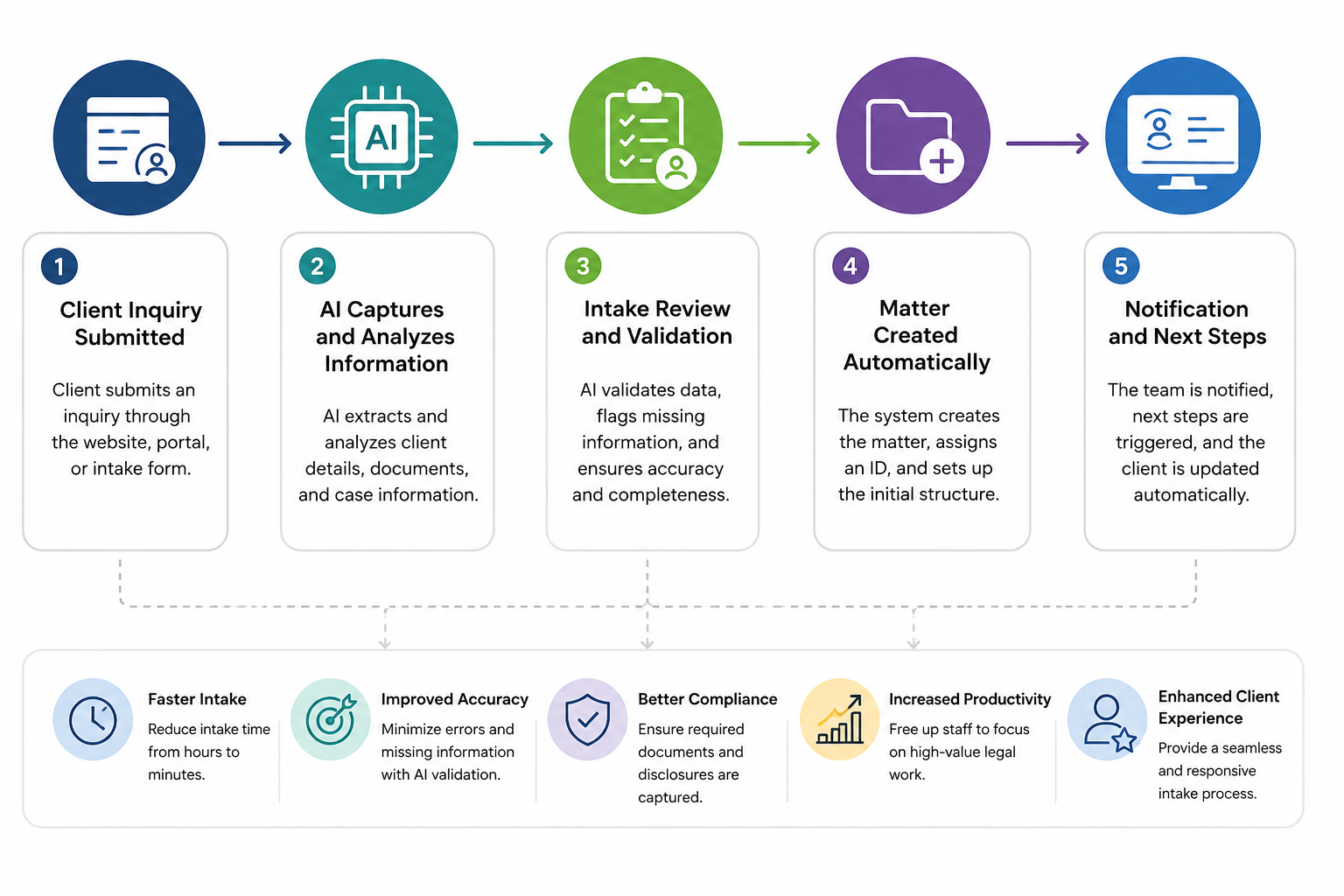
1. Automating Client Intake and Matter Creation
1. Automating Client Intake and Matter Creation
lient intake is often one of the most time-consuming administrative processes within a law firm. Traditionally, staff members manually collect client information, enter data into systems, create matters, and route requests to the appropriate teams.
AI-powered intake solutions can automatically capture information through online forms, validate data, identify the type of legal matter, and assign cases to the appropriate lawyer or department.
Benefits:
- Faster onboarding of new clients
- Reduced manual data entry
- Fewer administrative errors
- Improved client experience
How It Changes Law Firms:
Law firms can respond to potential clients more quickly, reduce delays in case creation, and create a smoother onboarding process that improves client satisfaction from the very first interaction.
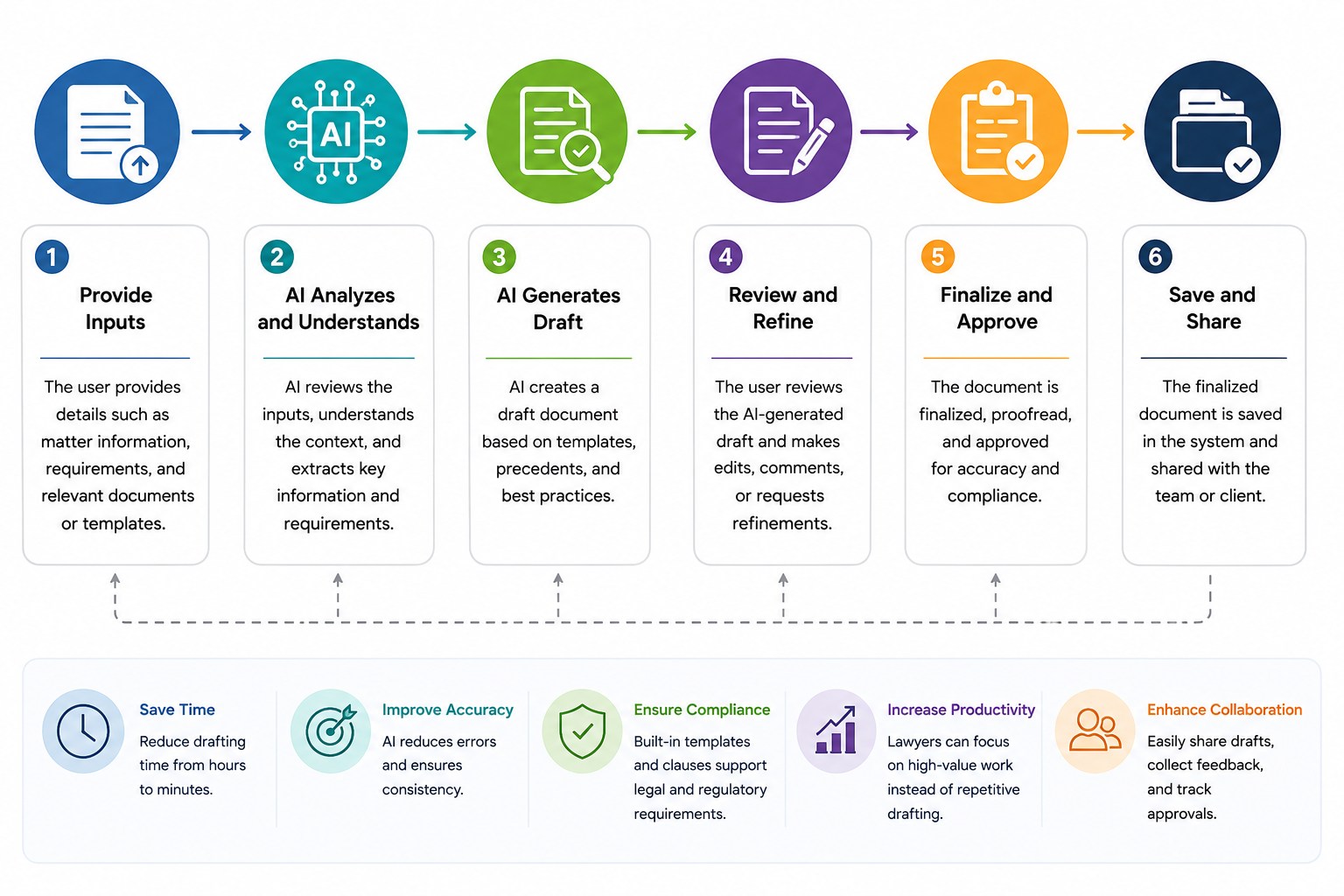
2. AI-Powered Document Drafting
2. AI-Powered Document Drafting
Document creation is a core activity in every legal practice. AI can generate contracts, engagement letters, legal agreements, and standard documents using approved templates and previous firm knowledge.
Instead of starting from scratch, legal professionals can use AI-generated drafts as a starting point and focus on reviewing and refining content.
Benefits:
- Faster document creation
- Greater consistency across legal documents
- Reduced drafting time
- Improved productivity
How It Changes Law Firms:
Lawyers spend less time preparing routine documents and more time providing strategic legal advice, increasing both productivity and billable capacity.
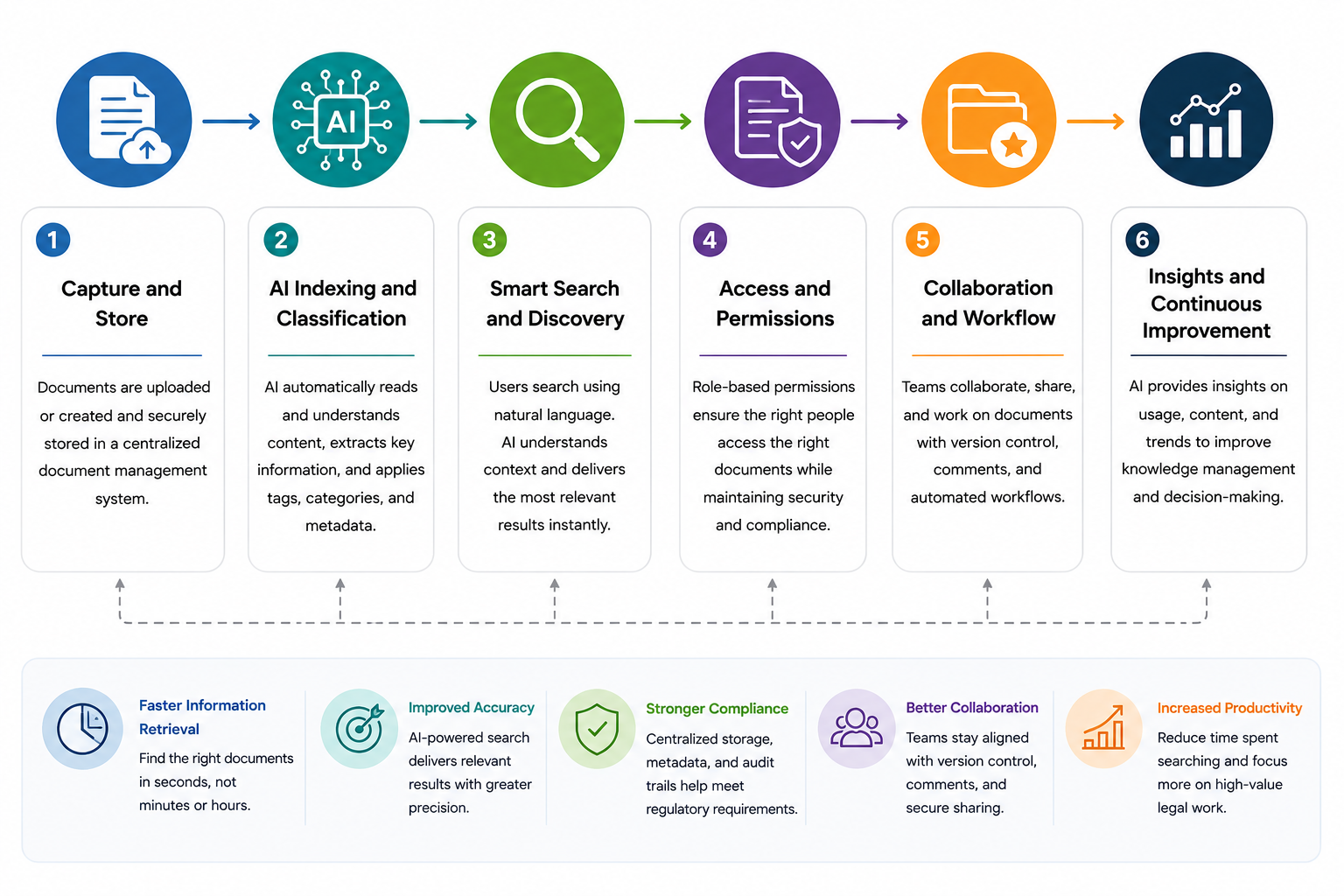
3. Smart Document Management and Search
3. Smart Document Management and Search
Most law firms manage thousands of documents, contracts, case files, legal records, and meeting notes. Finding the right information can often take longer than expected, especially when important details are buried across multiple systems.
AI-powered document management systems can analyze content, categorize documents, suggest related files, and provide intelligent search capabilities that retrieve information based on meaning rather than exact keywords.
Many firms are also adopting the best AI note taker for lawyers to automatically capture meeting discussions, organize notes, and make key information searchable alongside case documents and legal records.
Benefits:
- Faster information retrieval
- Better document organization
- Improved knowledge accessibility
- Reduced duplication of work
- Easier access to meeting notes and case discussions
How It Changes Law Firms:
Instead of spending hours searching through folders, emails, and handwritten notes, legal professionals can instantly access the information they need to support cases and client work. AI-powered search and note-taking tools help ensure valuable knowledge is captured, organized, and readily available when needed.
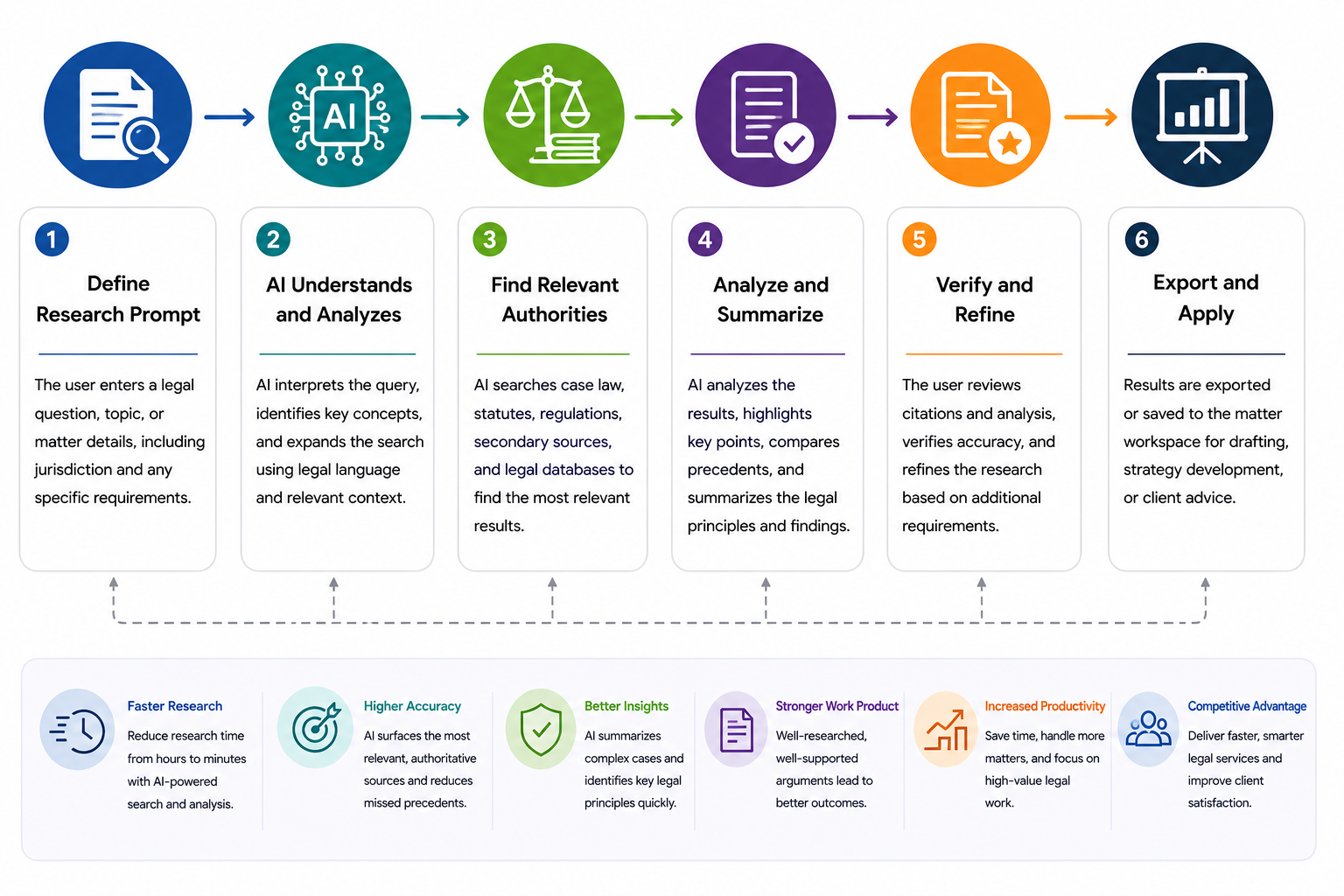
4. Legal Research Assistance
4. Legal Research Assistance
Legal research remains one of the most valuable yet time-intensive activities within a law firm. AI tools can review large volumes of legal content, summarize findings, identify relevant precedents, and highlight important case law.
While human review remains essential, AI significantly accelerates the research process.
Benefits:
- Faster legal research
- Improved access to case law
- Reduced research time
- Better knowledge discovery
How It Changes Law Firms:
Lawyers can spend more time analyzing legal issues and less time manually searching through databases and legal resources.
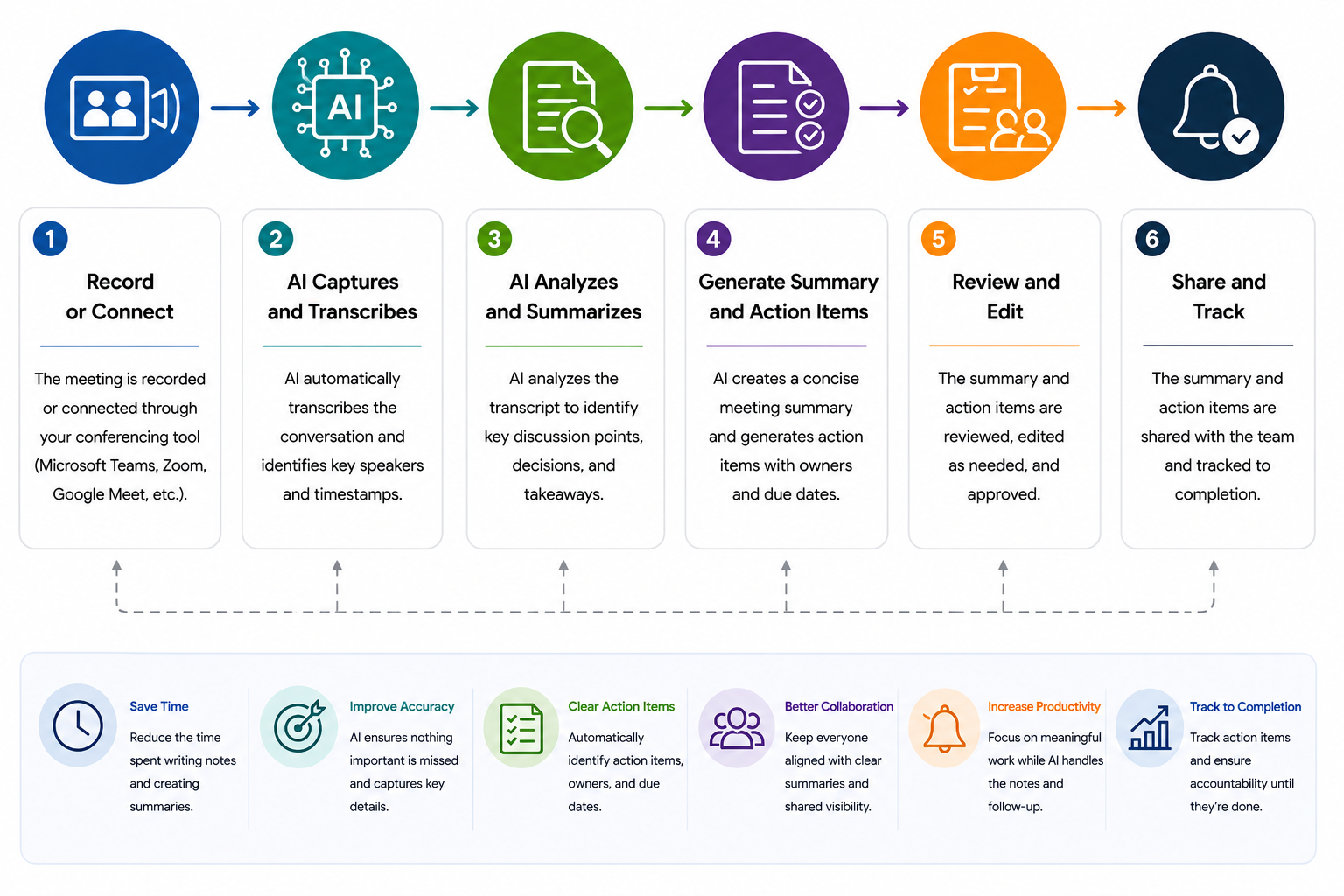
5. Meeting Summaries and Action Items
5. Meeting Summaries and Action Items
Law firms hold numerous internal meetings, client consultations, and case discussions. AI-powered meeting assistants can automatically transcribe conversations, generate summaries, identify action items, and distribute notes.
Benefits:
- Reduced note-taking burden
- Better meeting documentation
- Improved accountability
- Faster follow-up actions
How It Changes Law Firms:
Legal teams can focus on conversations rather than documentation while ensuring important decisions and action items are accurately captured.
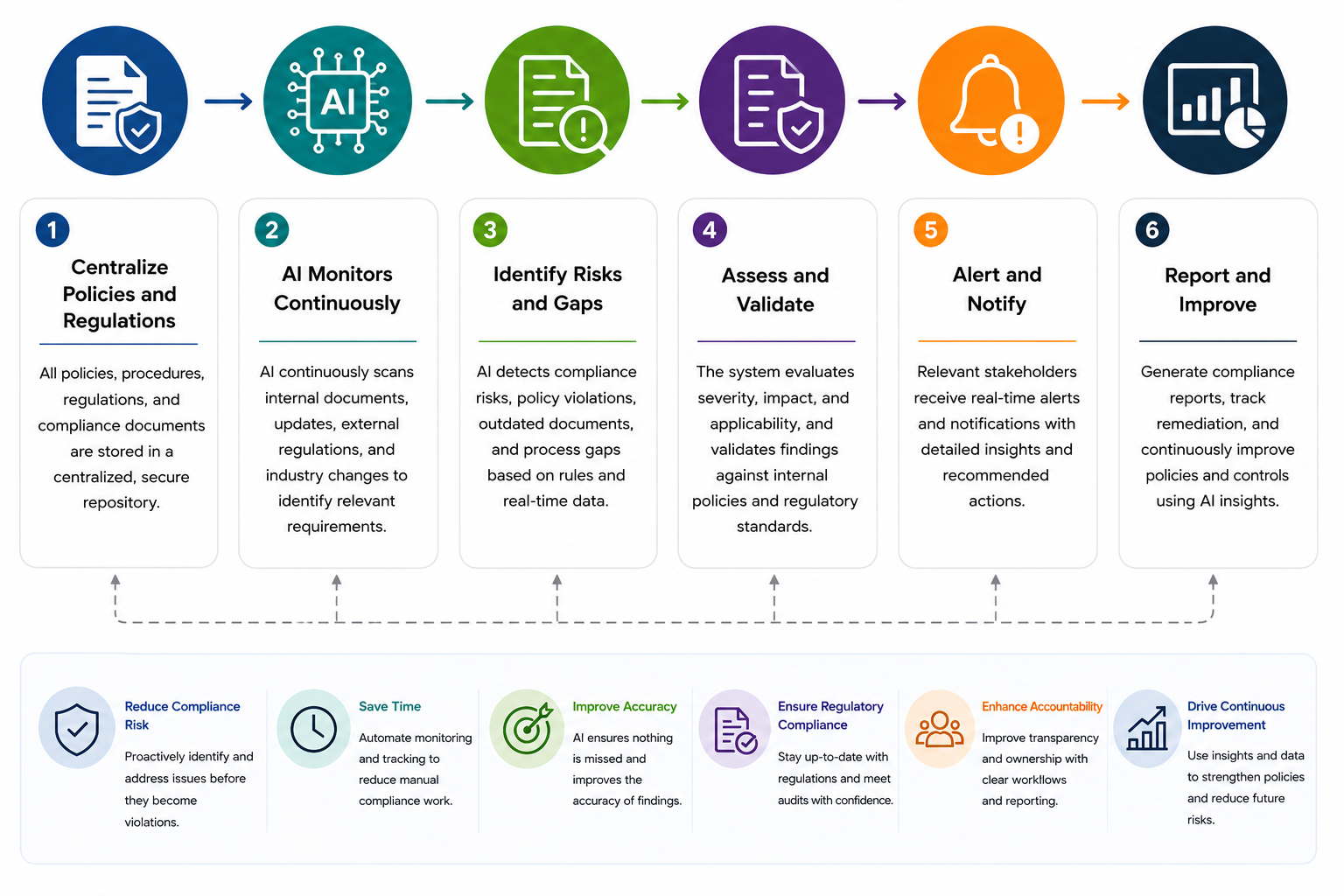
6. Compliance and Policy Monitoring
6. Compliance and Policy Monitoring
Law firms operate within highly regulated environments where compliance failures can result in significant risk. AI can monitor policy adherence, flag unusual activity, identify compliance risks, and track regulatory changes.
Benefits:
- Improved risk management
- Better compliance visibility
- Faster identification of issues
- Enhanced audit readiness
How It Changes Law Firms:
Compliance shifts from a reactive process to a proactive strategy that helps reduce risk before issues become serious problems.
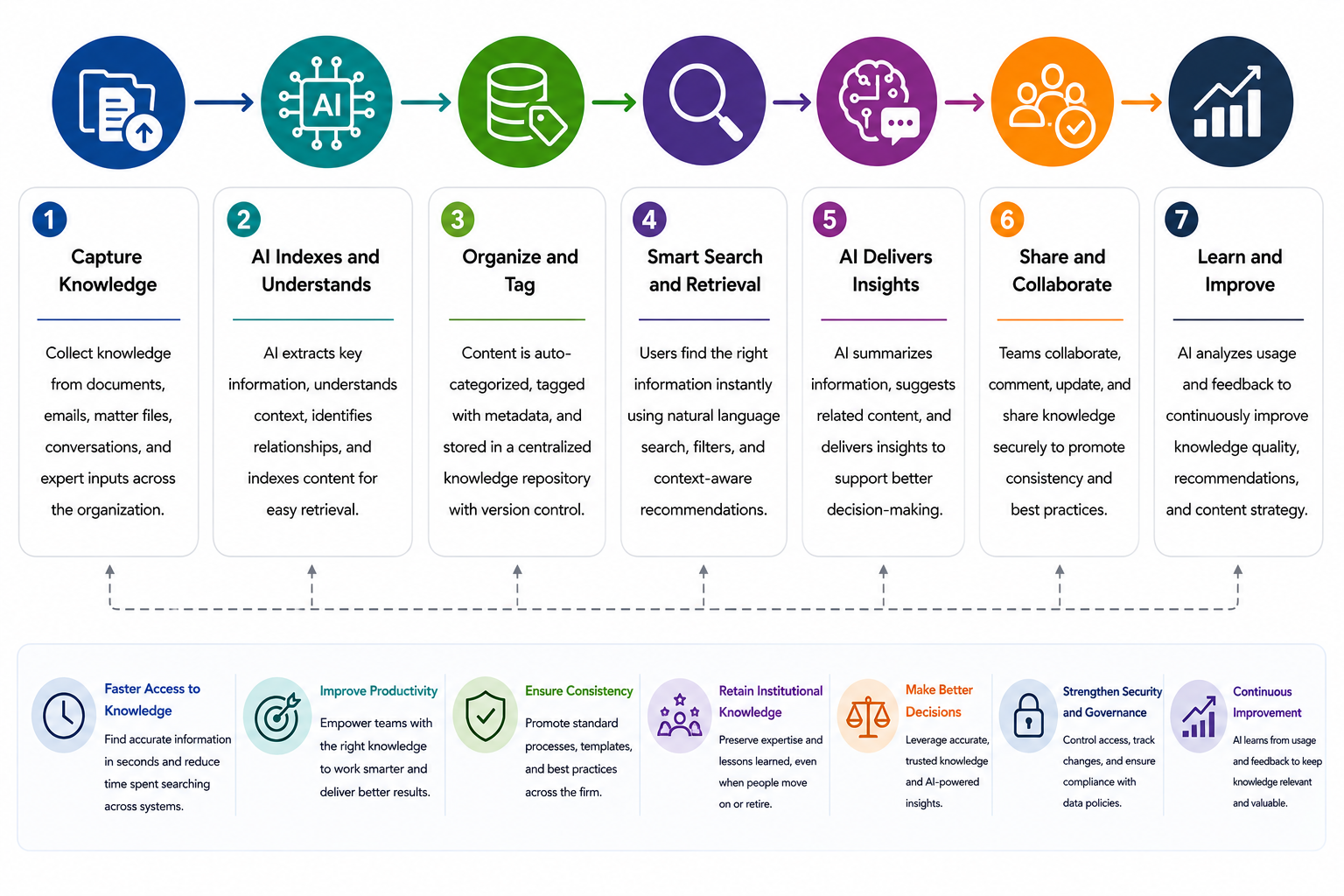
7. Internal Knowledge Management
7. Internal Knowledge Management
Many law firms possess decades of institutional knowledge spread across documents, emails, and employee expertise. AI can centralize and organize this information into searchable knowledge repositories.
This makes it easier for lawyers to find precedents, best practices, templates, and previous case information.
Benefits:
- Improved knowledge sharing
- Better collaboration
- Reduced knowledge loss
- Faster onboarding
How It Changes Law Firms:
Institutional knowledge becomes accessible across the entire organization rather than remaining locked away within individual teams or employees.
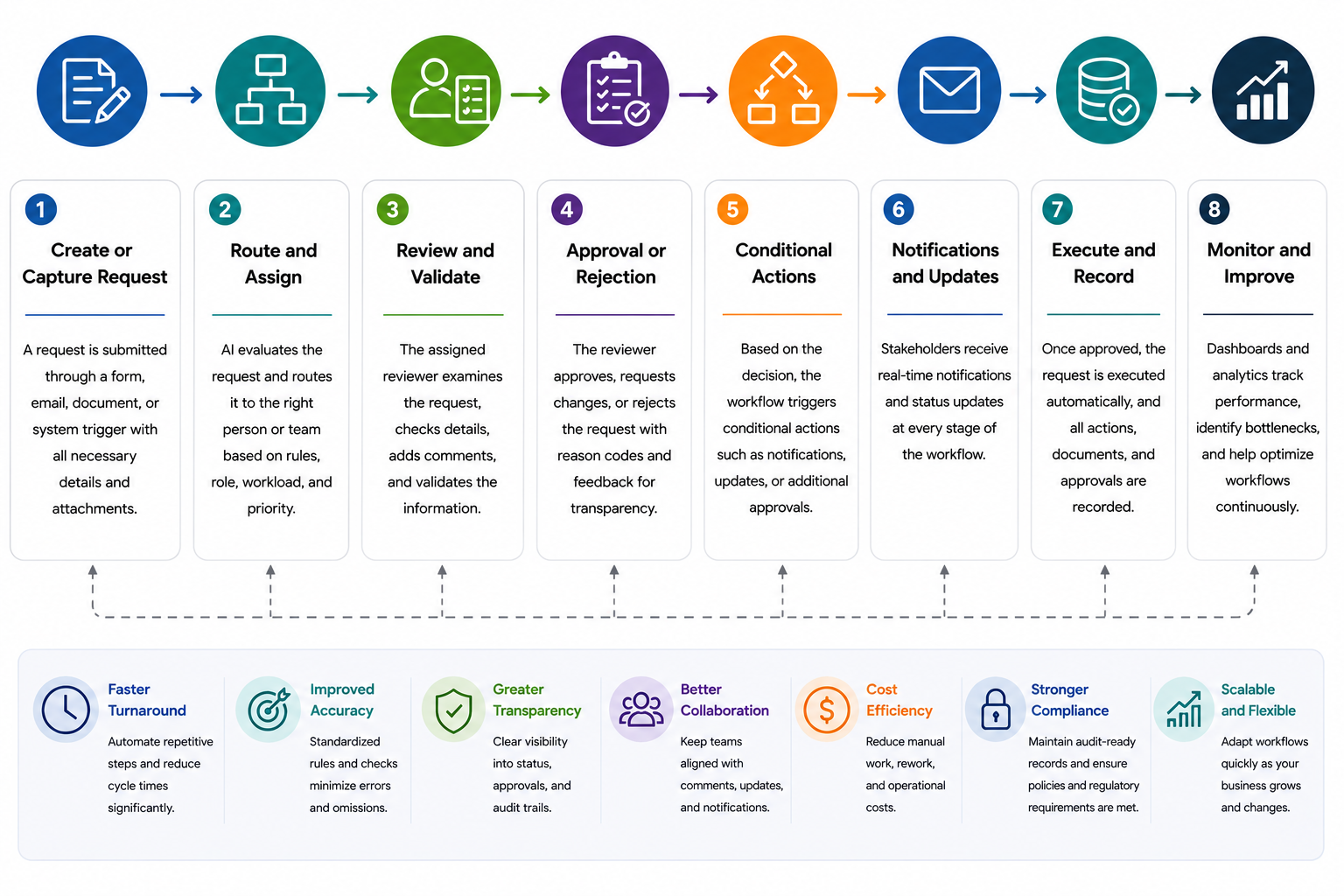
8. Workflow and Approval Automation
8. Workflow and Approval Automation
Legal work often involves multiple approval processes, including contract reviews, client approvals, compliance checks, and internal requests. AI-powered workflow automation can route tasks automatically and ensure the right people are involved at the right time.
Benefits:
- Faster approvals
- Reduced bottlenecks
- Improved process consistency
- Better visibility into workflows
How It Changes Law Firms:
Administrative processes become more predictable and efficient, reducing delays that impact both staff productivity and client service.
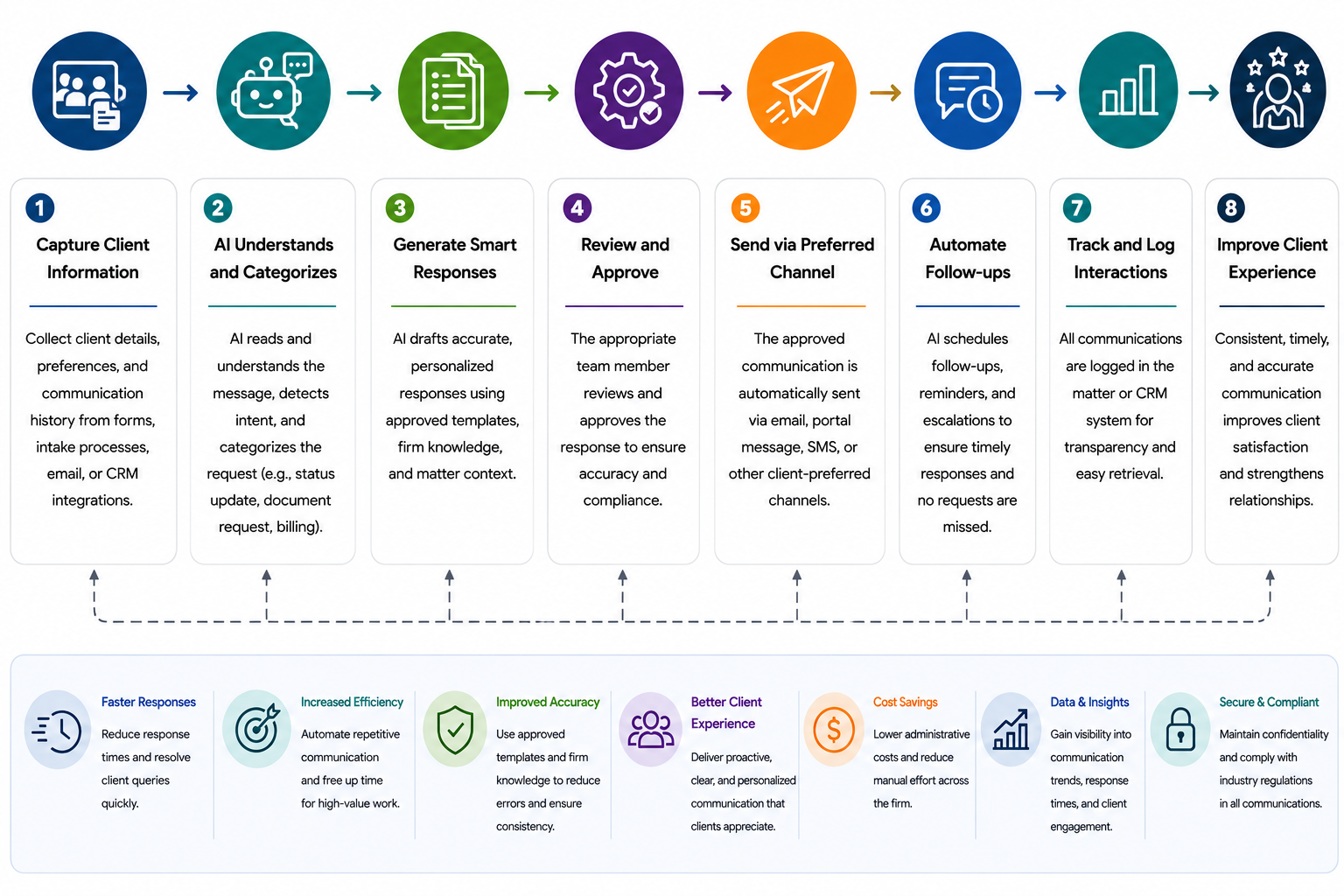
9. Client Communication Automation
9. Client Communication Automation
Clients increasingly expect quick responses and regular updates. AI can automate routine communications, provide status updates, answer common questions, and support client portals.
This improves transparency without creating additional workload for legal teams.
Benefits:
- Improved client engagement
- Faster response times
- Better communication consistency
- Reduced administrative workload
How It Changes Law Firms:
Legal professionals spend less time answering repetitive questions while clients receive more timely and transparent communication.
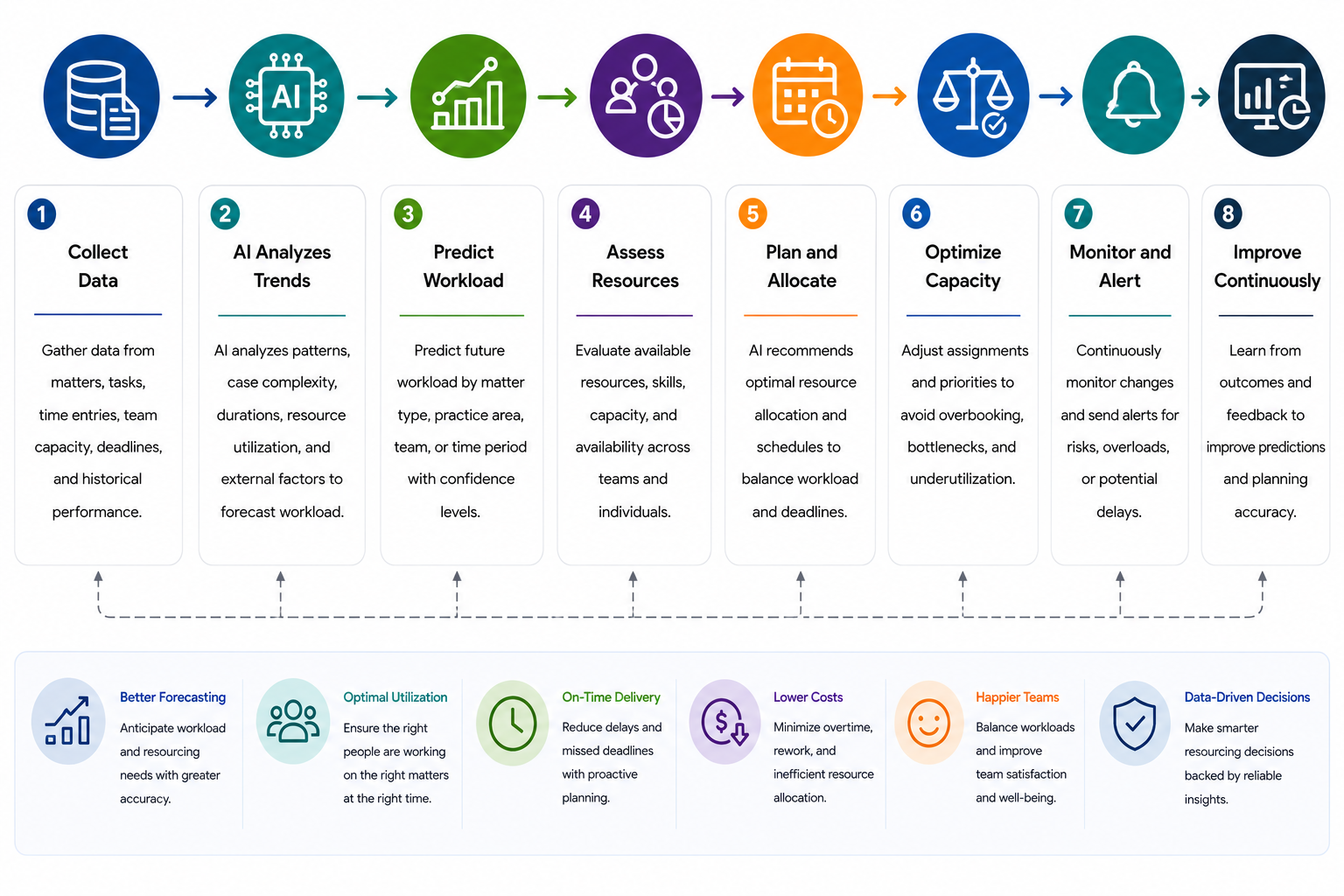
10. Predictive Workload and Resource Planning
10. Predictive Workload and Resource Planning
AI can analyze historical data, current workloads, staffing levels, and upcoming matters to predict resource requirements and identify potential bottlenecks before they occur.
Benefits:
- Improved staffing decisions
- Better workload balancing
- Enhanced forecasting
- Increased operational efficiency
How It Changes Law Firms:
Firms can make more informed decisions about hiring, resource allocation, and workload management, helping them operate more strategically and profitably.
The most significant impact of AI is not simply automation.
It is the shift from manual, reactive processes to intelligent, data-driven operations. Leading law firms are using AI to reduce administrative work, improve collaboration, accelerate decision-making, strengthen knowledge management, and create more productive legal teams.
As AI continues to evolve, firms that adopt these technologies today will be better positioned to deliver exceptional client service, improve profitability, and maintain a competitive advantage in an increasingly digital legal landscape.
The Business Benefits Law Firms Are Seeing From AI

Increased Billable Hours
One of the most immediate benefits of AI adoption is the ability to increase billable hours without increasing workload. By automating repetitive administrative tasks such as document preparation, scheduling, data entry, and matter management, legal professionals can spend less time on non-billable activities and more time serving clients. This allows firms to maximize revenue opportunities while improving overall efficiency.
Key Benefits:
- Less time spent on administration
- More time serving clients
- Increased billable work capacity
- Improved resource utilization
AI helps legal teams work smarter by reducing repetitive tasks and simplifying day-to-day workflows. Instead of manually searching for information, drafting standard documents, or managing routine requests, employees can leverage AI-powered tools to complete tasks faster and with greater accuracy. This enables legal professionals to focus on strategic and high-value work.
Key Benefits:
- Reduced repetitive work
- Faster decision-making
- Improved workflow efficiency
- Better use of employee expertise
Better Client Experiences
Clients increasingly expect fast responses, transparent communication, and efficient service delivery. AI helps law firms meet these expectations by streamlining communication, automating status updates, accelerating document processing, and improving access to information. As a result, clients receive quicker responses and a more seamless experience throughout their engagement with the firm.
Key Benefits:
- Faster response times
- Greater transparency
- Improved client satisfaction
- Enhanced service delivery
Administrative overhead can significantly impact a firm's profitability. AI reduces operational costs by automating manual processes, minimizing errors, and improving process consistency. Firms can achieve greater efficiency without necessarily increasing headcount, making AI a valuable tool for sustainable growth.
Key Benefits:
- Improved process efficiency
- Lower administrative overhead
- Reduced manual errors
- Better scalability as the firm grows
AI Use Cases for Different Types of Legal Practices
Artificial intelligence is not limited to a single area of law.
Different legal practices are adopting AI in ways that align with their specific workflows, client needs, and operational challenges.
Whether the goal is improving legal research, automating document management, streamlining compliance, or enhancing client communication, AI is helping firms across every practice area become more efficient and competitive.

AI Use Cases for Different Types of Legal Practices
Corporate Law Firms
Corporate law firms manage large volumes of contracts, regulatory documentation, due diligence reviews, and compliance requirements. AI helps automate many of these time-consuming processes while reducing the risk of human error.
Common AI use cases include:
- Contract drafting and review
- Due diligence automation
- Regulatory compliance monitoring
- Corporate document management
- Legal research and knowledge retrieval
Key benefits:
- Faster contract turnaround times
- Improved compliance oversight
- Reduced administrative workload
- Greater operational efficiency
Litigation Practices
Litigation teams often work with extensive case files, court documents, evidence records, and legal research materials. AI helps organize, analyze, and summarize large volumes of information quickly.
Common AI use cases include:
- Case law research
- Evidence analysis
- Document review and discovery
- Deposition summaries
- Litigation workflow automation
Key benefits:
- Faster case preparation
- Improved research efficiency
- Better document organization
- Reduced review time
Employment Law Firms
Employment law practices frequently handle policy reviews, workplace investigations, compliance issues, and employee-related disputes. AI can help streamline documentation and improve compliance monitoring.
Common AI use cases include:
- Policy and handbook analysis
- Employment contract reviews
- Workplace compliance monitoring
- Investigation documentation
- Employee dispute case management
Key benefits:
- Improved regulatory compliance
- Faster policy reviews
- Better documentation management
- Reduced administrative burden
Real Estate Law Firms
Real estate lawyers manage contracts, leases, property records, and due diligence documentation. AI can automate many repetitive tasks involved in property transactions and document review.
Common AI use cases include:
- Lease agreement analysis
- Property document review
- Transaction management
- Due diligence checks
- Contract automation
Key benefits:
- Faster property transactions
- Reduced document review time
- Improved accuracy
- Enhanced client service
Family Law Practices
Family law firms often handle significant volumes of client communication, legal documentation, financial records, and case management activities.
AI helps improve efficiency while allowing lawyers to spend more time supporting clients.
Common AI use cases include:
- Client intake automation
- Document preparation
- Meeting summaries and note-taking
- Scheduling and appointment management
- Case file organization
Key benefits:
- Faster client onboarding
- Better case organization
- Improved client communication
- Reduced administrative workload
In-House Legal Teams
Corporate legal departments are increasingly expected to do more with limited resources. AI helps in-house teams manage contracts, compliance requirements, legal requests, and knowledge management more efficiently.
Common AI use cases include:
- Contract lifecycle management
- Legal request automation
- Compliance tracking
- Internal knowledge management
- Legal operations reporting
Key benefits:
- Increased productivity
- Faster response to business requests
- Better compliance management
- Reduced legal operational costs
While the specific use cases may differ, the goal remains the same across all legal practice areas: reducing administrative work, improving productivity, strengthening knowledge management, and enabling legal professionals to focus on higher-value work.
As AI continues to evolve, firms that successfully integrate AI-powered legal technology into their workflows will be better positioned to improve client service, increase profitability, and maintain a competitive advantage.
Common Challenges When Implementing AI in Law Firms
While the benefits of AI for law firms are substantial, successful implementation requires careful planning and governance.
Many firms rush into adopting AI legal software, legal workflow automation, or AI-powered document management tools without fully understanding the challenges involved.
Addressing these issues early can significantly improve adoption rates, reduce risk, and maximize return on investment.
Data Privacy and Security
Law firms handle highly sensitive information, including client records, contracts, litigation documents, financial data, and confidential communications.
This makes data privacy and security one of the most important considerations when implementing AI.
Before adopting any AI solution, firms should evaluate how data is stored, processed, and protected.
Common concerns include:
- Unauthorized access to client information
- Data breaches and cyber threats
- Third-party AI providers storing sensitive data
- Cross-border data transfer risks
- Compliance with data protection regulations
Best practices include:
- Using enterprise-grade AI platforms
- Implementing encryption and access controls
- Maintaining detailed audit logs
- Conducting regular security assessments
- Establishing clear data governance policies
Ethical Considerations
AI can improve efficiency, but legal professionals must ensure that technology is used responsibly and ethically. AI-generated outputs should never replace professional legal judgment.
Lawyers remain responsible for validating information, reviewing recommendations, and ensuring client interests are protected.
Common ethical concerns include:
- AI-generated inaccuracies or hallucinations
- Bias within AI models
- Transparency in AI-assisted decision-making
- Professional accountability
- Maintaining client trust
Best practices include:
- Human review of AI-generated content
- Clear policies governing AI usage
- Ongoing employee training
- Regular audits of AI outputs
Employee Adoption
One of the biggest barriers to AI success is not technology—it's people. Employees may resist change if they fear job displacement or feel uncomfortable learning new systems.
Successful firms focus on positioning AI as a tool that supports legal professionals rather than replacing them.
Common adoption challenges include:
- Resistance to change
- Lack of training
- Fear of job displacement
- Low confidence in AI recommendations
- Poor user experience
Best practices include:
- Providing comprehensive training
- Demonstrating practical use cases
- Encouraging gradual adoption
- Highlighting productivity benefits
- Gathering employee feedback
Integration With Existing Systems
Many law firms already rely on multiple technology platforms, including document management systems, practice management software, CRM platforms, billing systems, and knowledge repositories.
Introducing AI without considering existing infrastructure can create additional complexity rather than improving efficiency.
Common integration challenges include:
- Data silos across systems
- Compatibility issues
- Duplicate information
- Inconsistent workflows
- Limited API connectivity
Best practices include:
- Evaluating integration capabilities before purchase
- Prioritizing platforms with open APIs
- Creating a phased implementation strategy
- Establishing a centralized information architecture
Governance and Compliance
AI adoption must align with legal, regulatory, and organizational requirements. Without proper governance, firms may expose themselves to compliance risks and operational issues.
Strong governance frameworks help ensure AI is used consistently, securely, and responsibly across the organization.
Common governance concerns include:
- Regulatory compliance requirements
- Auditability of AI-generated outputs
- Internal policy enforcement
- Data retention requirements
- Risk management oversight
Best practices include:
- Establishing AI governance committees
- Creating formal AI usage policies
- Defining approval workflows
- Monitoring AI performance regularly
- Conducting compliance reviews
The most successful law firms recognize that implementing AI is not simply a technology project—it is an operational transformation initiative.
Firms that address security, ethics, employee adoption, integration, and governance from the outset are more likely to realize the full benefits of AI while minimizing risk.
By taking a strategic approach, legal organizations can confidently adopt AI technologies that improve productivity, strengthen compliance, and deliver better client outcomes.
How to Choose the Right AI Solution for Your Law Firm
With hundreds of AI tools entering the legal market, choosing the right solution can feel overwhelming.
Not every platform is designed for legal workflows, and selecting the wrong technology can lead to poor adoption, security concerns, and limited return on investment.
The best AI for law firms should do more than automate tasks. It should improve productivity, strengthen knowledge management, support legal workflow automation, enhance client service, and integrate seamlessly with your firm's existing systems.
When evaluating AI legal software, consider the following criteria:
| Evaluation Criteria | Why It Matters |
| Security & Compliance | Protects sensitive client data and supports regulatory requirements |
| Knowledge Management | Improves access to firm knowledge, precedents, and legal resources |
| Workflow Automation | Reduces repetitive administrative tasks and improves efficiency |
| Integration Capabilities | Connects with existing legal, document management, and CRM systems |
| User Adoption | Ensures employees actually use the technology |
| Reporting & Analytics | Measures productivity improvements and ROI |
Security & Compliance
Security should be your first consideration when evaluating any legal AI platform. Law firms manage highly confidential client information, making data protection critical.
Look for solutions that offer:
- Data encryption
- Role-based permissions
- Audit trails
- Compliance certifications
- Secure data storage options
A strong security framework helps protect sensitive information while ensuring compliance with industry regulations and client expectations.
Knowledge Management
Many AI initiatives succeed or fail based on the quality of information available to the system. AI performs best when it can access organized, accurate, and searchable knowledge.
Look for platforms that support:
- Centralized document repositories
- Legal precedent libraries
- Intelligent search capabilities
- Document categorization
- Knowledge sharing across teams
Strong AI-powered knowledge management helps legal professionals find information faster and reduces duplication of work.
Workflow Automation
One of the primary reasons firms invest in AI is to eliminate repetitive administrative work. The right solution should automate routine processes without adding complexity.
Look for automation capabilities such as:
- Client intake workflows
- Document approvals
- Matter creation
- Task assignments
- Compliance tracking
Effective legal workflow automation can significantly reduce administrative burden while improving consistency and efficiency.
Integration Capabilities
AI should enhance your existing technology stack rather than operate in isolation. Poor integration often creates information silos and limits adoption.
Look for platforms that integrate with:
- Document management systems
- Practice management software
- CRM platforms
- Microsoft 365
- Google Workspace
- Internal knowledge bases
The more connected your systems are, the more value AI can deliver across the organization.
User Adoption
Even the most advanced AI platform will fail if employees do not use it. Ease of use should be a major consideration during evaluation.
Look for:
- Simple user interfaces
- Minimal training requirements
- Clear workflows
- Mobile accessibility
- Strong vendor onboarding support
The best solutions feel like a natural extension of existing processes rather than another system employees must learn.
Reporting & Analytics
To justify investment, firms need visibility into performance and outcomes. AI solutions should provide reporting that demonstrates measurable value.
Look for analytics that track:
- Productivity improvements
- Time savings
- Adoption rates
- Workflow efficiency
- Knowledge usage
- Return on investment (ROI)
These insights help leadership understand where AI is delivering value and identify opportunities for further optimization.
The right AI solution should align with your firm's strategic goals, operational needs, and client expectations. Rather than focusing solely on features, evaluate how well a platform improves security, knowledge management, workflow automation, collaboration, and overall productivity.
Law firms that choose technology strategically are more likely to achieve long-term success and gain a competitive advantage as AI adoption continues to grow across the legal industry.
Why Digital Workplace Platforms Are Becoming Essential for AI Success
Many law firms assume that implementing AI is simply a matter of purchasing the right software. However, AI is only as effective as the information, processes, and workflows that support it.
Without organized data, centralized knowledge, and strong collaboration practices, even the most advanced AI tools will struggle to deliver meaningful results.
This is why many legal organizations are investing in digital workplace platforms alongside their AI initiatives.
By combining AI for law firms, knowledge management, document management, workflow automation, and internal communication, firms can create an environment where AI delivers measurable business value.
AI Needs Organized Information
Artificial intelligence relies on information to generate insights, answer questions, automate tasks, and support decision-making.
If documents are scattered across email inboxes, shared drives, desktops, and disconnected systems, AI has limited visibility into the information employees need.
A well-structured digital workplace helps organize and centralize information so AI can access accurate and relevant data.
Key benefits include:
- Better AI-generated responses
- Faster information retrieval
- Reduced duplicate content
- Improved document accessibility
- More accurate legal research and knowledge discovery
Without organized information, AI often produces incomplete or unreliable results, reducing trust and adoption across the firm.
Centralized Knowledge Improves AI Accuracy
One of the biggest challenges facing law firms is knowledge fragmentation. Valuable expertise often exists across case files, legal precedents, employee experience, policies, contracts, and internal documentation.
When this knowledge is centralized within a secure knowledge management system, AI can leverage that information to provide more relevant and accurate outputs.
Key benefits include:
- Improved AI accuracy
- Better access to legal precedents
- Faster onboarding of new employees
- Reduced knowledge loss
- Stronger organizational learning
Firms with centralized knowledge repositories often gain significantly more value from their AI investments because the technology has access to trusted information sources.
Communication and Collaboration Drive Adoption
Technology alone does not guarantee success. One of the most overlooked aspects of AI implementation is employee adoption.
When teams communicate effectively and collaborate through a shared digital workplace, employees are more likely to understand how AI supports their daily work and where it provides value.
Key benefits include:
- Faster technology adoption
- Improved employee engagement
- Better cross-department collaboration
- Increased transparency
- More consistent workflows
Legal teams that combine AI with strong communication and collaboration practices are often able to accelerate adoption while minimizing resistance to change.
Creating a Single Source of Truth for Legal Teams
Many law firms struggle with information silos. Documents may exist in multiple locations, policies may be outdated, and employees may rely on different versions of the same information.
A digital workplace creates a single source of truth where legal professionals can access the latest documents, policies, procedures, knowledge resources, and client information.
Key benefits include:
- Improved consistency
- Reduced errors
- Faster decision-making
- Better compliance management
- Greater confidence in AI-generated outputs
When everyone works from the same information, AI can operate more effectively while reducing the risk of inaccurate recommendations.
How Leading Law Firms Are Combining AI and Digital Workplace Technology
The most successful legal organizations are not treating AI as a standalone solution.
Instead, they are combining multiple technologies to create a connected digital ecosystem that improves productivity and operational efficiency.
Many firms are integrating:
- AI-powered legal assistants
- Knowledge management systems
- Internal communication platforms
- Document management software
- Employee onboarding solutions
- Workflow automation tools
- Collaboration and case management systems
Together, these technologies help legal professionals find information faster, automate repetitive work, improve communication, and deliver better client experiences.
AI can significantly reduce administrative work and improve productivity, but its success depends on the quality of the environment in which it operates.
Law firms that invest in organized information, centralized knowledge, strong communication, and digital workplace technology are better positioned to unlock the full potential of AI.
By creating a connected workplace that combines AI, knowledge management, document management, and workflow automation, firms can build a stronger foundation for long-term growth, efficiency, and competitive advantage.
Future Trends: How AI Will Continue Transforming Law Firms
The legal industry is only beginning to realize the full potential of artificial intelligence.
While today's law firms are using AI for document drafting, legal research, workflow automation, and administrative support, the next generation of legal technology will go much further.
Over the next several years, advances in legal technology, law firm automation, AI legal assistants, legal analytics, and intelligent case management will fundamentally change how legal services are delivered.
Firms that embrace these innovations early will be better positioned to improve efficiency, reduce costs, enhance client experiences, and gain a competitive advantage.
AI-Powered Legal Knowledge Hubs
One of the biggest opportunities for future AI adoption lies in transforming how legal knowledge is stored, accessed, and shared.
Instead of manually searching through documents, case files, emails, and legal databases, lawyers will increasingly rely on AI-powered legal knowledge hubs that provide instant access to relevant information.
Future capabilities may include:
- Instant retrieval of legal precedents
- Automated case summaries
- Context-aware legal recommendations
- Intelligent document discovery
- Real-time knowledge sharing across teams
Potential benefits:
- Faster legal research
- Improved knowledge retention
- Better collaboration
- Reduced duplication of work
- Increased lawyer productivity
Data-Driven Legal Decision Making
As AI systems become more sophisticated, firms will use predictive analytics to support strategic decision-making and resource planning.
By analyzing historical matters, workload patterns, client behavior, and case outcomes, AI will help legal leaders make more informed business decisions.
Future applications may include:
- Case outcome forecasting
- Resource allocation planning
- Capacity management
- Risk assessment
- Revenue forecasting
Potential benefits:
- Better operational planning
- Improved profitability
- Smarter staffing decisions
- Reduced business risk
- Enhanced firm performance
Smarter Client Engagement and Experience Management
Client expectations continue to evolve, and future AI systems will play a larger role in improving communication and service delivery.
Rather than waiting for manual updates, clients will receive personalized information, automated status updates, and faster responses through intelligent client engagement platforms.
Future capabilities may include:
- AI-powered client portals
- Personalized legal updates
- Intelligent client support assistants
- Automated appointment scheduling
- Proactive case communications
Potential benefits:
- Improved client satisfaction
- Faster response times
- Stronger client relationships
- Greater transparency
- Higher client retention rates
Fully Automated Administrative Operations
Administrative work remains one of the largest productivity drains within many law firms. Future AI systems will automate even more operational processes, reducing the need for manual intervention.
Tasks that currently require multiple employees and workflows may eventually be handled automatically through intelligent business process automation.
Future applications may include:
- Automated matter creation
- Contract lifecycle management
- Invoice generation and processing
- Compliance monitoring
- Workflow orchestration
Potential benefits:
- Reduced operational costs
- Faster turnaround times
- Fewer administrative errors
- Improved compliance management
- Increased scalability
The Rise of the Connected Legal Workplace
Perhaps the biggest transformation will be the emergence of fully connected legal workplaces where AI, communication, collaboration, document management, and knowledge management systems work together seamlessly.
Instead of switching between disconnected applications, legal professionals will access everything they need from a unified digital environment.
Key capabilities may include:
- Centralized legal knowledge
- AI-powered search and discovery
- Intelligent workflow recommendations
- Automated task management
- Real-time collaboration
Potential benefits:
- Improved employee experience
- Faster decision-making
- Better knowledge sharing
- Greater operational efficiency
- Stronger competitive positioning
The future of legal services will not be defined by AI replacing lawyers. Instead, it will be defined by how effectively firms use AI to eliminate repetitive work, improve knowledge access, strengthen client relationships, and streamline operations.
Law firms that invest in legal innovation, workflow automation, digital collaboration, and AI-powered productivity tools today will be best positioned to thrive in an increasingly technology-driven legal landscape.
Final Thoughts
Artificial intelligence is no longer a future consideration for the legal industry—it is rapidly becoming a competitive necessity.
As administrative workloads continue to grow and client expectations increase, law firms must find smarter ways to improve efficiency without compromising service quality or compliance.
The most successful firms are already using AI for law firms to automate client intake, streamline legal research, improve document management, strengthen knowledge sharing, and reduce repetitive administrative tasks.
These improvements are allowing legal professionals to focus on what they do best: providing expert legal advice, building client relationships, and delivering successful outcomes.
However, adopting AI is not simply about implementing new technology.
Long-term success depends on having the right foundation in place, including organized information, strong knowledge management, effective communication, secure document management, and well-defined workflows.
Firms that combine legal workflow automation, AI legal software, and modern digital workplace practices are often seeing the greatest return on their investment.
The gap between technology-enabled law firms and traditional firms is expected to widen over the coming years.
Organizations that embrace innovation today will be better positioned to improve productivity, increase profitability, enhance client experiences, and remain competitive in an increasingly digital legal landscape.
Whether your goal is to reduce administrative work, improve operational efficiency, strengthen collaboration, or prepare your firm for the future, AI offers a significant opportunity to transform how legal services are delivered.
The question is no longer whether AI will impact the legal profession—it is how quickly your firm will adapt and take advantage of the opportunities it creates.
Frequently Asked Questions About AI for Law Firms
How are law firms using AI today?
Law firms are using AI for a wide range of tasks, including document drafting, legal research, client intake, contract review, workflow automation, knowledge management, compliance monitoring, meeting summaries, and administrative task reduction.
AI helps legal professionals complete routine work faster so they can focus on higher-value client activities.
Can AI replace lawyers?
No. AI is designed to support legal professionals rather than replace them.
While AI can automate repetitive administrative tasks and assist with research and document creation, it cannot replace legal expertise, professional judgment, client advocacy, negotiation skills, or strategic decision-making.
Human oversight remains essential in every legal matter.
What are the biggest benefits of AI for law firms?
The most significant benefits include:
- Improved productivity
- Reduced administrative burden
- Faster legal research
- Increased billable time
- Better client service
- Lower operational costs
- Improved knowledge management
- Stronger workflow efficiency
These benefits allow firms to operate more effectively while maintaining high standards of legal service.
Is AI safe for handling legal documents?
When implemented correctly, AI can be used securely within legal environments. Many enterprise-grade AI solutions include encryption, role-based permissions, audit trails, compliance controls, and secure hosting environments designed to protect sensitive legal information.
Law firms should always evaluate security, privacy, and compliance requirements before adopting any AI platform.
What is the best AI solution for law firms?
The best AI solution depends on your firm's size, practice area, operational requirements, compliance obligations, and existing technology stack.
Some firms focus on legal research tools, while others prioritize document automation, knowledge management, workflow automation, or client communication platforms.
The most successful firms often combine AI tools with digital workplace, document management, and knowledge management solutions to maximize productivity and long-term value.
How much time can AI save in a law firm?
The amount of time saved varies depending on the processes being automated.
Many firms report significant reductions in the time spent on document drafting, research, client intake, and administrative tasks. By automating repetitive work, legal professionals can dedicate more time to billable activities and client service.
What should law firms consider before implementing AI?
Before investing in AI, firms should evaluate:
- Security and compliance requirements
- Data privacy protections
- Integration capabilities
- Knowledge management readiness
- Employee training needs
- Workflow automation opportunities
- Expected return on investment
A successful AI strategy requires both the right technology and the right organizational processes to support adoption.
AI Summary
- Leading law firms are increasingly using artificial intelligence to automate repetitive administrative work, improve productivity, and allow legal professionals to focus on higher-value client services.
- Common AI use cases include client intake automation, document drafting, legal research, compliance monitoring, workflow automation, meeting summaries, knowledge management, and client communication.
- AI-powered legal technology helps reduce non-billable work, accelerate legal processes, improve information retrieval, and enhance collaboration across legal teams.
- Successful AI adoption requires secure data management, employee training, governance frameworks, and integration with existing legal software and document management systems.
- Law firms that combine AI with knowledge management, digital workplace platforms, workflow automation, and centralized information systems are achieving the greatest productivity gains.
- As legal technology continues to evolve, firms that embrace AI today will be better positioned to improve operational efficiency, increase profitability, deliver better client experiences, and maintain a competitive advantage.
Most Popular Posts

Effective communication among team members is vital for the productivity and success of any organization. Surprisingly, 60% of companies lack a long-term internal communication strategy, which p...


Businesses thrive on communication for efficiency, productivity and accomplishment. When the right information is passed from the right designation in the organization, it promotes positivity an...
Categories
Blog
(2992)
Business Management
(377)
Employee Engagement
(223)
Digital Transformation
(192)
Growth
(143)
Intranets
(137)
Remote Work
(63)
Sales
(53)
Collaboration
(48)
Customer Experience
(30)
Culture
(30)
Knowledge Management
(28)
Project management
(28)
Leadership
(20)
Comparisons
(9)
News
(1)

Related Posts

Law firms are under increasing pressure to deliver exceptional client service while controlling operational costs and managing growing administrative demands. Tasks such as document drafting, client intake, compliance tracking, legal research, ...

Choosing the right intranet software or business tool isn't easy. Today's buyers are faced with thousands of SaaS solutions, countless feature comparisons, and hundreds of online reviews. In fact, research from Gartner found that B2B buye...

For frontline employees, difficult conversations are not a matter of if—they are a matter of when. Whether dealing with frustrated customers, resolving workplace conflicts, addressing complaints, or delivering unwelcome news, frontline communic...

Workplace hygiene has evolved far beyond keeping desks clean and ensuring washrooms are stocked. In today's hybrid work environment, it encompasses everything from workplace cleanliness and air quality to employee wellbeing, health and safety p...

Recruitment challenges remain one of the biggest obstacles to growth for deep tech companies in 2026. As demand for AI engineers, data scientists, robotics specialists, semiconductor experts, and biotech researchers continues to rise, organizat...


Jill Romford
I am a digital nomad, lover of exploring new places and making friends.
I love to travel and I love the internet. I take pictures of my travels and share them on the internet using Instagram.
Traveler, entrepreneur, and community builder. I share my insights on digital marketing and social media while inspiring you to live your fullest life.
Ready to learn more? 👍
One platform to optimize, manage and track all of your teams. Your new digital workplace is a click away. 🚀
Free for 14 days, no credit card required.