Insight Blog
Agility’s perspectives on transforming the employee's experience throughout remote transformation using connected enterprise tools.
30 minutes reading time
(6001 words)
Schedule of Reinforcements in Organizational Behavior (With Real Workplace Examples)

Schedule of Reinforcements in Organizational Behavior (With Real Workplace Examples)
Learn how schedule of reinforcements work in organizational behavior, including fixed interval reinforcement schedules, continuous reinforcement examples, workplace applications, and the most effective employee motivation strategies.
Schedule of Reinforcements in Organizational Behavior (With Real Workplace Examples)

Most people don't realize it, but businesses use some form of a Schedule of Reinforcements every single day — whether it's employee bonuses, praise from a manager, sales commissions, promotions, or even simple recognition during team meetings.
The idea is actually pretty simple: when people get rewarded for certain behaviors, they're more likely to repeat them.
That's why companies invest so heavily in employee recognition and motivation programs today.
In fact, according to Gallup research, employees who receive regular recognition are significantly more engaged, productive, and less likely to leave their jobs.
Gallup also found that highly engaged teams can see up to 23% higher profitability compared to disengaged teams. That's a huge reason why reinforcement strategies still matter so much in modern workplaces.
23%
higher profitability
According to Gallup, highly engaged teams can achieve up to 23% higher profitability compared to disengaged teams, highlighting why employee motivation, recognition, and reinforcement strategies remain critical in modern workplaces.
Source: Gallup Workplace Research
In this guide, we're going to break everything down in a simple way without making it feel overly academic or complicated.
We'll explain what a Schedule of Reinforcements actually means in organizational behavior, how different reinforcement schedules work, and why some methods are more effective than others depending on the situation.
We'll also look at real workplace examples, including Continuous Reinforcement Examples such as rewarding employees during onboarding, recognizing positive customer service interactions, and giving immediate feedback during training.
Along the way, you'll learn the pros and cons of fixed interval, variable ratio, fixed ratio, and continuous reinforcement schedules — plus which reinforcement strategy tends to work best for long-term employee motivation and performance.
Whether you manage a team, work in HR, study organizational behavior, or simply want to understand how motivation works at work, this article will help you understand reinforcement schedules in a practical, real-world way.
Key Takeaways
- A Schedule of Reinforcements helps businesses understand how rewards, recognition, and feedback influence employee behavior.
- Different Types of Reinforcement Schedules work better for different workplace goals, such as training, productivity, motivation, and retention.
- Continuous Reinforcement is most useful when employees are learning new tasks because feedback is given after every correct behavior.
- A Fixed Interval Reinforcement Schedule works well for structured rewards such as monthly reviews, quarterly bonuses, and annual appraisals.
- The most effective reinforcement strategy usually combines multiple reward methods to support both short-term learning and long-term engagement.
What Is Reinforcement in Organizational Behavior?
In organizational behavior, reinforcement is a way businesses encourage employees to repeat positive actions by connecting good behavior with rewards or recognition.
The overall idea behind a Schedule of Reinforcements is simple — when employees are rewarded for doing something well, they are more likely to continue doing it.
For example, if an employee receives praise for completing a project early, they may feel motivated to keep performing at that level.
Over time, reinforcement helps shape workplace habits, improve productivity, and create stronger employee engagement.
There are several Types of Reinforcement Schedules that companies use depending on their goals. Some businesses reward employees immediately, while others use systems based on time, performance, or completed tasks.
One common method is the fixed ratio schedule, where employees receive rewards after completing a certain number of actions. For example, a sales representative may earn a bonus after every 10 sales closed.
Reinforcement in the workplace is commonly used to improve:
- Employee motivation
- Productivity
- Workplace habits
- Employee engagement
- Performance consistency
- Training outcomes
What Are the Types of Reinforcement Schedules?
The main Types of Reinforcement Schedules are continuous reinforcement, fixed interval, fixed ratio schedule, variable interval, and variable ratio. These reinforcement methods explain how and when rewards are given after a behaviour occurs.
For example, a fixed ratio schedule rewards employees after they complete a set number of actions, such as giving a salesperson a bonus after every 10 closed deals or rewarding a customer support team after resolving a certain number of tickets.
Why Reinforcement Schedules Matter in the Workplace
A well-planned Schedule of Reinforcements helps businesses create a more motivated and productive workforce. Employees are more likely to stay engaged when they know their effort is noticed and rewarded consistently.
Different Types of Reinforcement Schedules work better for different situations.
For example, a company may use continuous reinforcement when training new employees, but later switch to a fixed ratio schedule to reward long-term performance and productivity.
Many businesses use reinforcement schedules to support:
- Employee retention
- Sales performance
- Customer service quality
- Employee morale
- Workplace culture
- Goal achievement
When reinforcement is used correctly, employees often feel more valued and connected to their work, which can improve both performance and company culture.
Real Workplace Examples of Reinforcement Schedules
Businesses use reinforcement schedules every day, even if they do not realize it.
A Schedule of Reinforcements can be found in bonuses, commissions, recognition programs, promotions, and employee incentives.
Here are some common workplace examples:
- A salesperson earns a bonus after every 10 sales using a fixed ratio schedule
- Employees receive monthly recognition awards through a fixed interval schedule
- New hires receive praise after every completed task during onboarding
- Managers give surprise rewards to boost employee motivation
- Customer support teams earn incentives for hitting service goals
Different Types of Reinforcement Schedules help businesses encourage positive behavior, improve consistency, and maintain long-term employee motivation.
Which Reinforcement Schedule Is Most Effective for Employee Motivation?
When businesses start learning about employee behavior and workplace motivation, one of the biggest questions they ask is: Which Reinforcement Schedule Is Most Effective for improving long-term performance and engagement?
The answer really depends on the goal the company is trying to achieve.
Different Types of Reinforcement Schedules work better for different situations, employees, and workplace environments.
Some reinforcement methods help employees learn new behaviors quickly, while others are more effective for maintaining long-term motivation and consistency.
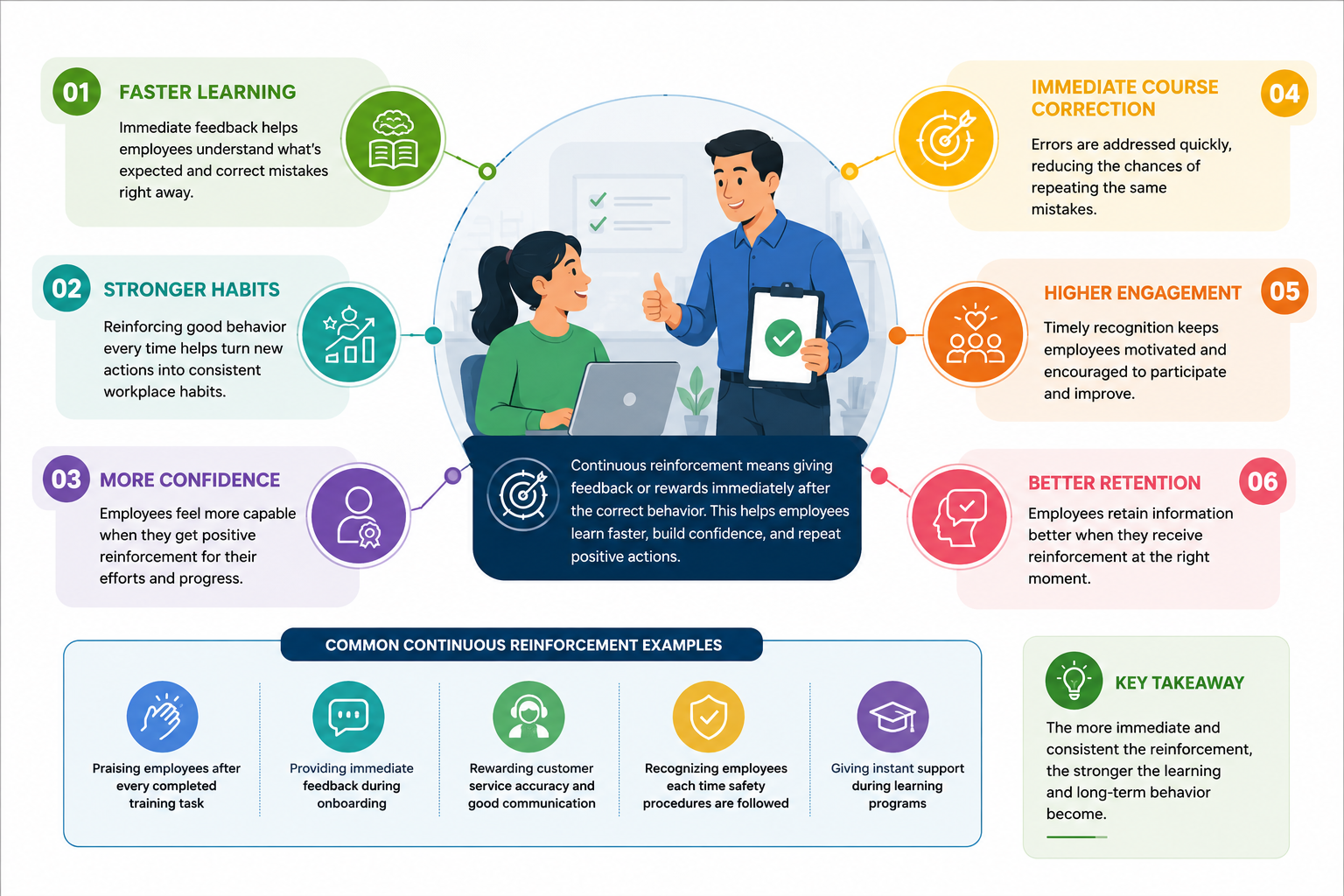
For example, a Continuous Reinforcement strategy works well when businesses are training employees or introducing new workplace processes because employees receive immediate feedback every time the correct behavior happens.
On the other hand, a Fixed Interval Reinforcement Schedule is often better for structured environments where businesses use scheduled rewards such as monthly bonuses, quarterly reviews, or annual appraisals.
Why Continuous Reinforcement Works So Well During Training
Why Continuous Reinforcement Works So Well During Training
Understanding Fixed Interval Reinforcement Schedule
One reason many businesses use Continuous Reinforcement during onboarding and employee development is because it creates fast learning and immediate behavior correction.
Employees quickly understand:
- What behaviors are expected
- Which actions are rewarded
- How performance is measured
- What success looks like
This type of reinforcement can build confidence much faster, especially for new employees who are still learning company processes and expectations.
Some common workplace examples include:
- Praising employees after every completed training task
- Providing immediate feedback during onboarding
- Rewarding customer service accuracy
- Recognizing employees each time safety procedures are followed correctly
- Giving instant support during learning programs
These Continuous Reinforcement Examples help employees build positive workplace habits more quickly because rewards happen immediately after the desired behavior occurs.
When a Fixed Interval Reinforcement Schedule Makes More Sense
When a Fixed Interval Reinforcement Schedule Makes More Sense
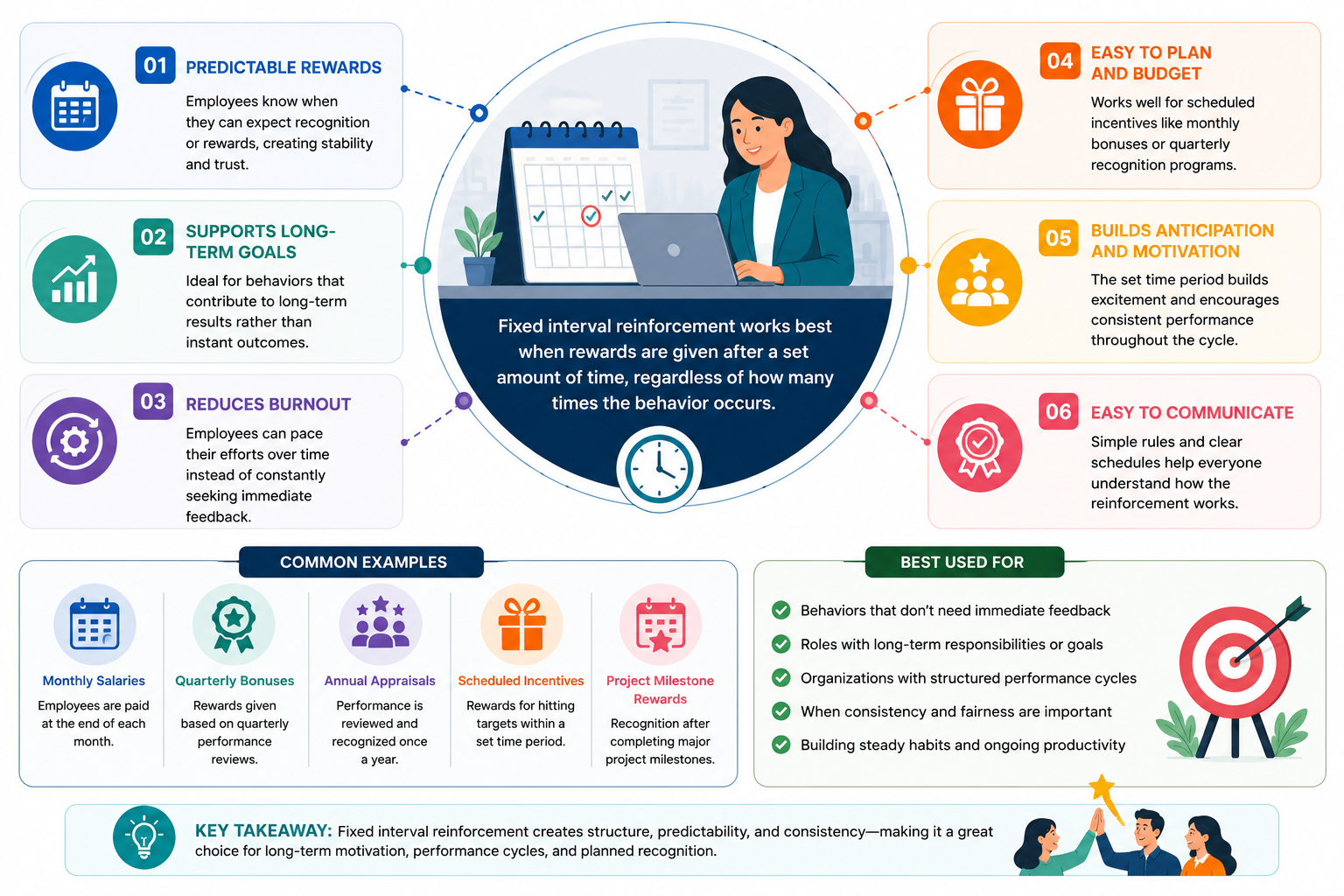
A Fixed Interval Reinforcement Schedule works differently because rewards happen after a specific amount of time rather than after every behavior.
Businesses commonly use this reinforcement method for:
- Monthly salaries
- Quarterly bonuses
- Weekly performance reviews
- Annual employee appraisals
- Scheduled recognition programs
This approach creates structure and predictability, which can work very well in larger organizations where consistency and routine performance management are important.
However, some businesses notice that employee motivation may temporarily drop immediately after rewards are received and then increase again closer to the next reward period.
What Is a Fixed Interval Reinforcement Schedule?
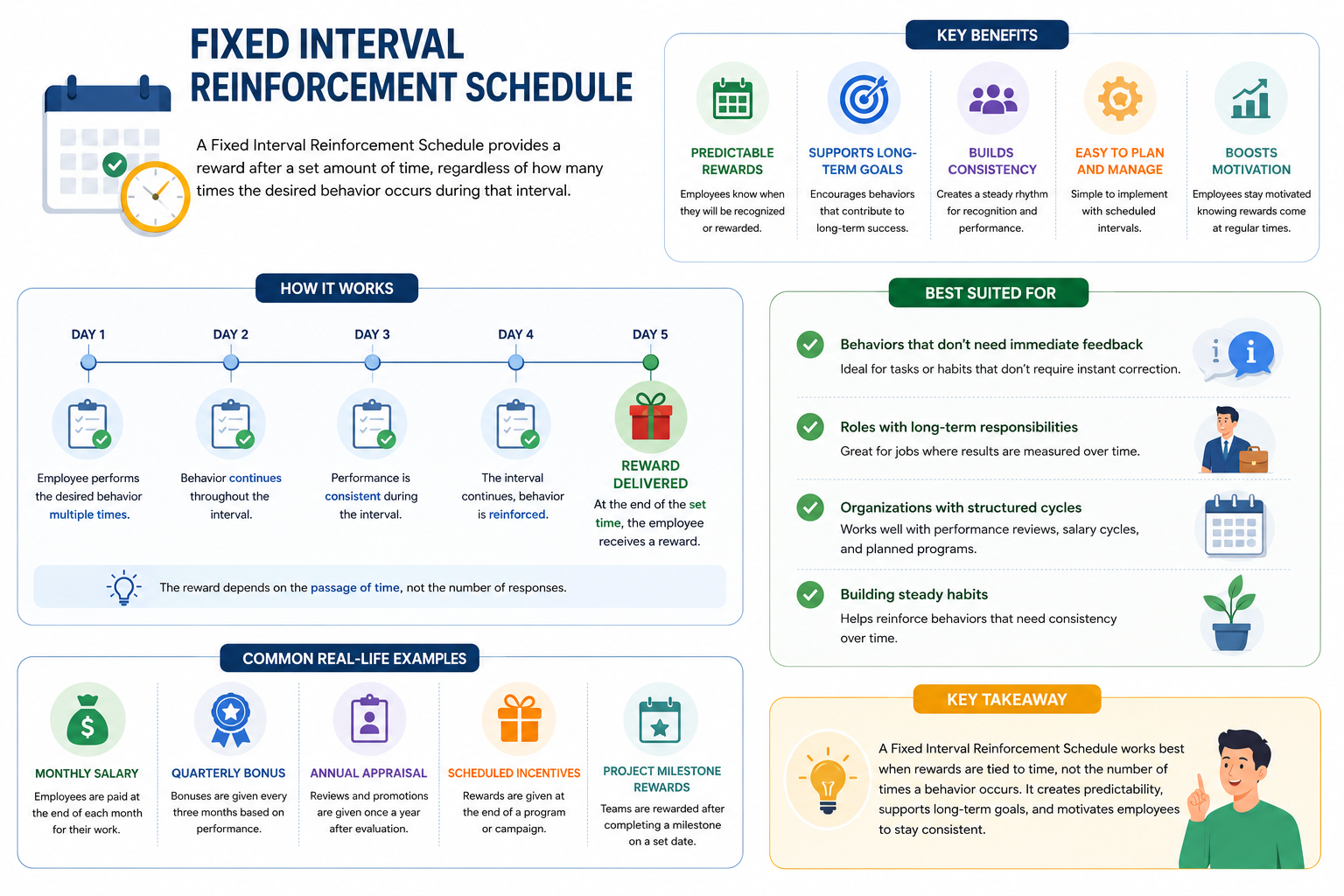
A Fixed Interval Reinforcement Schedule is a reinforcement method where rewards are given after a specific amount of time has passed, as long as the desired behavior continues. In simple terms, employees know when the reward is coming, which can help create routine and consistency in the workplace.
For example, monthly salaries, quarterly bonuses, and annual performance reviews are all common examples of fixed interval reinforcement schedules in business environments.
In the world of schedules of reinforcement in psychology, this method is often used to encourage steady behavior over time.
However, one challenge is that people may become less motivated immediately after receiving the reward and then increase effort again as the next reward period gets closer.
Fixed Interval Reinforcement Schedule Examples
Businesses use fixed interval reinforcement schedules more often than most people realize. These systems help create structure and predictable expectations for employees.
Here are some common workplace examples:
- Monthly salary payments
- Quarterly performance bonuses
- Weekly employee check-ins
- Annual appraisals and reviews
- Monthly attendance rewards
- Scheduled commission payouts
- Employee recognition programs held every quarter
For example, if a company gives employees a bonus every three months based on performance, that is considered a Fixed Interval Reinforcement Schedule because the reward is tied to a specific time period.
Advantages of Fixed Interval Reinforcement
One reason businesses use fixed interval reinforcement schedules is because they are simple to manage and easy for employees to understand.
Benefits include:
- Predictable reward structure
- Clear employee expectations
- Easier performance tracking
- Encourages routine behavior
- Helps maintain workplace consistency
- Works well for long-term planning
Many HR teams use this approach because employees know exactly when evaluations, bonuses, or rewards will happen.
Disadvantages of Fixed Interval Reinforcement
While this reinforcement method can work well in structured workplaces, it is not always the best solution for every environment.
Common disadvantages include:
- Employee motivation may drop after rewards are received
- Some employees only increase effort near review periods
- Can feel repetitive over time
- Less effective in fast-moving industries
- Employees may focus more on timing than performance quality
This is one reason many experts debate Which Reinforcement Schedule Is Most Effective for long-term motivation and engagement.
Which Schedule of Reinforcement Is Most Resistant to Extinction?
In psychology, researchers often ask which schedule of reinforcement is most resistant to extinction. The answer is usually the variable ratio schedule.
This reinforcement method gives rewards after an unpredictable number of actions, which keeps people motivated because they never know exactly when the next reward will happen.
Casinos and gaming systems commonly use this approach, but businesses also use it through surprise bonuses, incentive programs, and unexpected recognition.
Compared to fixed interval systems, variable ratio reinforcement often creates stronger long-term behavior because employees continue putting in effort even when rewards are unpredictable.
That's why many experts believe variable reinforcement methods may outperform fixed systems when looking at Which Reinforcement Schedule Is Most Effective for sustained motivation and engagement.
Best Reinforcement Schedule by Goal
Different reinforcement methods work better for different workplace goals.
Some reinforcement schedules help employees learn new behaviors quickly, while others are better for maintaining long-term motivation and productivity.
Understanding how each system works can help businesses improve employee engagement, performance, and workplace consistency.
The table below explains the most common reinforcement schedules used in organizational behavior and workplace psychology.
| Reinforcement Schedule | How It Works | Workplace Example | Best Used For | Potential Drawback |
| Continuous Reinforcement | Employees receive a reward every time the desired behavior happens | Praising a new employee after every correctly completed task during onboarding | Training new employees and building habits quickly | Employees may become dependent on constant rewards |
| Fixed Interval Reinforcement Schedule | Rewards are given after a fixed amount of time has passed | Monthly salaries, quarterly bonuses, annual reviews | Routine performance management and consistency | Motivation may drop after rewards are received |
| Fixed Ratio Schedule | Employees receive rewards after completing a specific number of tasks or actions | A salesperson earns a bonus after every 10 sales | Increasing productivity and measurable output | Employees may focus more on quantity than quality |
| Variable Interval Schedule | Rewards happen at unpredictable time intervals | Managers randomly recognize employees for strong performance | Maintaining employee engagement | Rewards may feel inconsistent to some employees |
| Variable Ratio Schedule | Rewards happen after an unpredictable number of actions | Surprise incentives, random bonuses, gamified rewards | Long-term motivation and high engagement | Can create unhealthy competition if overused |
In many workplaces, businesses combine multiple reinforcement schedules depending on the situation.
For example, companies may use continuous reinforcement during employee onboarding and later switch to a fixed ratio schedule or variable reinforcement model to maintain long-term performance and motivation.
What Managers Often Get Wrong
A lot of businesses understand the idea behind a Schedule of Reinforcements, but the problem usually comes down to how the reinforcement is actually applied in the workplace.
Even the best reinforcement strategy can fail if employees feel the system is unfair, inconsistent, or disconnected from their daily work experience.
One of the biggest mistakes managers make is inconsistent rewards. If employees see one person getting recognized for certain behavior while others are ignored for doing the same thing, motivation can quickly drop.
People want fairness and consistency, especially when performance-based rewards are involved.
Another common issue is delayed recognition. In many cases, employees work hard on a project, hit targets, or go above expectations, but feedback arrives weeks or even months later.
By then, the emotional connection between the behavior and the reward is weaker. In both organizational behavior and schedules of reinforcement in psychology, timing matters a lot. The closer the reward is to the action, the stronger the reinforcement tends to be.
Some businesses also rely too heavily on financial incentives alone. While bonuses and commissions can work well — especially in a fixed ratio schedule — money is not always the main thing driving employee engagement.
Recognition, career growth, flexibility, trust, and workplace culture often play an equally important role in long-term motivation.
Managers also make the mistake of ignoring employee preferences. Not every employee responds to the same type of reinforcement. Some employees value public recognition, while others may prefer private praise, extra flexibility, development opportunities, or performance incentives.
Understanding what motivates different people is a huge part of building an effective reinforcement strategy.
Poor communication is another major problem.
Employees need to clearly understand:
- What behaviors are being rewarded
- How rewards are earned
- When recognition happens
- What goals or expectations exist
- Why certain reinforcement systems are being used
Without clear communication, even well-designed reinforcement systems can feel confusing or unfair.
This is one reason businesses continue debating Which Reinforcement Schedule Is Most Effective.
The reality is that no reinforcement system works perfectly unless managers apply it consistently, communicate expectations clearly, and connect rewards to meaningful employee behavior.
Other Types of Reinforcement Schedules
Once you understand the basics of a Schedule of Reinforcements, the next step is learning how different reinforcement methods actually influence employee behavior in the real world.
The truth is, there is no single reinforcement strategy that works perfectly in every workplace.
Different situations require different approaches depending on the goal, the team, and the type of behavior a business wants to encourage.
Some reinforcement schedules are designed to help employees learn quickly, while others are better for maintaining long-term motivation and engagement.
This is why understanding the different Types of Reinforcement Schedules is so important for managers, HR teams, and business leaders trying to improve performance and workplace culture.
Other Types of Reinforcement Schedules
Continuous Reinforcement Schedule
A continuous reinforcement schedule is one of the simplest reinforcement methods to understand.
Employees receive a reward or positive feedback every single time the desired behavior happens.
This approach works especially well when businesses are training new employees or introducing new workplace processes because people quickly learn which behaviors are expected.
For example, imagine a new customer service employee starting their first week.
Every time they handle a customer interaction correctly, their manager immediately praises them or provides positive feedback. Over time, this helps build confidence and creates strong workplace habits much faster.
Continuous Reinforcement ExamplesSome common workplace examples include:
- Praising employees after every completed onboarding task
- Giving immediate feedback during training sessions
- Rewarding customer service accuracy
- Recognizing employees each time they follow safety procedures correctly
- Providing instant incentives for completing learning modules
One reason this method is widely used in schedules of reinforcement in psychology is because it creates very fast learning.
However, businesses usually reduce continuous reinforcement over time because employees can become too dependent on constant rewards or recognition.
Fixed Ratio Reinforcement Schedule
A fixed ratio schedule rewards employees after they complete a specific number of tasks, actions, or achievements. In many workplaces, this reinforcement method is heavily tied to productivity and measurable performance.
You have probably already seen this in action without realizing it. Sales teams, manufacturing companies, customer support departments, and commission-based jobs commonly use fixed ratio reinforcement systems because employees know exactly what they need to achieve to earn the reward.
For example, a salesperson may receive a bonus after every 10 sales completed, or a warehouse employee might earn an incentive after packing 100 successful orders.
Common Fixed Ratio Schedule Examples
Businesses often use fixed ratio schedules for:
- Sales commission programs
- Productivity bonuses
- Performance-based incentives
- Project completion rewards
- Referral bonus systems
- Production targets
One reason the fixed ratio schedule is so effective is because it creates a direct connection between effort and reward. Employees clearly understand that the more work they complete, the greater the reward they can earn.
However, businesses should also be careful not to focus only on output. If poorly managed, employees may prioritize speed over quality simply to reach the next reward threshold faster.
Variable Interval Reinforcement Schedule
A variable interval reinforcement schedule works differently because rewards happen at unpredictable times rather than after a fixed timeline or specific number of actions.
In simple terms, employees do not know exactly when the reward or recognition will happen, which often encourages more consistent long-term behavior.
For example, a manager may randomly recognize employees for strong teamwork throughout the month instead of waiting for a formal quarterly review.
Since employees never know when positive feedback may happen, they are more likely to stay engaged consistently.
Common Variable Interval Reinforcement Examples
Examples include:
- Surprise employee recognition
- Random performance rewards
- Unexpected bonuses
- Manager shout-outs during meetings
- Unplanned appreciation incentives
- Spot rewards for teamwork or leadership
Many experts believe this reinforcement method can help maintain stronger long-term motivation because employees continue putting in effort without relying on predictable reward schedules.
In fact, when businesses ask Which Reinforcement Schedule Is Most Effective, variable reinforcement methods are often considered some of the most powerful for sustaining engagement over time because they keep rewards feeling fresh and meaningful rather than routine.
How HR Teams Encourage Employee Motivation in Modern Workplaces

How HR Teams Encourage Employee Motivation in Modern Workplaces
Today's workplaces look very different compared to just a few years ago.
With remote work, hybrid teams, flexible schedules, and digital communication becoming the norm, HR teams are constantly looking for better ways to keep employees connected, motivated, and engaged.
Traditional workplace incentives alone are no longer enough.
Employees now expect faster feedback, more recognition, stronger communication, and a better overall employee experience.
This is why many businesses are investing in modern employee engagement strategies that focus on recognition, wellbeing, communication, and company culture rather than only financial rewards.
According to research from Gallup, employees who feel recognized and valued at work are significantly less likely to experience burnout and are more likely to stay with their employer long term.
This is especially important as businesses continue struggling with retention challenges and workplace disengagement.
Motivation Strategies for Remote and Hybrid Teams
Managing remote employees comes with unique challenges.
Without regular face-to-face interaction, many employees can start feeling disconnected, overlooked, or isolated from the wider team.
To solve this, many HR departments now use digital workplace tools and employee communication platforms to create more consistent recognition and feedback across distributed teams.
Modern businesses commonly use:
- Virtual employee recognition programs
- Digital shout-outs during team meetings
- Peer-to-peer recognition systems
- Team achievement dashboards
- Employee wellbeing initiatives
- Online reward and appreciation platforms
- Real-time feedback tools
For example, some companies now celebrate employee achievements publicly through internal communication platforms, while others use gamified recognition systems to improve participation and morale across departments.
The goal is simple: help remote employees feel visible, appreciated, and connected even when working from different locations.
Why Employee Recognition Matters More Than Ever
Recognition has become one of the biggest drivers of employee satisfaction in modern workplaces.
Employees want to know their work matters, especially in high-pressure or fast-moving environments where burnout can easily happen.
When employees consistently feel ignored or undervalued, motivation often drops quickly.
Over time, this can lead to lower productivity, poor morale, disengagement, and eventually higher staff turnover.
Strong employee recognition programs can help businesses improve:
- Employee retention
- Team morale
- Workplace culture
- Employee wellbeing
- Productivity levels
- Employee loyalty
- Collaboration and teamwork
Many companies are now shifting toward people-first workplace strategies because they understand that motivated employees are more likely to stay engaged, contribute ideas, and support long-term business growth.
In many ways, modern HR teams are no longer just managing employees — they are actively shaping workplace experience, communication, and organizational culture every single day.
Common Employee Reward System Mistakes Companies Make
Even well-designed employee motivation programs can fail if businesses apply them the wrong way.
A lot of companies focus heavily on incentives and workplace rewards, but they often overlook how employees actually respond to recognition, feedback, and performance management over time.
The reality is simple: if workplace rewards feel inconsistent, unfair, or disconnected from employee effort, motivation usually drops instead of improving.
Many organizations accidentally create frustration by using poor behavioral management strategies, delayed recognition systems, or one-size-fits-all incentive programs that do not match what employees actually value.

Common Employee Reward System Mistakes Companies Make
Delayed Employee Recognition Reduces Motivation
One of the biggest mistakes businesses make is waiting too long to recognize employee achievements.
When positive feedback arrives weeks or months after the behavior happens, the emotional impact becomes much weaker.
Employees are far more likely to repeat positive workplace behaviors when recognition feels immediate and connected to their actions.
For example:
- Thanking an employee immediately after solving a customer issue
- Recognizing strong teamwork during a meeting
- Providing fast feedback after completing a successful project
Small moments of recognition often create stronger engagement than delayed annual rewards.
Focusing Only on High Performers
Many companies unintentionally create workplace disengagement by only recognizing top-performing employees. While high achievers absolutely deserve recognition, constantly ignoring steady contributors can damage morale across the wider team.
Employees want to feel their effort matters, even if they are not always the highest performer in the department.
Businesses that create healthier workplace cultures often recognize:
- Consistency
- Team collaboration
- Improvement over time
- Leadership behaviors
- Problem-solving
- Positive attitude
- Employee reliability
Balanced recognition programs help employees feel valued across all levels of the organization.
Creating Too Much Workplace Competition
Competition can sometimes improve productivity, but too much pressure can quickly create stress, burnout, and unhealthy team dynamics.
When businesses rely too heavily on leaderboard-style incentives or aggressive performance contests, employees may become more focused on beating coworkers rather than collaborating effectively.
This can lead to:
- Poor teamwork
- Reduced knowledge sharing
- Increased workplace tension
- Employee burnout
- Lower morale
- Short-term thinking
Strong workplace culture usually comes from balancing individual performance with collaboration and team success.
Using the Same Incentives for Every Employee
Not all employees are motivated by the same rewards. Some people value financial bonuses, while others care more about flexibility, career growth, public recognition, or additional time off.
This is where many employee incentive programs fail. Businesses assume one reward system will motivate everyone equally, but employee motivation is much more personal than that.
Modern organizations are now offering more flexible reward options such as:
- Professional development opportunities
- Flexible working arrangements
- Wellness benefits
- Additional leave days
- Public recognition
- Career progression programs
- Team appreciation events
The more personalized the recognition feels, the more meaningful it often becomes.
Overlooking Non-Financial Workplace Rewards
Money matters, but financial incentives alone rarely build long-term employee satisfaction.
Employees also want:
- Respect
- Trust
- Career development
- Strong leadership
- Clear communication
- Work-life balance
- Purpose and belonging
In fact, many workplace studies show that employees who feel appreciated and supported are more likely to stay engaged and loyal to their employer over time.
This is why modern employee engagement strategies now focus on creating positive workplace experiences rather than relying only on bonuses or performance-based compensation.
How Digital Workplace Platforms Support Employee Motivation
How Digital Workplace Platforms Support Employee Motivation
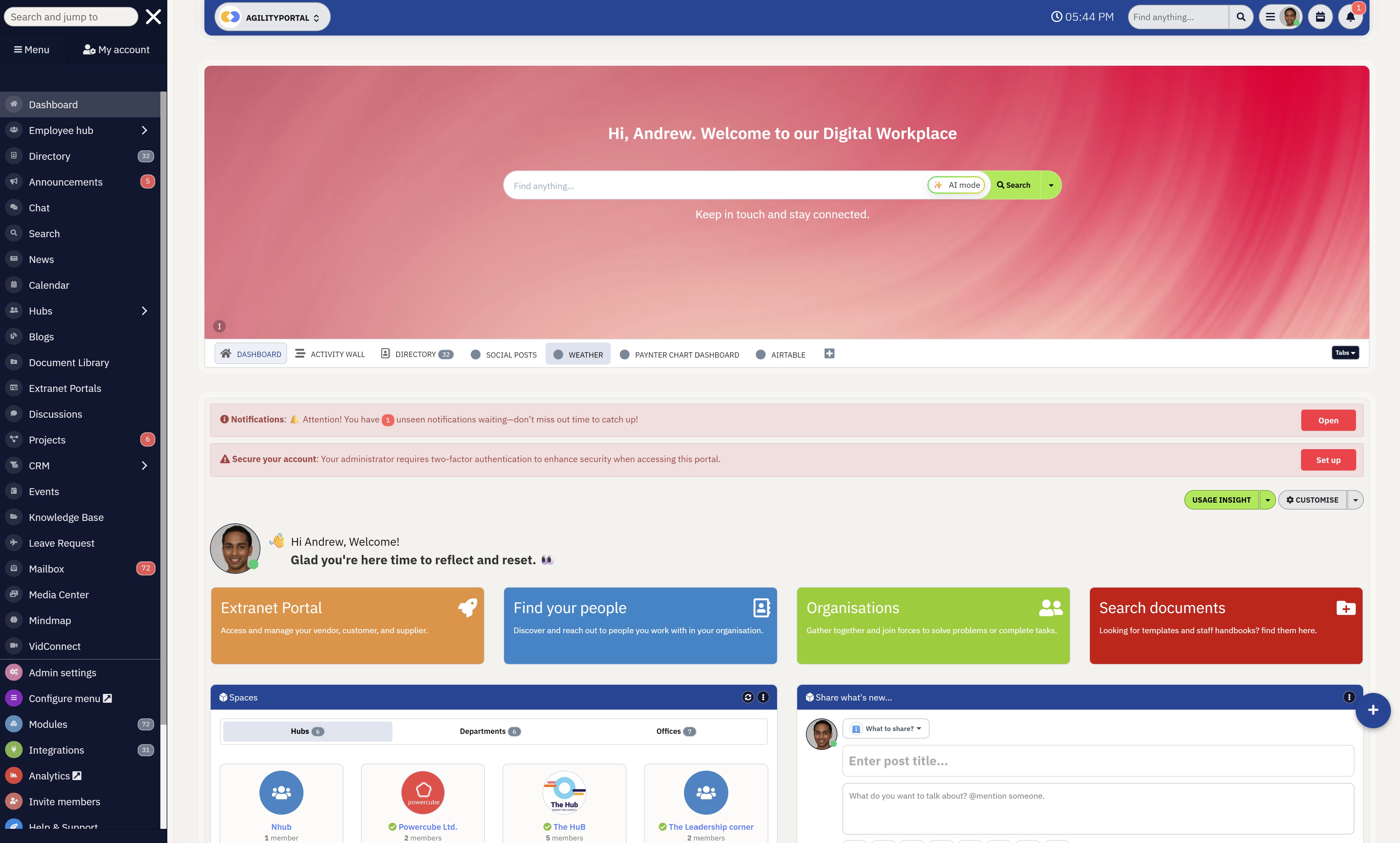
Modern businesses often struggle to apply reinforcement strategies consistently, especially across remote and hybrid teams. Employees can easily feel disconnected when recognition, communication, and feedback are scattered across emails, chat apps, spreadsheets, and disconnected systems.
This is where digital workplace platforms like AgilityPortal can help businesses create more structured employee engagement and recognition experiences.
For example, businesses can use AgilityPortal to:
- Recognize employee achievements publicly
- Share team wins through social feeds
- Reward employee participation
- Improve onboarding experiences
- Deliver real-time feedback
- Create employee recognition programs
- Track engagement across departments
- Improve communication consistency
Instead of relying only on annual reviews or delayed recognition, companies can create ongoing employee engagement systems that reinforce positive workplace behaviors in real time.
This becomes especially important for remote and hybrid teams where employees may not receive the same level of in-person feedback or recognition compared to traditional office environments.
By combining communication, recognition, collaboration, and employee engagement tools into one platform, businesses can create a more connected workplace culture while supporting long-term employee motivation and retention.
Built for Modern Employee Engagement
Employee Motivation Starts With Better Communication and Recognition
Many businesses struggle to maintain employee engagement because communication, recognition, onboarding, and workplace feedback are often spread across disconnected tools, emails, spreadsheets, and outdated systems.
AgilityPortal helps organizations create a more connected digital workplace by centralizing employee communication, recognition programs, onboarding, company updates, document sharing, engagement tools, and workplace collaboration into one platform.
- Employee recognition and engagement tools
- Centralized communication for remote and hybrid teams
- Employee onboarding and training workflows
- Company announcements and social activity feeds
- Secure document management and knowledge sharing
- Mobile access for frontline and distributed employees
- Collaboration tools for departments and project teams
Final Thoughts
Understanding how a Schedule of Reinforcements works can completely change the way businesses approach employee motivation, productivity, and workplace behavior.
As you've seen throughout this guide, different Types of Reinforcement Schedules influence employees in different ways depending on the situation, the reward system, and the goals a business wants to achieve.
Whether you use a Fixed Interval Reinforcement Schedule for structured performance reviews or apply Continuous Reinforcement during employee training, the key is consistency, fairness, and timely recognition.
We also explored several Continuous Reinforcement Examples and explained Which Reinforcement Schedule Is Most Effective for both short-term learning and long-term engagement.
At the end of the day, employees respond best when they feel valued, recognized, and connected to their work — and the right reinforcement strategy can help businesses build exactly that.
Frequently Asked Questions About Reinforcement Schedules
What are the 4 schedules of reinforcement?
The four main schedules of reinforcement used in psychology and organizational behavior are:
- Continuous reinforcement
- Fixed interval reinforcement
- Fixed ratio reinforcement
- Variable reinforcement schedules
These reinforcement methods explain how and when rewards are delivered after a behavior occurs.
Businesses commonly use these systems to improve employee motivation, workplace performance, learning, and engagement.
For example, a company may use a fixed ratio reward system for sales commissions, while another business may use continuous reinforcement during employee onboarding and training.
What are the 5 schedules of reinforcement?
The five most commonly discussed reinforcement schedules include:
- Continuous reinforcement
- Fixed interval schedule
- Fixed ratio schedule
- Variable interval schedule
- Variable ratio schedule
Each reinforcement strategy influences workplace behavior differently. Some systems help employees learn new tasks quickly, while others are designed to maintain long-term motivation and productivity.
For example:
- Continuous reinforcement works well during training
- Fixed interval systems support structured performance reviews
- Variable ratio reinforcement often creates stronger long-term engagement
Understanding the different reinforcement models can help businesses choose the best employee motivation strategy for their workplace.
What is an example of a reinforcement schedule?
A reinforcement schedule is any system where rewards or recognition are tied to employee behavior, actions, or performance.
Some common workplace examples include:
- A salesperson earning a bonus after every 10 sales
- Monthly employee recognition programs
- Quarterly performance bonuses
- Immediate praise during employee onboarding
- Surprise incentives for strong teamwork
- Rewarding employees for meeting productivity goals
These reinforcement systems are commonly used in employee engagement programs, workplace training, productivity management, and performance improvement strategies.
What are the 4 compound schedules of reinforcement?
Compound schedules of reinforcement combine multiple reinforcement methods together rather than relying on a single reward system.
The four common compound reinforcement schedules include:
- Mixed schedules
- Multiple schedules
- Chained schedules
- Tandem schedules
In workplace environments, compound reinforcement strategies are often used to manage more complex employee behaviors and performance expectations.
For example, a company may combine scheduled performance reviews with surprise employee recognition programs to maintain both consistency and long-term engagement.
Many modern businesses use blended reinforcement systems because employee motivation is rarely driven by one type of reward alone.
How do reinforcement schedules improve employee motivation?
Reinforcement schedules help employees understand which behaviors are valued and rewarded inside the workplace.
When employees receive consistent recognition, feedback, or incentives, they are more likely to stay motivated and repeat positive behaviors.
Effective reinforcement strategies can help businesses improve:
- Employee engagement
- Productivity
- Workplace morale
- Training outcomes
- Employee retention
- Team performance
- Workplace consistency
In many organizations, reinforcement systems play a major role in shaping company culture, improving communication, and supporting long-term business growth.
AI Summary
- A Schedule of Reinforcements explains how and when rewards, recognition, or incentives are given to encourage positive employee behavior and improve workplace performance.
- Businesses use different Types of Reinforcement Schedules to strengthen employee motivation, productivity, workplace habits, learning outcomes, and long-term engagement.
- Common reinforcement methods include Continuous Reinforcement, Fixed Interval Reinforcement Schedule, fixed ratio systems, variable interval rewards, and variable ratio incentive programs.
- Continuous Reinforcement Examples include praising employees during onboarding, rewarding completed training tasks, recognizing customer service performance, and providing immediate feedback during workplace learning.
- A Fixed Interval Reinforcement Schedule rewards employees after a specific amount of time, such as monthly salaries, quarterly bonuses, annual reviews, or scheduled recognition programs.
- Businesses often use reinforcement strategies in sales incentives, employee recognition programs, productivity management, workplace training, performance reviews, and employee engagement initiatives.
- Organizations using effective reinforcement systems can improve employee morale, increase productivity, strengthen workplace culture, reduce disengagement, and support long-term employee retention.
Most Popular Posts

Effective communication among team members is vital for the productivity and success of any organization. Surprisingly, 60% of companies lack a long-term internal communication strategy, which p...


Businesses thrive on communication for efficiency, productivity and accomplishment. When the right information is passed from the right designation in the organization, it promotes positivity an...
Categories
Blog
(2944)
Business Management
(366)
Employee Engagement
(222)
Digital Transformation
(190)
Growth
(141)
Intranets
(134)
Remote Work
(63)
Sales
(53)
Collaboration
(47)
Customer Experience
(30)
Culture
(29)
Knowledge Management
(28)
Project management
(28)
Leadership
(20)
Comparisons
(9)
News
(1)

Related Posts

Most people don't realize it, but businesses use some form of a Schedule of Reinforcements every single day — whether it's employee bonuses, praise from a manager, sales commissions, promotions, or even simple recognition during team meetings. ...

AI-assisted software development is rapidly changing how modern businesses build software, and it's happening much faster than many companies expected. From AI coding tools that generate code suggestions in seconds to intelligent testing automation a...

Healthcare teams are under more pressure than ever right now. Between staff shortages, rising patient expectations, admin overload, and longer wait times, many clinics and healthcare organizations are struggling to keep up. That's exactly...

Remote work has completely changed how businesses operate, but it has also created a growing problem many companies did not fully expect: workforce compliance. As more organizations hire employees across different cities, states, and even count...

As businesses continue to evolve, the hybrid work model has become the standard for many organizations worldwide. Companies are shifting away from rigid office-based structures, embracing a more flexible approach that allows employees to split ...

Jill Romford
I am a digital nomad, lover of exploring new places and making friends.
I love to travel and I love the internet. I take pictures of my travels and share them on the internet using Instagram.
Traveler, entrepreneur, and community builder. I share my insights on digital marketing and social media while inspiring you to live your fullest life.
Ready to learn more? 👍
One platform to optimize, manage and track all of your teams. Your new digital workplace is a click away. 🚀
Free for 14 days, no credit card required.