
Insight Blog
Agility’s perspectives on transforming the employee's experience throughout remote transformation using connected enterprise tools.
17 minutes reading time
(3376 words)
How Smart Digital Practices Help Businesses Stand Out on the Global Stage

How Smart Digital Practices Help Businesses Stand Out on the Global Stage
Discover how modern digital workplace strategies improve communication, reduce inefficiencies, and help businesses scale successfully in a competitive global market.
How Smart Digital Practices Help Businesses Stand Out on the Global Stage

In a global business environment where speed, transparency, and adaptability determine success, organizations can no longer rely on outdated processes or disconnected tools.
Companies that adopt smart digital practices gain a significant competitive advantage by improving how employees communicate, collaborate, and make decisions.
Employee engagement strategies is no longer just a technology initiative. It is a strategic approach to building a more resilient, scalable, and efficient organization. Businesses that modernize their internal systems are better equipped to manage remote teams, improve productivity, protect sensitive data, and deliver consistent customer experiences across regions.
According to McKinsey & Company, employees spend nearly 28% of their workweek searching for information across disconnected systems, highlighting how inefficient workflows can quietly erode productivity.
Organizations that address these inefficiencies through better digital infrastructure often see improvements in communication, engagement, and operational visibility.
For companies expanding internationally or managing distributed teams, digital maturity is quickly becoming one of the most important indicators of long-term success.
28%
of the workweek
According to McKinsey & Company, employees spend nearly 28% of their workweek searching for information across disconnected systems, highlighting how inefficient workflows can quietly erode productivity.
Source: McKinsey Global Institute
Why Digital Transformation Matters More Than Ever
Digital transformation is often misunderstood as simply adopting new technology.
In reality, it focuses on improving how work gets done by connecting people, processes, and information more effectively.
Organizations that invest in modern digital systems often benefit from:
- Faster communication between departments
- Reduced manual processes through automation
- Improved access to knowledge and documentation
- Better decision-making supported by data
- Stronger collaboration across remote and hybrid teams
Cloud platforms and SaaS solutions have made these capabilities accessible to businesses of all sizes, not just large enterprises with extensive IT budgets.
Companies that successfully implement digital practices tend to focus on workflow efficiency and employee experience, ensuring that technology supports the way people actually work.
1,000+
cloud apps per enterprise
According to Gartner, the average enterprise now uses over 1,000 cloud applications, with nearly 70% introduced without IT approval.
Source: Gartner
The Real Challenges Businesses Face When Adopting Digital Practices
While digital transformation offers significant advantages, many organizations underestimate the practical challenges involved in modernizing their internal systems.
Technology alone does not solve operational problems. Without the right strategy, adoption plan, and leadership support, digital initiatives can stall or fail to deliver expected results.
One of the most common challenges is tool fragmentation. Many companies adopt new platforms over time without fully replacing older systems.
As a result, employees end up juggling multiple tools for messaging, file storage, project tracking, and company updates. This creates confusion and makes it harder for teams to locate information quickly.
Another major challenge is employee adoption. Even well-designed digital platforms can struggle if employees are not properly introduced to the new workflows.
According to research from Gartner, nearly 70% of digital transformation initiatives fail to meet their goals, often due to cultural resistance, lack of training, or unclear leadership direction.
70%
failure rate
According to research from Gartner, nearly 70% of digital transformation initiatives fail to meet their goals, often due to cultural resistance, lack of employee training, or unclear leadership direction.
Source: Gartner Research
Organizations also face integration difficulties when introducing new technology.
Many businesses rely on existing systems such as CRM platforms, HR tools, document management systems, and productivity suites. Ensuring these systems work together smoothly requires careful planning and technical expertise.
Security and compliance concerns can also slow digital transformation.
Businesses operating in industries such as healthcare, finance, and government services must ensure that any digital platform meets strict data protection and privacy regulations.
Without proper governance, organizations risk exposing sensitive information or failing compliance audits.
Finally, leadership alignment is often overlooked.
Digital transformation requires commitment across departments, not just within IT teams. When executives, managers, and employees share a clear understanding of the goals behind digital initiatives, adoption tends to be far more successful.
Recognizing these challenges early allows organizations to build more realistic digital strategies.
Companies that approach digital transformation with clear objectives, employee training, and strong governance frameworks are far more likely to achieve meaningful improvements in communication, productivity, and collaboration.
Better internal communication creates stronger businesses
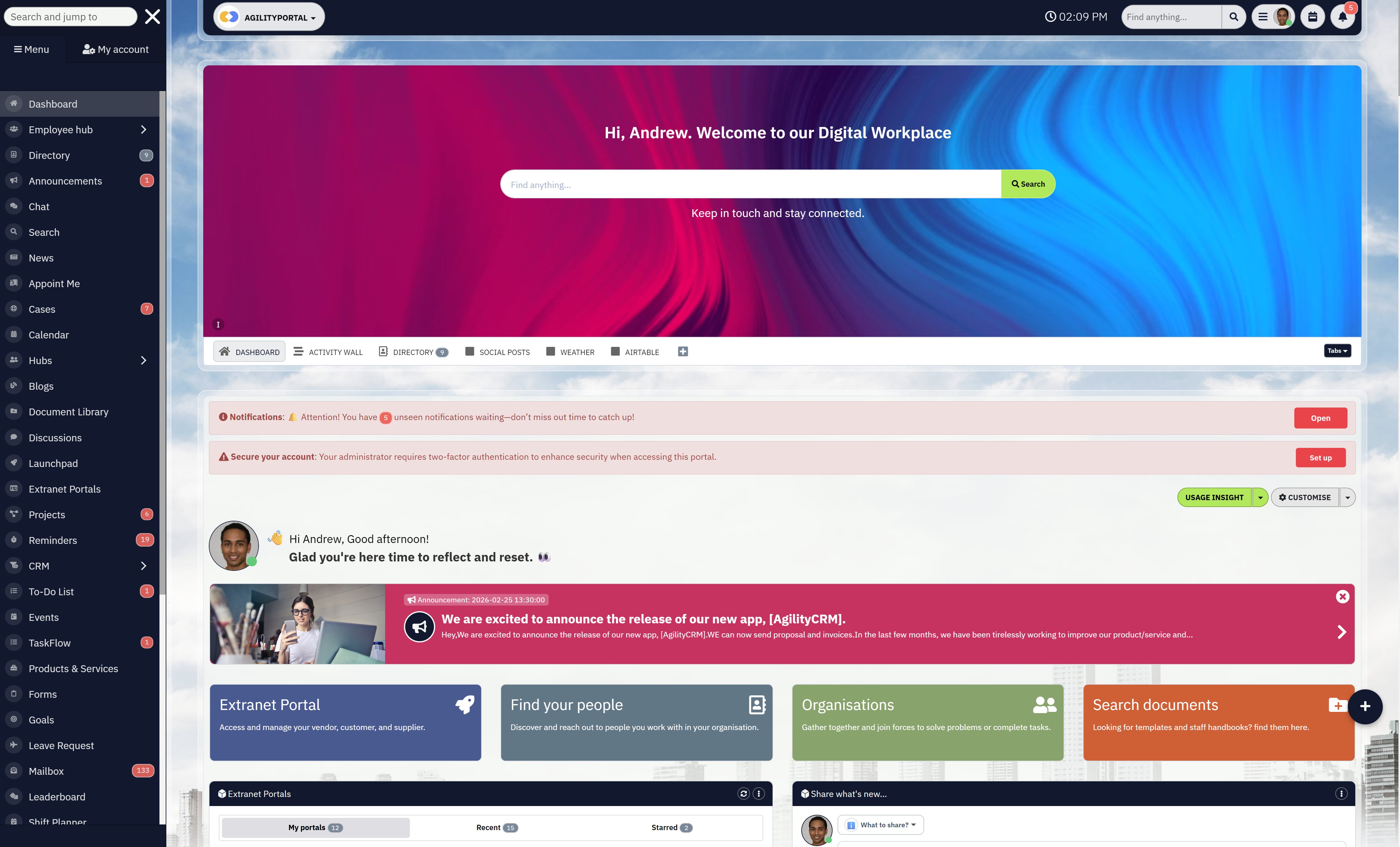
Better internal communication creates stronger businesses
One of the clearest signs of a digitally mature business is how well its people communicate.
When employees rely on scattered emails, disconnected files, and outdated systems, communication slows down. Important updates get missed, documents are hard to find, and decision-making becomes inconsistent.
That has a direct impact on productivity, morale, and service delivery.
A more unified digital workplace solves this by bringing communication, content, and collaboration into one place. Instead of jumping between tools, employees can access company updates, documents, conversations, and shared resources in a more structured way.
Platforms such as AgilityPortal are designed to support this kind of environment by combining internal communication, document sharing, messaging, and collaboration features in one central space.
The benefits of stronger internal communication are clear:
- faster decision-making because teams work from the same information
- higher engagement through more interactive and visible communication
- better knowledge retention because important resources are easier to find
- less noise and fewer unnecessary email chains
- stronger alignment across offices, departments, and remote teams
For businesses trying to build a consistent culture across multiple locations, this is not a small improvement. It is a foundation.
Key Takeaways
- Smart digital practices help businesses improve communication, streamline workflows, and operate more efficiently across global and distributed teams.
- Disconnected tools create hidden productivity loss, with research from McKinsey showing employees can spend up to 28% of their workweek searching for information.
- Digital workplace platforms centralize communication, documents, and collaboration, helping employees access the resources they need faster.
- Successful digital transformation depends not only on technology but also on leadership support, employee training, and strong adoption strategies.
- Organizations that invest in secure, connected digital environments improve productivity, strengthen employee engagement, and build long-term business resilience.
Data helps businesses make better decisions
Experience matters, but relying on instinct alone is not enough when businesses are scaling or competing internationally.
Smart digital practices allow organizations to turn everyday activity into useful insight.
That includes team engagement, project progress, communication performance, operational bottlenecks, and workflow efficiency.
When leaders can actually see what is happening across the business, they can make decisions with more confidence and less delay.
For example, a digital workplace analytics module can help organizations:
- monitor team activity and engagement trends
- identify communication gaps or low adoption areas
- track project visibility and operational performance
- measure the impact of internal campaigns or initiatives
- support planning with more accurate reporting
This kind of visibility is especially important in growing businesses, where leaders need to understand what is working, what is being ignored, and where friction is building before it becomes a bigger problem.
Remote and hybrid work depend on good digital systems
Remote and hybrid work are now a standard part of modern business, but they only work well when employees have the right systems around them.
Without a reliable digital environment, distributed teams often deal with poor communication, inconsistent access to information, duplicated work, and lower engagement. People feel disconnected, and managers lose visibility.
Smart digital practices help fix this by making work accessible from anywhere.
That includes secure file sharing, mobile access, collaborative document editing, company news, searchable knowledge, and team spaces where employees can ask questions and exchange ideas.
This matters for more than productivity. It affects culture too.
When people can find support, share knowledge, and stay informed regardless of location, they are more likely to feel included and connected to the wider business. For companies with deskless, remote, or multi-site teams, that can make a major difference to retention and performance.
Digital maturity strengthens brand trust
A company's internal systems often influence how customers, partners, and employees perceive its professionalism and reliability.
Businesses that rely on outdated or disconnected systems frequently experience slower response times, inconsistent communication, and operational inefficiencies that can damage credibility over time.
When teams struggle to access information or collaborate effectively, it becomes harder to deliver the level of service that modern customers expect.
Conversely, organizations with well-structured digital practices are often able to respond to requests more quickly, coordinate internal teams more efficiently, and maintain consistent service delivery across departments and locations.
These improvements not only increase productivity but also strengthen the overall reputation of the business.
Security also plays a critical role in building trust.
Companies operating internationally must ensure that their digital systems protect sensitive information, support secure communication, and comply with data protection regulations.
According to VPNoverview.com, cyber threats and data breaches continue to increase globally, highlighting the importance of secure digital infrastructure and responsible data management practices for modern organizations.
By investing in secure and well-managed digital environments, businesses can reduce operational risks while reinforcing confidence among customers, partners, and employees.
Ultimately, digital maturity is not just about improving internal processes—it also shapes how a company is perceived externally.
Organizations that manage communication, collaboration, and security effectively are far better positioned to build long-term credibility and trust in a competitive global market.
What successful digital adoption usually looks like
Businesses that adopt digital practices well tend to focus on business outcomes, not just software rollouts.
In practice, the strongest results usually come from a few consistent areas:
- Unified communication - Bringing messaging, updates, documents, and collaboration into fewer systems reduces confusion and helps people move faster.
- Mobile accessibility - Employees need access to tools and information wherever work happens, not only when they are at a desk.
- Reporting and analytics - Dashboards and performance data help businesses spot inefficiencies and improve processes over time.
- Knowledge management - Policies, guides, onboarding content, and shared documentation need to be easy to access and maintain.
- Security and governance - Stronger access controls, secure infrastructure, and clear information management practices help protect data and build trust.
This is where modular platforms can make a real difference.
Rather than relying on a patchwork of disconnected tools, businesses can create a more joined-up digital environment that supports communication, collaboration, analytics, and process management in one place.
How businesses can approach digital transformation more effectively
A smart digital strategy should start with real operational needs, not shiny tools.
That means asking practical questions first:
- Where does communication break down today?
- Which processes are slowing teams down?
- What information is hardest for employees to access?
- Where are managers lacking visibility?
- Which tools are creating overlap instead of efficiency?
From there, businesses should focus on solutions that are easy to adopt, integrate well with existing systems, and can grow with the organization.
A more effective rollout usually includes:
- reviewing current workflows and pain points
- selecting tools that solve clear business problems
- training employees properly instead of assuming they will figure it out
- measuring engagement and adoption over time
- adjusting the strategy based on feedback and actual usage
This is the difference between digital transformation that looks good in a strategy deck and digital transformation that actually improves the business.
Why smart digital practices are becoming a competitive differentiator
As markets become more connected and customer expectations continue to rise, businesses need systems that help them move quickly without losing control.
Smart digital practices give organizations a better chance to:
- adapt faster to change
- improve collaboration across teams and regions
- support employees more effectively
- make decisions using real operational insight
- protect information and maintain trust as they grow
The companies that stand out globally are often not the ones with the most tools. They are the ones using technology in a more deliberate, joined-up, and practical way.
Common Issues Businesses Encounter During Digital Transformation
Even with the best intentions, many organizations run into common problems when introducing new digital systems.
These issues often arise not because the technology is flawed, but because the implementation strategy, internal processes, or expectations were not fully aligned from the beginning.
One of the most frequent issues is low employee adoption.
New tools are introduced, but employees continue using old habits such as email chains, spreadsheets, or messaging apps outside the company's official platforms. When this happens, the organization ends up maintaining multiple workflows, which reduces the value of the digital investment. Successful digital adoption requires proper onboarding, training, and clear communication about why the new system matters.
Another common issue is information overload.
When companies rapidly deploy multiple communication channels, employees can become overwhelmed by notifications, messages, and updates coming from different systems. Instead of improving productivity, poorly managed communication tools can create noise and make it harder for employees to focus on their work.
Businesses also frequently experience data silos.
Different departments may adopt their own tools for managing documents, tasks, or reporting. Over time, valuable information becomes scattered across platforms, making it difficult for leadership to maintain a clear view of operations. Centralizing information and ensuring systems integrate properly is critical to avoiding this problem.
Integration challenges can also slow progress.
Many companies rely on a combination of legacy software, cloud applications, and third-party services. If these systems cannot communicate effectively, employees may need to manually transfer data between platforms, increasing the risk of errors and wasted time.
Another issue that organizations face is unclear ownership of digital initiatives. When responsibility for digital tools is spread across multiple departments without clear leadership, implementation can become inconsistent. Some teams adopt the new systems while others ignore them, creating uneven workflows across the organization.
Finally, companies sometimes focus too heavily on technology rather than the human side of transformation. Digital tools are most effective when they support how employees actually work.
Organizations that invest in user training, internal champions, and continuous feedback loops are far more likely to see long-term success.
Understanding these common issues allows businesses to approach digital transformation with more realistic expectations.
By addressing adoption, integration, governance, and communication early in the process, organizations can create a digital workplace that genuinely improves collaboration, efficiency, and employee engagement.
Future Outlook: Digital Practices as a Differentiator
As businesses continue to expand globally, smart digital practices will become a key differentiator.
Companies that invest in these strategies will be able to:
- Adapt quickly to evolving market conditions.
- Empower teams to work more efficiently and creatively.
- Build stronger client relationships through transparency and responsiveness.
- Maintain a secure, scalable infrastructure to support growth.
Digital transformation is not a one-time initiative but an ongoing journey.
By continuously evaluating processes, adopting emerging technologies, and prioritizing employee and customer experience, businesses can maintain a competitive edge in a rapidly changing global market.
Wrapping up
Smart digital practices are no longer optional for businesses that want to compete and grow on a global stage.
They improve communication, support hybrid work, strengthen decision-making, and help create a more resilient and trusted business.
For leaders, the real goal is not digital transformation for its own sake. It is building a business that works better for employees, customers, and partners.
When companies invest in the right digital foundations, they put themselves in a much stronger position to scale, adapt, and stand out in a crowded market.
AI Summary
- Smart digital practices help businesses improve communication, collaboration, and decision-making by reducing reliance on disconnected tools and outdated workflows.
- Research from McKinsey & Company shows employees spend nearly 28% of their workweek searching for information across fragmented systems, revealing the hidden cost of poor digital infrastructure.
- Many digital transformation efforts fail because of cultural resistance, weak leadership alignment, lack of training, and poor adoption planning rather than the technology itself.
- A strong digital workplace brings together communication, knowledge sharing, analytics, mobile access, and governance in one connected environment.
- Businesses that invest in secure and well-structured digital systems are better positioned to support hybrid work, strengthen trust, and compete more effectively on a global scale.
- Long-term digital success depends on combining the right tools with leadership support, employee enablement, and clear operational goals.
Most Popular Posts

Effective communication among team members is vital for the productivity and success of any organization. Surprisingly, 60% of companies lack a long-term internal communication strategy, which p...


Businesses thrive on communication for efficiency, productivity and accomplishment. When the right information is passed from the right designation in the organization, it promotes positivity an...
Categories
Blog
(2986)
Business Management
(376)
Employee Engagement
(223)
Digital Transformation
(192)
Growth
(143)
Intranets
(137)
Remote Work
(63)
Sales
(53)
Collaboration
(48)
Customer Experience
(30)
Culture
(29)
Knowledge Management
(28)
Project management
(28)
Leadership
(20)
Comparisons
(9)
News
(1)

Related Posts

Recruitment challenges remain one of the biggest obstacles to growth for deep tech companies in 2026. As demand for AI engineers, data scientists, robotics specialists, semiconductor experts, and biotech researchers continues to rise, organizat...

The rise of artificial intelligence is transforming the way SEO professionals research keywords, analyze competitors, monitor rankings, and optimize content. According to a 2024 HubSpot survey, more than 64% of marketers already use AI tools in...

The DEI maturity model represents a structured approach to assessing and enhancing diversity, equity, and inclusion within corporate environments. This model serves as a crucial framework for organizations aiming to not only diversify their wor...

If you've ever managed relationships with partners, distributors, resellers, suppliers, or clients, you've probably experienced the frustration of searching through endless email threads, outdated spreadsheets, and scattered documents just to find a ...

We all know that Fund management plays a critical role in the success of any partner program. Whether you're managing marketing development funds (MDF), co-marketing budgets, partner incentives, rebates, training initiatives, or broader partner ...


Jill Romford
I am a digital nomad, lover of exploring new places and making friends.
I love to travel and I love the internet. I take pictures of my travels and share them on the internet using Instagram.
Traveler, entrepreneur, and community builder. I share my insights on digital marketing and social media while inspiring you to live your fullest life.
Ready to learn more? 👍
One platform to optimize, manage and track all of your teams. Your new digital workplace is a click away. 🚀
Free for 14 days, no credit card required.