Insight Blog
Agility’s perspectives on transforming the employee's experience throughout remote transformation using connected enterprise tools.
43 minutes reading time
(8595 words)
Best Free LMS Platforms for Employee Training + Online Learning in 2026 [Expert Picks]

Best Free LMS Platforms for Employee Training + Online Learning in 2026 [Expert Picks]
Looking for the best free LMS platforms? Discover top free learning management systems for employee training, online learning, onboarding, and remote team development.
Best Free LMS Platforms for Employee Training + Online Learning in 2026 [Expert Picks]

Employee training has changed a lot over the last few years.
More businesses are now managing remote teams, hybrid workers, and distributed employees across different locations, which means traditional classroom training simply doesn't work the way it used to.
That's one of the biggest reasons companies are now searching for learning management software free solutions that can help them train staff without spending thousands on expensive enterprise systems.
And the demand is growing fast.
According to research from Statista, the global e-learning market is expected to surpass $400 billion in the coming years as businesses continue investing heavily in digital learning, employee upskilling, and online training programs.
At the same time, LinkedIn's Workplace Learning Report found that companies with strong learning cultures are far more likely to improve employee retention, productivity, and internal mobility.
$400B+
global e-learning market
According to Statista, the global e-learning market is expected to surpass $400 billion in the coming years as businesses continue investing heavily in digital learning, employee upskilling, and online training platforms.
Source: Statista
The problem is that many small businesses and growing companies simply don't have huge training budgets.
That's where free LMS platforms come in.
A good free learning management system can help businesses centralize employee training, onboarding, compliance courses, company knowledge, and remote learning in one place — without the massive upfront costs.
Some platforms even include features like progress tracking, certificates, mobile learning, quizzes, reporting dashboards, and collaboration tools completely free.
In this article, we're going to break down some of the best free LMS platforms available today, what features actually matter, the pros and cons of each system, and how to choose the right solution for your business or team.
Whether you're training employees, onboarding new hires, or building an online learning hub for remote workers, this guide will help you find the right fit without overcomplicating things.
Key Takeaways
- Free LMS platforms help businesses deliver employee training, onboarding, and online learning without high upfront software costs.
- The right learning management system can centralise courses, training materials, compliance resources, and employee progress tracking.
- Free LMS software is useful for small businesses, nonprofits, remote teams, and growing companies that need affordable training tools.
- Important features to compare include mobile learning, reporting, course management, integrations, storage limits, and upgrade pricing.
- Popular free LMS platforms include Moodle, TalentLMS, Google Classroom, Canvas LMS, Thinkific, LearnDash, Chamilo LMS, Open edX, iSpring Learn, and Zoho Learn.
Why Employee Training Matters More Than Ever in the AI Era

Why Employee Training Matters More Than Ever in the AI Era
The modern workplace is changing incredibly fast.
Artificial intelligence, automation, remote work, and digital transformation are reshaping how businesses operate across almost every industry.
Employees are now expected to adapt to new technologies, AI-powered tools, and digital workflows much faster than ever before.
According to the World Economic Forum, nearly 50% of employees worldwide will need reskilling or upskilling as AI continues transforming workplace roles.
That's one of the biggest reasons businesses are investing heavily in employee learning, online training platforms, and digital workplace education.
Companies that fail to train employees properly may struggle to stay competitive.
50%
of employees worldwide
According to the World Economic Forum, nearly 50% of employees worldwide will require reskilling or upskilling as artificial intelligence and workplace automation continue transforming modern job roles.
Source: World Economic Forum
AI and Automation Are Reshaping the Workplace
Many daily business tasks are now supported by AI software, workflow automation, machine learning tools, and cloud-based systems.
Employees are expected to understand new technologies, cybersecurity practices, collaboration tools, and digital communication platforms to remain productive.
This is where online learning platforms and learning management software free solutions become incredibly valuable for businesses trying to scale employee development affordably. As technology continues to transform the workplace, many organizations are also adopting AI learning software to create more personalized training experiences, deliver relevant learning recommendations, and help employees build new skills more effectively.
Organizations now rely on:
- Employee training software
- Online learning management systems
- Digital learning platforms
- Corporate LMS software
- Virtual training platforms
- Workforce development tools
These systems help businesses continuously train teams as technology evolves.
Remote Teams Need Flexible Online Learning
Remote work and hybrid work environments have completely changed how companies deliver employee training.
Traditional classroom sessions are often expensive, difficult to manage, and not scalable for distributed teams.
Modern LMS platforms allow employees to access training materials anytime, from anywhere, using laptops, tablets, or mobile devices. Businesses can centralize onboarding, compliance training, knowledge sharing, and staff development into one secure platform.
This flexibility is one reason cloud-based learning management systems continue growing rapidly across businesses of all sizes.
Continuous Learning Improves Employee Retention
Employees today want more than just a paycheck.
They want career growth, skills development, and learning opportunities that help them stay relevant in a fast-changing workplace.
LinkedIn's Workplace Learning Report found that companies with strong learning cultures tend to improve employee engagement, retention, and internal mobility.
Simply put, employees are more likely to stay with organizations that invest in professional development and continuous learning.
Businesses using employee development platforms often see benefits such as:
- Higher employee engagement
- Faster onboarding processes
- Better productivity levels
- Improved adoption of AI tools
- Stronger compliance awareness
- More consistent knowledge management
Businesses Need Scalable Training Solutions
As organizations grow, manual training methods become difficult to manage.
Sending documents through email, running repetitive onboarding sessions, or relying on outdated training processes wastes time and creates inconsistency.
That's why many companies are now searching for scalable solutions like:
- Free LMS platforms
- Online course management software
- Staff training systems
- Corporate learning management systems
- Employee onboarding software
- E-learning platforms for businesses
A modern learning management system helps businesses deliver consistent employee training, track progress, manage certifications, and support long-term workforce development without huge upfront costs.
In today's AI-driven world, businesses that continuously train and upskill employees will have a major advantage over companies that ignore learning and development altogether.
50%
of employees worldwide
According to the World Economic Forum, nearly 50% of employees globally will require reskilling or upskilling as AI and automation continue reshaping workplace roles.
Source: World Economic Forum
What Is a Free LMS Platform?
What Is a Free LMS Platform
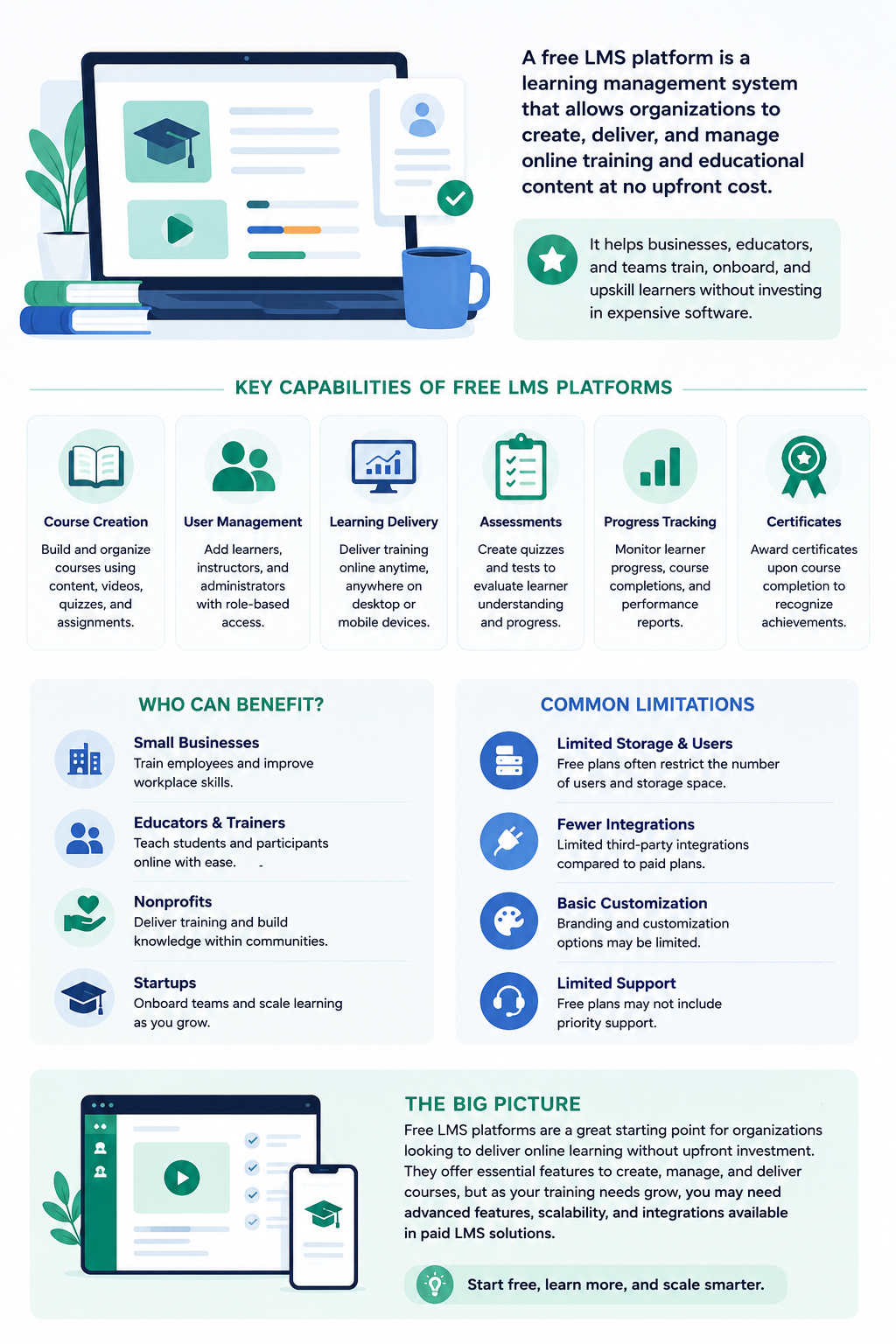
A free LMS platform, short for Learning Management System, is software designed to help businesses, schools, and organizations create, manage, deliver, and track online learning and employee training programs.
Think of it as a central hub where companies can store training materials, onboarding documents, courses, videos, quizzes, and employee learning resources all in one place.
Instead of sending training documents through endless emails or running in-person sessions every time a new employee joins, businesses can use a free LMS to make learning more organized, scalable, and accessible from anywhere.
The reason so many companies are now searching for learning management software free solutions is simple — training costs are rising fast.
According to Training Industry research, businesses spend billions every year on employee learning and development, while remote and hybrid work models continue increasing the need for digital training systems.
Now, it's important to understand that free LMS software and paid LMS platforms are not exactly the same thing.
Free LMS platforms are usually designed to help businesses get started with online learning without large upfront costs.
They often include core features like course management, employee onboarding, progress tracking, and mobile learning. However, some free plans may limit the number of users, storage space, advanced reporting, or automation features.
Paid LMS platforms, on the other hand, typically offer more advanced tools such as AI-powered learning recommendations, deeper analytics, custom branding, advanced compliance tracking, HR integrations, and enterprise-level support.
Larger organizations often upgrade once their training needs become more complex.
That said, many free LMS systems are surprisingly powerful and more than enough for startups, small businesses, nonprofits, and growing remote teams.
Most modern LMS platforms now include features like:
- Course creation and online training modules
- Employee onboarding workflows
- Progress tracking and completion reports
- Certificates and learning achievements
- Mobile learning for remote employees
- Video-based training content
- Quizzes and assessments
- Reporting dashboards and analytics
- Team collaboration and knowledge sharing
The biggest benefit is that employees can learn at their own pace while managers can easily track participation, course completion, and overall training performance from one central dashboard.
For businesses trying to improve onboarding, compliance training, or remote employee development without overspending, free LMS platforms have become one of the easiest ways to build a stronger learning culture.
Why Businesses Are Using Free LMS Platforms More Than Ever
Employee training has become a major priority for modern businesses, especially as remote work, AI tools, and digital transformation continue reshaping the workplace.
The challenge is that many companies simply don't have the budget for expensive enterprise training systems.
That's why more organizations are now turning to free LMS platforms, online learning tools, and employee training software to improve workforce development without huge upfront costs.
Modern businesses need affordable ways to:
- Train remote employees
- Improve employee onboarding
- Deliver compliance training
- Centralize company knowledge
- Support continuous learning
- Build scalable digital learning programs
Free learning platforms help companies achieve all of this while keeping training flexible and accessible.
Reduce Employee Training Costs
Traditional training methods can become expensive very quickly. Hiring trainers, organizing workshops, printing materials, and running repeated onboarding sessions often consume significant time and money.
With online training platforms and free learning management systems, businesses can create reusable digital courses, training videos, and onboarding programs employees can access anytime.
This is especially useful for:
- Startups with smaller budgets
- Growing businesses hiring quickly
- Nonprofits and charities
- Remote and hybrid teams
- Businesses with high staff turnover
Many companies now use corporate training software to standardize learning while reducing long-term training costs.
Improve Remote and Hybrid Employee Learning
Remote work has completely changed how businesses deliver training.
Employees are no longer sitting in one office attending classroom sessions together.
Modern e-learning platforms allow staff to complete courses from anywhere using laptops, tablets, or mobile devices. This makes learning far more flexible for distributed teams.
Businesses are increasingly investing in:
- Cloud-based LMS software
- Employee onboarding platforms
- Digital learning systems
- Workforce training tools
- Mobile learning platforms
These systems help businesses deliver consistent training experiences across multiple teams and locations.
Create a Centralized Knowledge Hub
One of the biggest workplace problems today is scattered information.
Employees often waste time searching through emails, shared drives, or outdated folders trying to find policies, processes, or training materials.
A modern LMS creates a centralized learning environment where businesses can store:
- Employee handbooks
- SOPs and documentation
- Compliance resources
- Video tutorials
- Internal certifications
- HR policies
- Skills development courses
- Company training materials
This improves knowledge management, supports continuous employee learning, and helps businesses build a stronger digital workplace culture.
Over time, organizations using employee learning software and online course management systems are able to scale training much more efficiently while keeping employees engaged and up to date with new skills.
Benefits of Using Free Learning Management Systems
Now that we understand what an LMS is, let's look at the direct benefits of using free LMS platforms and online learning software in your business.
- Reduce costs and save time - Traditional employee training can become expensive and time-consuming. With a free learning management system, businesses can create digital training programs, onboarding courses, and learning materials without paying for costly workshops or external trainers.
- Improve employee engagement - Most modern employee training platforms are designed to make learning more interactive and easier to complete. Features like quizzes, video learning, certifications, and progress tracking help keep employees engaged while giving businesses insights into what learners actually need.
- Streamline employee training - An LMS helps centralize onboarding, compliance training, company knowledge, and workforce learning into one organized system. This makes training more consistent while helping teams focus on productivity, collaboration, and continuous learning.
Free LMS Platforms Compared for Employee Training and Online Learning
Choosing the right LMS can feel overwhelming because every platform offers different features, pricing models, and learning tools.
Some are designed for employee onboarding and corporate training, while others focus more on online courses, education, or knowledge sharing.
To make things easier, the comparison table below breaks down some of the most popular free LMS platforms, including their best use cases, key features, advantages, and limitations.
Whether you're looking for employee training software, a cloud-based learning management system, or a simple online learning platform for remote teams, this guide will help you compare the options more quickly.
| Platform | Best For | Free Plan Available | Key Features |
| Moodle | Businesses needing customization and flexibility | Yes | Open-source LMS, course creation, quizzes, certifications, reporting, plugins |
| TalentLMS | Small businesses and remote teams | Yes | Employee onboarding, mobile learning, assessments, reporting dashboards |
| Google Classroom | Simple internal employee training | Yes | Google Workspace integration, assignments, file sharing, collaboration tools |
| Canvas LMS | Education and collaborative learning | Yes | Course management, discussions, grading tools, mobile access |
| Thinkific | Online courses and customer training | Yes | Course builder, video hosting, quizzes, landing pages |
| LearnDash | WordPress websites and online academies | Limited (plugin costs may apply) | WordPress LMS plugin, drip-feed content, certificates, quizzes |
| Chamilo LMS | Nonprofits and training organizations | Yes | Course authoring, tracking, certifications, learning paths |
| Open edX | Large-scale online learning platforms | Yes | Massive course support, analytics, interactive learning |
| iSpring Learn Free | Fast employee onboarding and compliance training | Yes | SCORM support, mobile learning, quizzes, progress tracking |
| Zoho Learn | Businesses already using Zoho tools | Yes | Knowledge bases, employee training, team collaboration |
1. Moodle — Best Open-Source LMS for Custom Employee Training
Moodle is one of the most widely used open-source learning management systems in the world.
It's especially popular with universities, nonprofits, and businesses that want full control over their online training environment.
Because Moodle is highly customizable, organizations can build tailored employee onboarding programs, compliance training courses, certification systems, and internal learning portals.
One of Moodle's biggest strengths is flexibility.
Businesses can install plugins, create advanced learning paths, track employee progress, and integrate the platform with HR systems or communication tools.
For companies looking for a scalable digital learning platform without expensive licensing costs, Moodle remains one of the strongest options available.
2. TalentLMS — Best LMS for Small Businesses and Remote Teams
TalentLMS is designed for businesses that want a simple, modern, and easy-to-manage learning platform without complicated setup requirements.
The platform is especially useful for remote teams, startups, and growing companies that need to deliver employee training quickly.
The interface is clean, beginner-friendly, and works well for onboarding, compliance courses, sales training, and staff development.
TalentLMS also supports mobile learning, quizzes, certifications, and training analytics, making it ideal for companies managing hybrid workforces.
For businesses looking for cloud-based employee training software that doesn't require technical expertise, TalentLMS is often one of the easiest platforms to implement.
3. Google Classroom — Best Simple Learning Platform for Internal Training
Google Classroom is commonly associated with schools and education, but many businesses also use it for lightweight employee learning and internal training.
Companies already using Google Workspace often find it convenient because employees can access training content directly through familiar Google tools.
The platform allows organizations to share documents, assign learning tasks, manage training resources, and organize simple onboarding programs. While it may not offer advanced corporate LMS features, it works well for smaller teams that need a fast and accessible learning solution.
For businesses wanting a simple employee education platform with minimal setup, Google Classroom can be a practical starting point.
4. Canvas LMS — Best Collaborative Learning Management System
Canvas LMS is known for its modern interface and strong collaboration features. It's widely used by educational institutions, but many organizations also use it for employee development, training programs, and collaborative online learning.
The platform supports discussions, multimedia learning, assignments, assessments, and mobile access, making it useful for businesses that want more interactive training experiences.
Canvas is particularly effective for organizations focused on continuous learning and team collaboration.
Its user-friendly design also helps improve employee adoption rates compared to more complex enterprise systems.
5. Thinkific — Best Platform for Online Courses and Customer Education
Thinkific is ideal for businesses, coaches, consultants, and creators who want to build online courses and training programs.
Unlike traditional corporate LMS platforms, Thinkific focuses heavily on course creation, digital learning experiences, and customer education.
Businesses can create video lessons, quizzes, downloadable resources, and branded training portals without technical experience. Many organizations use Thinkific for external training, partner education, and monetized online courses.
Its clean design and beginner-friendly course builder make it one of the easiest e-learning platforms for non-technical users.
6. LearnDash — Best WordPress LMS Plugin for Online Learning
LearnDash is one of the most popular LMS plugins for WordPress websites. It's commonly used by businesses, educational providers, and membership websites that want to create structured online learning experiences directly inside WordPress.
The platform includes features such as drip-feed content, quizzes, certifications, learner tracking, and course progression tools. Because it integrates deeply with WordPress, businesses can fully customize their learning environment while keeping control over branding and website functionality.
For companies already operating on WordPress, LearnDash offers a highly scalable online learning solution.
7. Chamilo LMS — Best Lightweight LMS for Nonprofits and Training Programs
Chamilo is a lightweight open-source LMS platform designed to simplify online learning and employee training. It's especially popular with nonprofits, educational organizations, and businesses looking for a simpler alternative to more complex LMS systems.
The platform includes course management, certifications, assessments, learning paths, and reporting tools while remaining relatively easy to manage. Chamilo is often chosen by organizations that want affordable workforce training software without extensive technical overhead.
Its simplicity makes it attractive for smaller organizations focused on practical employee learnin
8. Open edX — Best Enterprise-Scale Online Learning Platform
Open edX is a powerful learning management platform originally created by Harvard and MIT. It's designed for organizations that need to deliver large-scale online learning experiences to thousands of users simultaneously.
The platform supports interactive learning, video content, certifications, advanced analytics, and highly scalable training environments. Many universities, corporations, and government organizations use Open edX for enterprise learning and professional development programs.
Because of its advanced capabilities, Open edX is often best suited for organizations with dedicated technical resources.
9. iSpring Learn — Best LMS for Fast Employee Onboarding
iSpring Learn focuses heavily on employee onboarding, compliance training, and workforce education. The platform is designed to help businesses quickly create and deliver training materials without complicated setup processes.
Organizations can upload presentations, videos, quizzes, and training modules while tracking employee completion rates and certifications. The platform also supports mobile learning, making it ideal for remote employees and frontline workers.
Businesses looking for practical onboarding software and corporate training tools often choose iSpring Learn because of its simplicity and fast deployment
10. Zoho Learn — Best Knowledge Sharing and Team Learning Platform
Zoho Learn combines employee training with knowledge management and team collaboration features. Businesses can create internal knowledge hubs, learning manuals, onboarding guides, and structured training resources all within one platform.
The system works especially well for organizations already using Zoho products because of its ecosystem integrations. Teams can organize company knowledge, create collaborative workspaces, and build employee learning programs without needing multiple disconnected systems.
For businesses focused on internal documentation, process training, and team collaboration, Zoho Learn offers a flexible and affordable solution.
Key Features to Look for in a Free LMS Platform
Not all free LMS platforms offer the same features, so it's important to choose a system that supports your employee training and long-term business goals.
Here are some of the most important features to look for when comparing online learning platforms and employee training software.
- Mobile accessibility — Employees should be able to access training courses, onboarding materials, and learning resources from mobile devices, tablets, or laptops, especially for remote and frontline teams.
- Reporting and analytics — A good learning management system should include reporting tools that help track employee progress, course completion rates, certifications, and overall training performance.
- Course management — Look for platforms that make it easy to create, organize, update, and manage online courses, training materials, quizzes, and onboarding content.
- User-friendly interface — An LMS should be simple for both employees and administrators to use. Complex systems often reduce employee adoption and training completion rates.
- Integrations with business tools — Many businesses benefit from LMS platforms that integrate with HR software, communication tools, video conferencing apps, or productivity platforms like Google Workspace and Microsoft 365.
- Scalability for future growth — Even if your business is small today, choosing a scalable employee learning platform helps support future growth, larger teams, and more advanced training needs over time.
Common Limitations of Free LMS Software
While free LMS platforms can be incredibly useful for employee training and online learning, it's important to understand that most free plans come with some limitations.
For many small businesses these restrictions may not be a problem initially, but growing organizations may eventually need more advanced features.
- User limits — Many free learning management systems restrict the number of users, active learners, or administrators allowed on the platform.
- Limited reporting and analytics — Some platforms only provide basic training reports, making it harder to track employee performance, certifications, or advanced learning metrics.
- Branding restrictions — Free plans often include vendor branding and may not allow businesses to fully customize the learning environment with company logos or colors.
- Missing automation features — Advanced tools like automated onboarding workflows, AI learning recommendations, integrations, and compliance reminders are often reserved for paid plans.
- Storage limitations — Some LMS providers limit video uploads, course files, cloud storage, or multimedia content on free accounts.
Despite these limitations, many online learning platforms and employee training systems still offer enough functionality for startups, nonprofits, remote teams, and small businesses getting started with digital learning.
How to Choose the Right Free LMS for Your Business
Choosing the right free LMS platform depends on your business goals, team size, and the type of employee training you want to deliver. Teams evaluating a branded internal academy often shortlist an employee training LMS such as Uteach alongside these free options.
While many online learning platforms offer similar core features, not every system will fit your workflow or long-term growth plans.
Here are some important things to consider before selecting a learning management system.
Define Your Employee Training Goals
Start by understanding what you actually need the LMS for.
Some businesses only need basic onboarding and compliance training, while others may require advanced course management, certifications, or continuous employee development.
Think about whether you need the platform for:
- Employee onboarding
- Compliance training
- Remote workforce learning
- Customer education
- Skills development
- Internal knowledge sharing
Clear training goals will help narrow down the best LMS solution for your business.
Consider Your Team Size
Some free learning management systems limit the number of active users or courses available under free plans.
A platform that works well for a startup with 10 employees may not scale properly for a business with hundreds of users.
If your company is growing quickly, it's important to choose an LMS that can scale alongside your workforce without creating major migration challenges later.
Evaluate Software Integrations
Many businesses already rely on tools like Google Workspace, Microsoft 365, Zoom, Slack, HR software, or project management systems.
Choosing an LMS that integrates with your existing software can make training much easier to manage.
Strong integrations also help improve:
- User experience
- Employee productivity
- Training automation
- Knowledge sharing
- Workflow efficiency
A connected digital workplace often leads to better employee adoption.
Check Mobile Learning Support
Modern employees expect flexibility, especially remote workers and frontline teams.
A good employee training platform should allow users to complete courses, watch videos, and access learning materials from mobile devices.
Mobile-friendly LMS software is especially important for:
- Remote employees
- Field workers
- Hybrid teams
- Hospitality staff
- Healthcare workers
- Frontline employees
The easier learning is to access, the more likely employees are to complete training.
Compare Upgrade Pricing and Scalability
Even if you start with a free LMS, there's a good chance your training needs will grow over time.
Some platforms become expensive very quickly once you add more users, advanced reporting, automation tools, or storage.
Before choosing a platform, compare:
- Paid upgrade costs
- Storage limitations
- User pricing models
- Feature restrictions
- Enterprise capabilities
This helps businesses avoid unexpected costs later while ensuring the platform can support long-term employee learning and workforce development.
Looking for a More Advanced Learning Management System?
Looking for a More Advanced Learning Management System
While free LMS platforms are a great starting point, many growing businesses eventually need more advanced employee training, onboarding, and knowledge-sharing capabilities.
That's where AgilityPortal comes in.
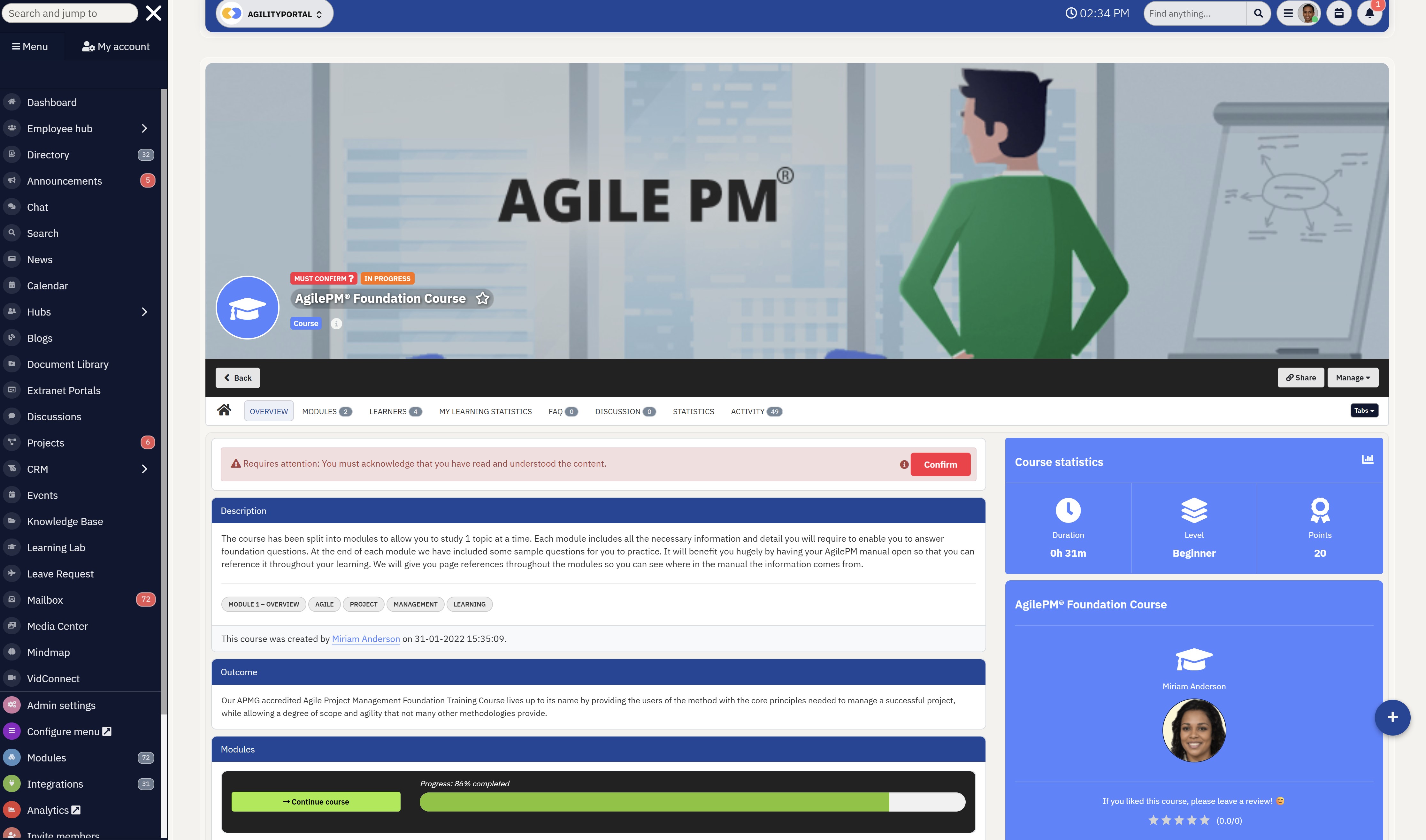
AgilityPortal includes a built-in learning management system called My Learning Lab, designed to help businesses deliver modern employee training, compliance programs, onboarding courses, and digital learning experiences from one centralized platform.
With My Learning Lab, businesses can:
- Import and manage SCORM packages
- Create rich interactive learning content
- Issue employee certificates and course completions
- Track learner progress and training analytics
- Deliver onboarding and compliance training
- Support remote and hybrid employee learning
- Centralize company knowledge and workforce development
Unlike standalone LMS tools, AgilityPortal also combines employee communication, document management, collaboration tools, knowledge sharing, and digital workplace features into one connected platform.
For businesses looking to move beyond basic training software and build a more engaging employee experience, My Learning Lab helps create scalable learning environments that employees actually enjoy using.
AgilityPortal
Best for Employee Training, SCORM Learning, and Workforce Upskilling
AgilityPortal includes a built-in learning management system called My Learning Lab, helping businesses centralize employee onboarding, compliance training, online learning, certifications, and workforce development in one secure digital workplace.
Modern Learning Management System
Import SCORM packages, create rich interactive learning content, issue employee certificates, track learner progress, and deliver engaging online training experiences across remote and hybrid teams.
Final Thoughts
Free LMS platforms have become one of the easiest ways for businesses to improve employee training, onboarding, and online learning without investing in expensive enterprise systems.
As remote work, AI tools, and digital transformation continue changing the workplace, companies need flexible learning solutions that can scale alongside their teams.
The right learning management system can help businesses centralize training materials, improve compliance education, support workforce development, and create a stronger learning culture across the organization.
Many modern online learning platforms now offer features like mobile learning, reporting dashboards, course management, certifications, and employee progress tracking completely free.
That said, not every LMS is built the same. Some platforms are better for small businesses, while others are designed for large-scale employee training or customer education.
The best approach is to focus on usability, scalability, integrations, and long-term training goals before choosing a platform that fits your business needs both now and in the future.
AI Summary
- Free LMS platforms help businesses deliver employee training, onboarding, compliance learning, and skills development without large software costs.
- Modern learning management systems make it easier to create online courses, track learner progress, manage certifications, and support remote or hybrid teams.
- Businesses often use free LMS software to reduce training costs, centralise learning materials, and make employee development more consistent across departments.
- The best free LMS platforms include tools for course creation, mobile learning, reporting, quizzes, assessments, knowledge sharing, and online training delivery.
- Popular free LMS options include Moodle, TalentLMS, Google Classroom, Canvas LMS, Thinkific, LearnDash, Chamilo LMS, Open edX, iSpring Learn, and Zoho Learn.
- Before choosing a free LMS, companies should compare user limits, storage restrictions, upgrade pricing, integrations, ease of use, and long-term scalability.
Most Popular Posts

Effective communication among team members is vital for the productivity and success of any organization. Surprisingly, 60% of companies lack a long-term internal communication strategy, which p...


Businesses thrive on communication for efficiency, productivity and accomplishment. When the right information is passed from the right designation in the organization, it promotes positivity an...

Categories
Blog
(3206)
Business Management
(395)
Employee Engagement
(235)
Digital Transformation
(218)
Growth
(150)
Intranets
(142)
Internal communications
(106)
Remote Work
(68)
Sales
(53)
Collaboration
(52)
Customer Experience
(33)
Culture
(30)
Knowledge Management
(29)
Project management
(29)
Leadership
(20)
Comparisons
(9)
News
(1)

Related Posts

An AI coworker could help solve a problem most businesses know well: too much knowledge work and too little time. Employees spend their day searching for information, preparing updates and answering the same questions. Having a system tha...

When is the right time to upgrade to a self-hosted AI agent—and how do you know whether switching will solve your team's problems or create more work? Picture an employee asking your AI assistant where to find the latest leave policy. It cannot...

Could an AI coworker take some of the busywork off your team's plate? The best AI coworkers promise to help employees research topics, prepare documents, find information and handle recurring tasks. But choosing one means looking beyond an impressive...

Are your company updates reaching everyone—or just the employees who have time to check their inbox? Intranet and digital signage can help you connect with people who rarely sit at a desk, work different shifts or miss announcements buried betw...

How many customers could your business lose while your team is too busy to answer—and could a customer service AI agent help close that gap? Missed calls and unanswered messages can mean lost bookings, frustrated customers and more pressure on employ...
![Follow Google News Best Free LMS Platforms for Employee Training + Online Learning in 2026 [Expert Picks] - Insight Blog](/images/Follow Google News.png)
![rss-subscribe Best Free LMS Platforms for Employee Training + Online Learning in 2026 [Expert Picks] - Insight Blog](/images/rss-subscribe.png)
Jill Romford
I am a digital nomad, lover of exploring new places and making friends.
I love to travel and I love the internet. I take pictures of my travels and share them on the internet using Instagram.
Traveler, entrepreneur, and community builder. I share my insights on digital marketing and social media while inspiring you to live your fullest life.
Ready to learn more? 👍
One platform to optimize, manage and track all of your teams. Your new digital workplace is a click away. 🚀
Free for 14 days, no credit card required.