
Insight Blog
Agility’s perspectives on transforming the employee's experience throughout remote transformation using connected enterprise tools.
15 minutes reading time
(2949 words)
How Employee Engagement Improves Employer Branding and Local Brand Awareness

How Employee Engagement Improves Employer Branding and Local Brand Awareness
Discover how employee engagement improves employer branding, local SEO, customer trust, and brand awareness. Learn why engaged employees help businesses grow faster locally.
How Employee Engagement Improves Employer Branding and Local Brand Awareness

Most businesses invest heavily in marketing, advertising, social media, and SEO to attract new customers, but many overlook one of their most valuable marketing assets: their employees.
That's where employee engagement comes in.
Employee engagement refers to how emotionally connected and committed employees feel toward their workplace, their colleagues, and the company's goals.
When employees genuinely care about the success of the business, they're more likely to provide exceptional customer service, recommend the company to others, and speak positively about their employer both online and offline.
Gallup reports that highly engaged workplaces experience 43% lower employee turnover in low-turnover organizations.
This demonstrates how employee engagement helps businesses retain talent, reduce hiring costs, and maintain stronger workplace culture.
43%
lower turnover
Gallup reports that highly engaged workplaces experience 43% lower employee turnover in low-turnover organizations, showing how employee engagement helps businesses retain talent, reduce hiring costs, and build a stronger workplace culture.
Source: Gallup
What many business owners don't realize is that employee engagement also plays a role in strengthening employer branding and even supporting local SEO efforts.
When employees create positive customer experiences, earn positive reviews, share company content, and advocate for the business within their communities, they help increase brand awareness and trust—two factors that can significantly influence local visibility.
In this article, we'll explore how employee engagement helps businesses build stronger employer brands, improve their local reputation, generate more customer trust, and ultimately increase local brand awareness through the people who represent the company every day.
Key Takeaways
- Employee engagement directly influences employer branding, customer satisfaction, and overall business reputation.
- Engaged employees often become brand ambassadors who help increase local brand awareness through advocacy, referrals, and positive customer interactions.
- Strong employee engagement can support local SEO efforts by generating more positive reviews, customer recommendations, and trust signals.
- Businesses with engaged workforces are more likely to create exceptional customer experiences that strengthen loyalty and community trust.
- Improving internal communication, recognition, and workplace culture helps organizations build a stronger brand from the inside out.
What Is Employee Engagement and Why Does It Matter?
If you've ever worked somewhere that made you feel valued, informed, and motivated to do your best work, you've experienced employee engagement firsthand.
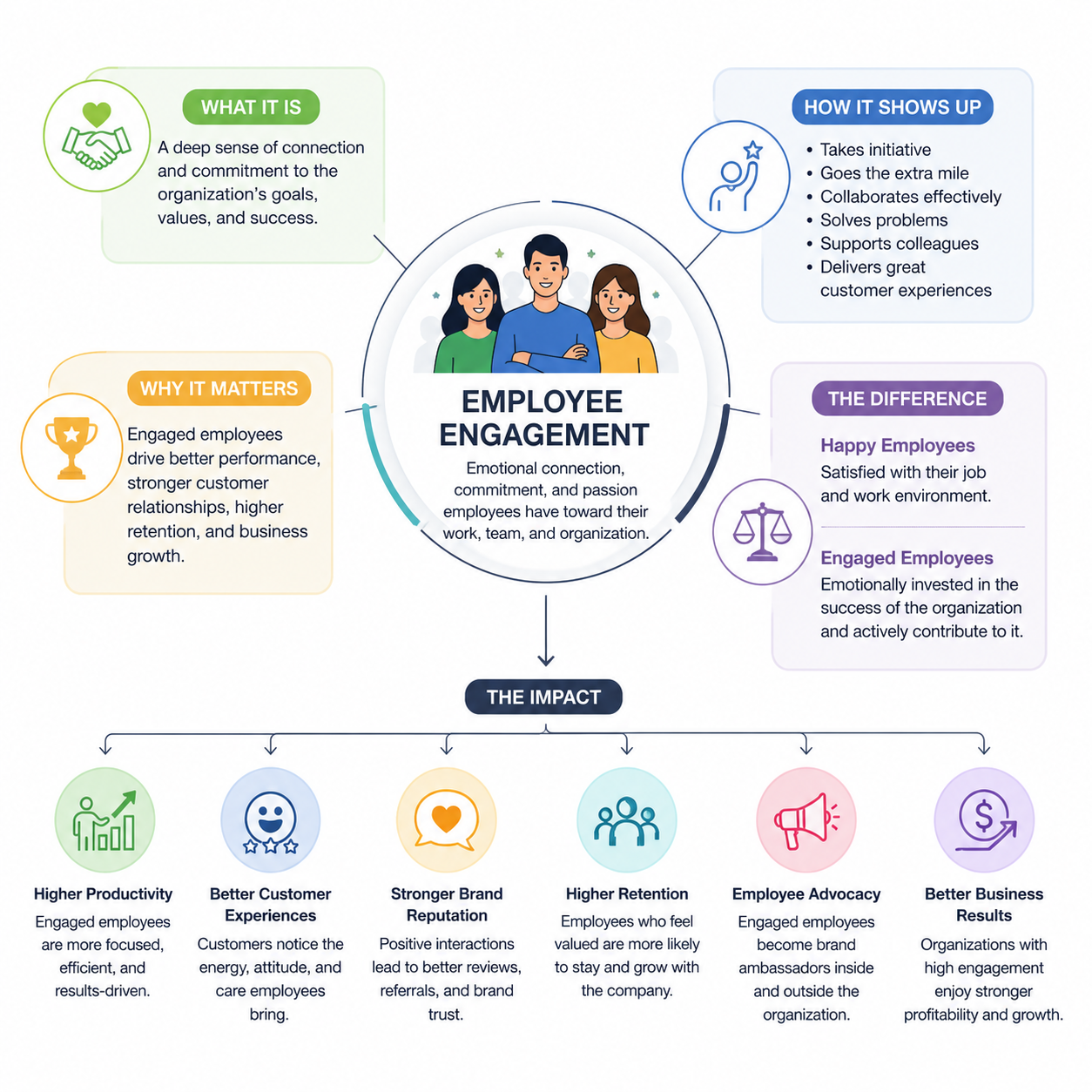
Many people confuse employee engagement with employee happiness, but they aren't the same thing.
An employee can be happy with their salary or work environment while still feeling disconnected from the company's mission and goals.
What Is Employee Engagement and Why Does It Matter?
True employee engagement goes much deeper. It reflects how committed employees are to helping the business succeed and whether they feel emotionally invested in their work.
This matters because engaged employees have a direct impact on customer experiences, company culture, productivity, and even brand reputation.
In today's competitive market, businesses that prioritize employee engagement often outperform those that don't.
Research from Gallup found that highly engaged teams achieve 23% higher profitability than teams with low engagement levels, demonstrating the significant business value of an engaged workforce.
23%
higher profitability
Research from Gallup found that highly engaged teams achieve 23% higher profitability than teams with low engagement levels, demonstrating the significant business value of an engaged workforce.
Source: Gallup
The Difference Between Happy Employees and Engaged Employees
While both are important, there is a significant difference between employee satisfaction and employee engagement.
A happy employee may:
- Enjoy their workplace environment
- Be satisfied with their salary and benefits
- Have positive relationships with colleagues
- Feel comfortable in their role
An engaged employee will:
- Actively contribute new ideas
- Take ownership of their responsibilities
- Go above and beyond for customers
- Advocate for the company both online and offline
- Help strengthen company culture
For organizations focused on improving employee engagement, the goal is not simply to keep employees happy but to create a workforce that feels connected to the company's purpose and long-term success.
How Employee Engagement Influences Brand Perception
Every interaction between an employee and a customer contributes to how people view a business.
Whether it's a retail store, healthcare provider, restaurant, nonprofit organization, or professional services firm, employees often become the face of the brand.
When employee engagement is high, customers typically notice:
- Better customer service experiences
- Faster response times
- More knowledgeable staff
- Increased professionalism
- Stronger customer relationships
These positive experiences often lead to:
- More positive online reviews
- Increased customer loyalty
- Higher customer retention rates
- Stronger employer branding
- Improved local brand awareness
From a local SEO perspective, positive customer interactions frequently result in more Google reviews and brand mentions, both of which can help improve local search visibility.
Simply put, engaged employees don't just improve workplace performance—they help build trust, strengthen employer branding, and create the positive reputation that businesses need to grow within their local communities.
The Connection Between Employee Engagement and Employer Branding

The Connection Between Employee Engagement and Employer Branding
Think about the last time someone recommended a company to you. Chances are it wasn't an advertisement that convinced you—it was a positive experience shared by an employee or customer.
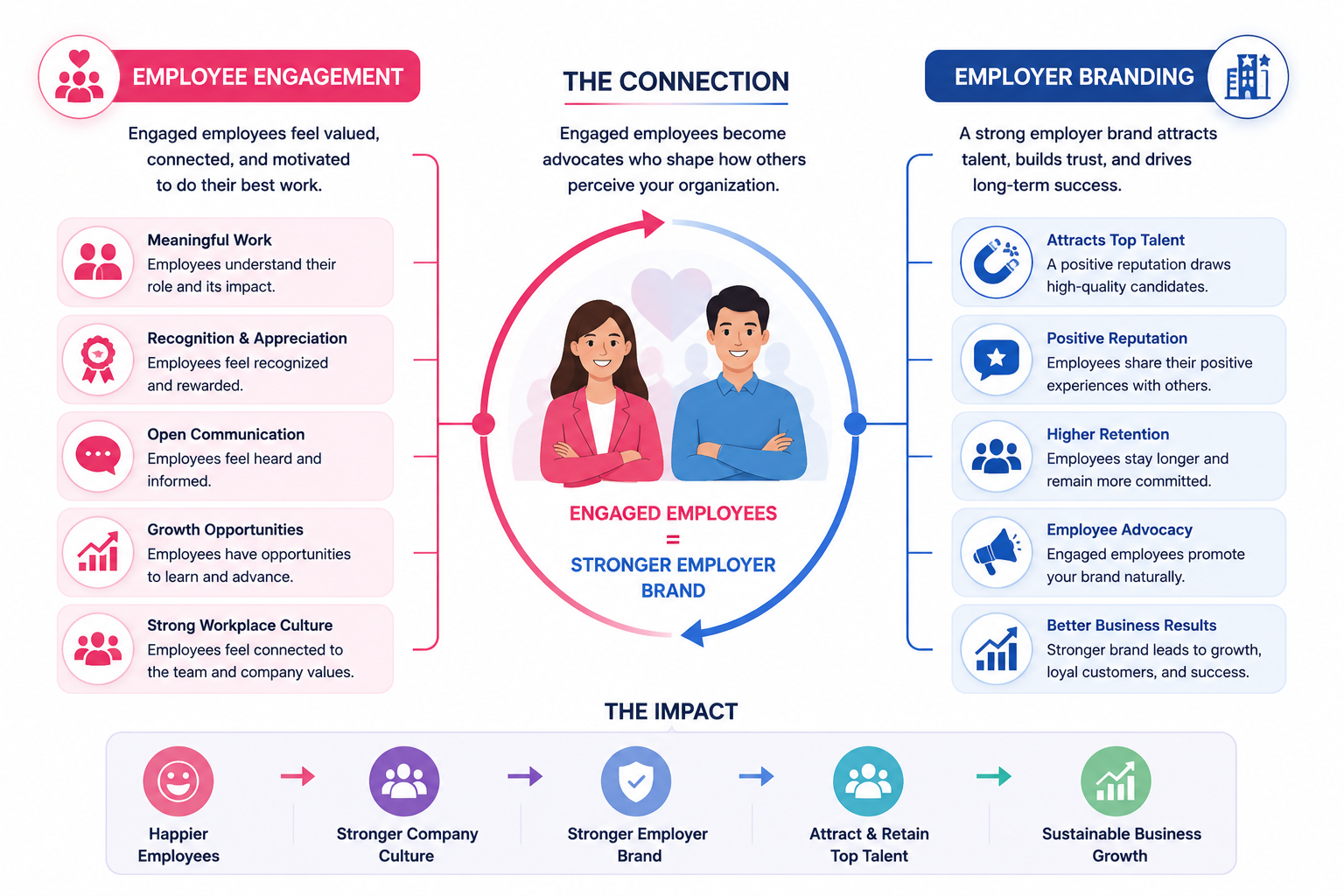
That's why employee engagement plays such a critical role in employer branding.
Engaged employees naturally become brand ambassadors.
They talk positively about their workplace, share company updates on social media, and recommend their employer to friends, family, and potential candidates. This type of authentic advocacy builds far more trust than traditional marketing.
A strong company culture also strengthens brand perception by creating:
- Greater transparency across the organization
- More employee recognition and appreciation
- Stronger employee advocacy and referrals
- Better customer experiences
For example, a local retail business introduced an employee recognition program and regularly celebrated staff achievements.
Within months, employee morale improved, customer reviews increased, and job applications rose significantly.
This demonstrates how employee engagement can directly improve employer branding, attract talent, and strengthen local brand awareness.
The Connection Between Employee Engagement and Employer Branding
How Employee Engagement Supports Local SEO
Many businesses invest heavily in local SEO to improve their visibility in local search results, but they often overlook the human factor behind online reputation.
While technical SEO, citations, and local content are important, employee engagement can significantly influence the factors that help businesses rank and build trust.
For example, agencies like Orchard Marketing Local SEO may focus on optimizing Google Business Profiles, local citations, and search performance. However, those efforts become far more effective when supported by employees who consistently deliver outstanding customer experiences.
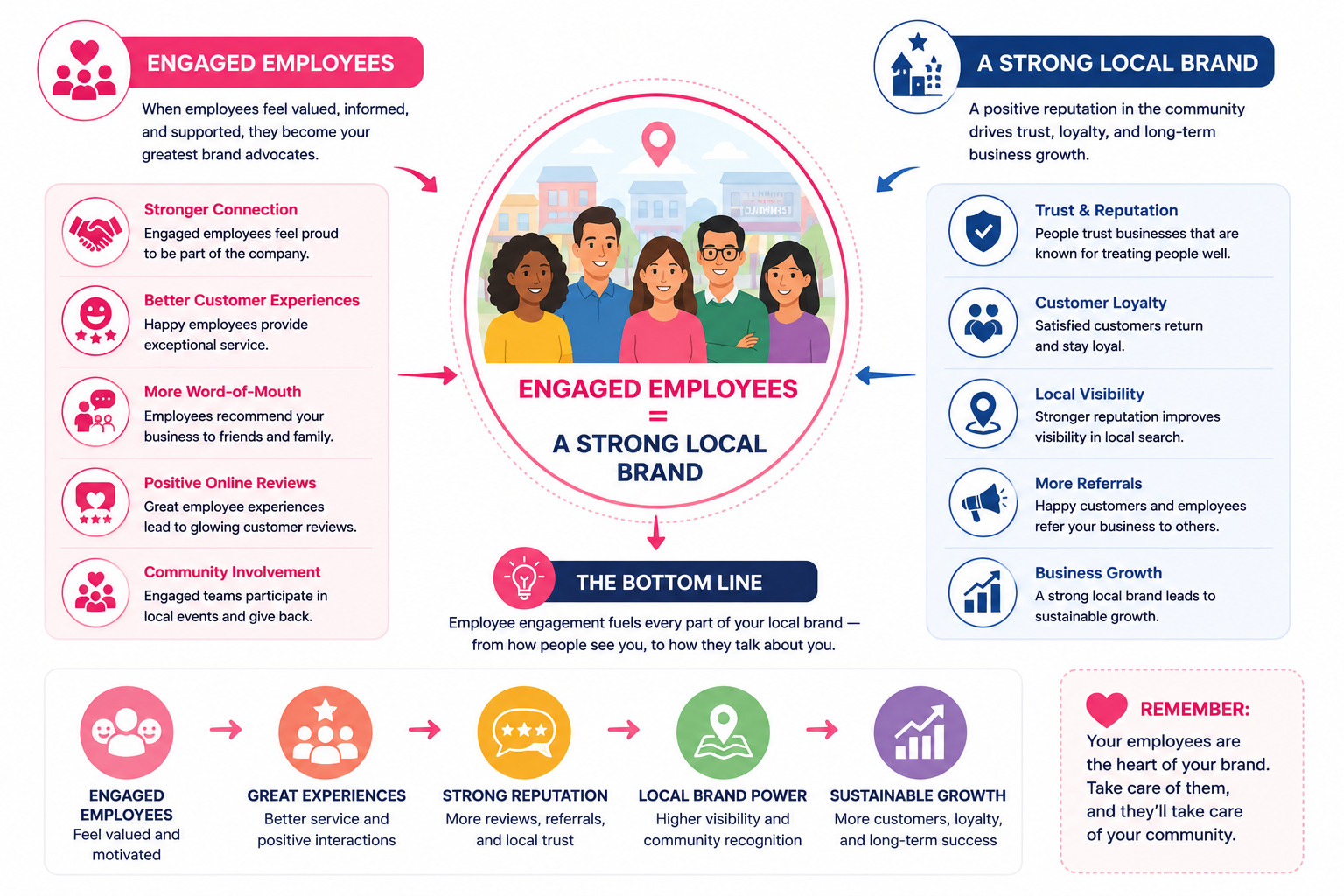
When employees are engaged, businesses often benefit from:
- Better review frequency on Google and local directories
- Higher customer satisfaction scores
- Increased referral activity
- More repeat customers
- Greater local brand trust
These outcomes directly support important local ranking signals. Positive reviews, strong customer sentiment, and brand mentions all contribute to improved local search visibility.
While local SEO may help customers discover a business initially, employee engagement helps create the positive experiences that encourage customers to leave reviews, recommend the business, and return in the future.
In other words, search visibility may begin through optimization, but reputation sustains visibility over time.
How Employee Engagement Supports Local SEO
Why Employee Engagement Is the Secret to Building a Strong Local Brand
When businesses think about growing their local reputation, they often focus on advertising, social media, local SEO, and customer reviews.
While these strategies are important, many organizations overlook one of the most powerful drivers of local brand success: employee engagement.
Engaged employees do more than complete their daily tasks.
They become advocates for the business, create better customer experiences, strengthen company culture, and help build trust within the local community.
In fact, businesses with highly engaged employees often enjoy stronger customer loyalty, improved online reviews, and greater brand visibility than their competitors.
Why Employee Engagement Matters for Local Brand Growth
Employee engagement refers to the emotional commitment employees have toward their organization.
Engaged employees are more likely to go above and beyond, recommend their employer to others, and positively represent the company both online and offline.
For local businesses, this can have a significant impact.
Customers frequently interact directly with employees, whether in retail stores, healthcare facilities, hospitality venues, professional services firms, or nonprofit organizations.
Every interaction contributes to the public perception of the brand.
When employees are motivated and connected to the company's mission, customers notice. Positive experiences often translate into stronger word-of-mouth referrals, repeat business, and better online reviews.
The Connection Between Employee Engagement and Local SEO

The Connection Between Employee Engagement and Local SEO
Many business owners do not realize that employee engagement can indirectly improve local SEO performance.
Google's local search algorithm relies heavily on signals such as:
- Customer reviews
- Brand mentions
- Local citations
- User engagement
- Business reputation
- Community involvement
Engaged employees contribute to many of these ranking factors.
For example, employees who provide exceptional customer service are more likely to generate positive reviews on Google Business Profile, Yelp, and other review platforms. Positive reviews remain one of the strongest local ranking signals.
Additionally, engaged employees often share company content on social media, participate in local events, and encourage community discussions about the business.
These activities increase online visibility and create valuable local brand signals that search engines use when evaluating trust and relevance.
Employee Advocacy Creates Brand Visibility

Employee Advocacy Creates Brand Visibility
One of the most overlooked marketing assets in any organization is its workforce.
Employee advocacy occurs when employees voluntarily promote their company through social media posts, referrals, recommendations, and community involvement.
Research consistently shows that content shared by employees often receives higher engagement than content shared directly by corporate brand accounts.
For local businesses, employee advocacy can help:
- Expand local reach
- Increase brand awareness
- Generate trust with prospective customers
- Attract new talent
- Improve employer branding
When employees actively support and talk positively about their workplace, they effectively become brand ambassadors within their communities.
Practical Ways to Improve Employee Engagement
Practical Ways to Improve Employee Engagement
Improving employee engagement doesn't always require major investments or complex initiatives.
In many cases, small but consistent improvements can have a significant impact on how employees feel about their workplace and how they represent the business.
Start by strengthening internal communication.
Employees are more engaged when they understand company goals, receive regular updates, and feel informed about important decisions.
Clear communication helps employees feel connected to the organization's mission rather than isolated from it.
Recognition is equally important.
Employees who feel appreciated for their contributions are more likely to remain motivated and committed to their work.
Simple recognition programs, peer-to-peer praise, and celebrating achievements can significantly boost morale.
Organizations should also create opportunities for employee feedback.
Regular surveys, suggestion programs, and open communication channels allow employees to share ideas and feel heard.
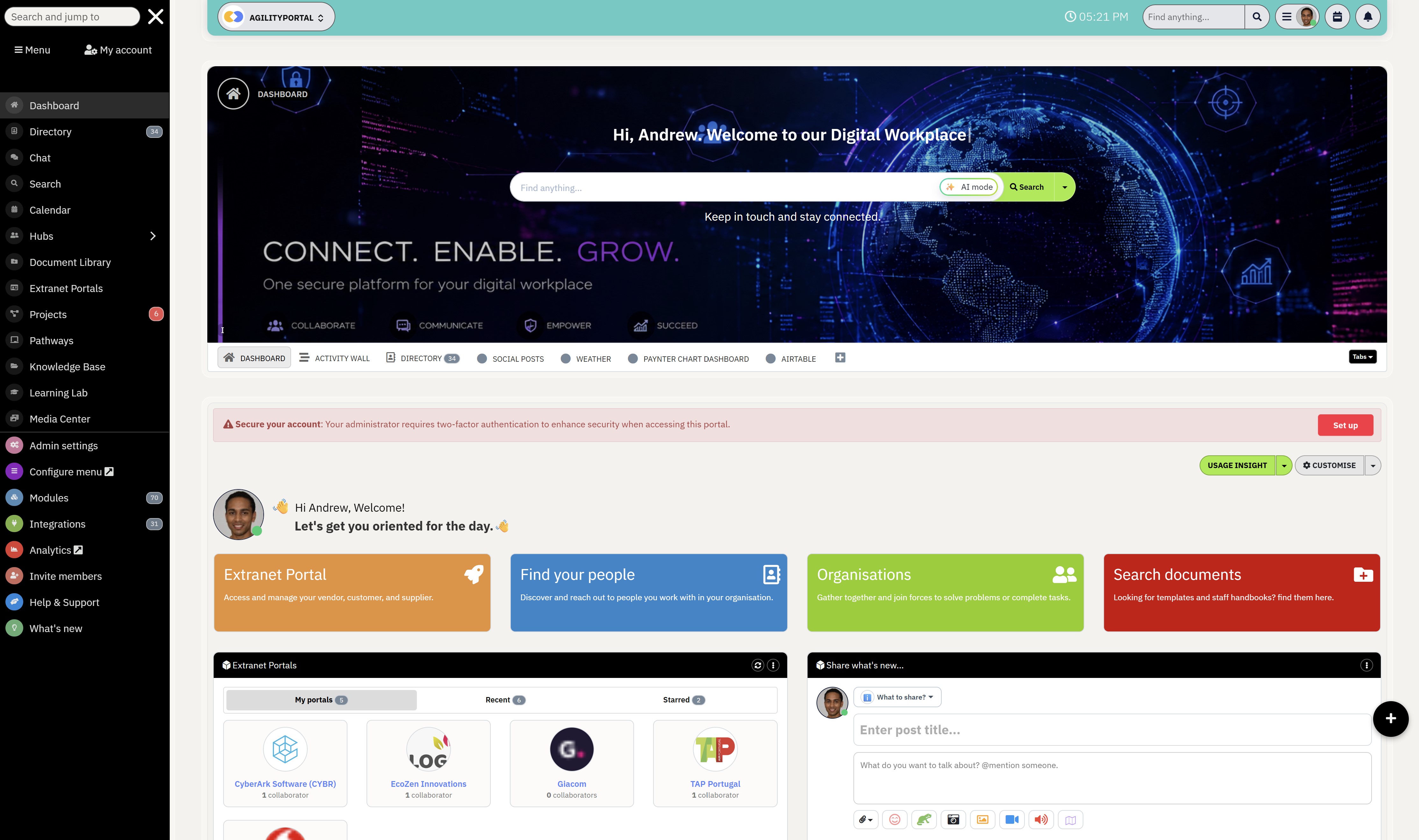
Modern employee communication platforms such as AgilityPortal can support these initiatives by centralizing company news, employee recognition, surveys, social interactions, and collaboration tools in one place.
By keeping employees informed, connected, and engaged, businesses can strengthen company culture, improve employer branding, and build a workforce that positively represents the organization both online and within the local community.
Employee Engagement Platform
Build a More Engaged and Connected Workforce
Employee engagement doesn't happen by accident. It requires consistent communication, recognition, collaboration, and a workplace culture that helps employees feel valued and connected.
AgilityPortal helps organizations improve employee engagement through company news, employee recognition, surveys, social collaboration, knowledge sharing, and mobile communication—all from one secure digital workplace platform.
Book a Free Demo
No credit card required · Free onboarding support included
Final Thoughts
Many organizations still view employee engagement as purely an HR responsibility, but its impact extends far beyond the workplace.
Engaged employees influence customer experiences, online reviews, employer branding, and even local SEO performance.
Every interaction an employee has with a customer contributes to how the business is perceived within the community.
When employees feel connected to the company's mission, they are more likely to provide exceptional service, recommend the business to others, and act as genuine brand advocates.
These positive experiences often result in stronger customer loyalty, better online reviews, increased referrals, and improved brand visibility.
Businesses that invest in employee engagement, internal communication, and workplace culture are not only creating a better employee experience—they are also building a stronger local brand.
In today's competitive market, companies that prioritize their people are often the ones that earn the greatest trust, strengthen their reputation, and achieve long-term growth within their local communities.
AI Summary
- Employee engagement refers to the emotional commitment employees have toward their organization, influencing productivity, workplace culture, customer experiences, and business performance.
- Highly engaged employees often become brand ambassadors who help strengthen employer branding through positive customer interactions, referrals, social advocacy, and community involvement.
- Businesses with strong employee engagement programs typically experience higher employee retention, better customer satisfaction, and improved workplace morale.
- Employee engagement can indirectly support local SEO by generating more positive reviews, stronger customer loyalty, increased brand mentions, and greater local trust signals.
- Key drivers of employee engagement include effective internal communication, employee recognition, feedback opportunities, career development, and a strong company culture.
- Modern employee engagement platforms help organizations centralize communication, recognition, collaboration, surveys, and knowledge sharing to create a more connected workforce.
Most Popular Posts

Effective communication among team members is vital for the productivity and success of any organization. Surprisingly, 60% of companies lack a long-term internal communication strategy, which p...


Businesses thrive on communication for efficiency, productivity and accomplishment. When the right information is passed from the right designation in the organization, it promotes positivity an...
Categories
Blog
(2966)
Business Management
(372)
Employee Engagement
(223)
Digital Transformation
(191)
Growth
(142)
Intranets
(135)
Remote Work
(63)
Sales
(53)
Collaboration
(47)
Customer Experience
(30)
Culture
(29)
Knowledge Management
(28)
Project management
(28)
Leadership
(20)
Comparisons
(9)
News
(1)

Related Posts

Most businesses invest heavily in marketing, advertising, social media, and SEO to attract new customers, but many overlook one of their most valuable marketing assets: their employees. That's where employee engagement comes in. Employee engage...

Partner enablement software has become essential for businesses that rely on distributors, resellers, affiliates, consultants, suppliers, and channel partners to generate revenue. As partner networks grow, many organizations struggle with inconsisten...

Partner enablement is becoming a critical growth strategy for businesses that rely on distributors, resellers, suppliers, franchisees, or strategic partners. As partner networks expand, organizations need a better way to share information, deli...

If your business relies on resellers, distributors, affiliates, consultants, or channel partners, one small communication breakdown can quickly turn into missed revenue, frustrated partners, and lost opportunities. That's exactly why more companies a...

As businesses continue evolving through digital transformation, hybrid work, and AI-powered collaboration, the need for a modern knowledge management framework has become more important than ever. According to IDC, employees spend nearly 30% of...


Jill Romford
I am a digital nomad, lover of exploring new places and making friends.
I love to travel and I love the internet. I take pictures of my travels and share them on the internet using Instagram.
Traveler, entrepreneur, and community builder. I share my insights on digital marketing and social media while inspiring you to live your fullest life.
Ready to learn more? 👍
One platform to optimize, manage and track all of your teams. Your new digital workplace is a click away. 🚀
Free for 14 days, no credit card required.