
Insight Blog
Agility’s perspectives on transforming the employee's experience throughout remote transformation using connected enterprise tools.
27 minutes reading time
(5361 words)
The Internal Comms Calendar Most Teams Get Wrong (Steal This Step-by-Step Template)

The Internal Comms Calendar Most Teams Get Wrong (Steal This Step-by-Step Template)
Plan smarter internal communication with an Internal Comms Calendar. Learn how an Internal Comms Calendar Template improves clarity, timing, and team alignment.
The Internal Comms Calendar Most Teams Get Wrong (Steal This Step-by-Step Template)

Most teams don't lack internal communication. They lack structure.
On paper, everything looks fine. There's a shared spreadsheet.
A few dates pencilled in. Maybe even colour-coding. That's usually where the internal comms calendar template comes in — and where the false sense of confidence starts.
Here's the hard truth: having a calendar is not the same thing as having a communication strategy.
What actually happens inside most organisations is predictable. Messages get written last minute. Important updates compete with "nice to know" posts.
Engagement drops, so teams post more… which makes things worse.
Before long, employees tune out, leaders lose trust in internal comms, and the calendar becomes a box-ticking exercise instead of a tool that drives alignment.
The data backs this up. Industry research consistently shows that over 60% of internal communication initiatives fail to meet their objectives, not because teams don't communicate enough, but because messages are poorly timed, poorly prioritised, or disconnected from real work.
Another widely cited stat shows that employees ignore or skim more than half of internal messages when communication feels random or repetitive.
That's not an attention problem — it's a planning problem.
● Industry Insight
Industry research consistently shows that over 60% of internal communication initiatives fail to meet their objectives—not because teams don’t communicate enough, but because messages are poorly timed, poorly prioritised, or disconnected from real work.
This article exists for one simple reason: to fix that.
We're going to break down why most internal comms calendars quietly fail behind the scenes, what teams usually get wrong when they try to "be more organised," and how to rebuild your approach step by step so communication actually supports the business instead of adding noise.
You'll also get practical guidance and reusable templates you can adapt to your own team — not theory, not fluff, and definitely not another calendar that looks good but goes unused.
If internal comms feels harder than it should be right now, you're not alone. Let's straighten it out.
● Key Takeaways
- An internal comms calendar only works when it is built around outcomes, not posting frequency.
- Alignment comes before tools; calendars fail when teams skip purpose and ownership.
- Simple, flexible formats outperform complex setups and are more likely to be used long term.
- Separating internal, external, and client messaging prevents priority clashes and confusion.
- Calendars should plan themes and intent, not lock teams into rigid long-term messaging.
- Regular review and adaptation keeps internal communication relevant as the organisation changes.
What is an Internal Comms Content Calendar?
An internal comms content calendar is a simple planning framework—often starting life as a spreadsheet—that maps out what messages are going out, when they'll be shared, and who they're for.
Think of it as the backbone of your Online Platform for Communication in the Workplace or internal communications calendar template excel, giving you a clear, visual view of how communication flows across the organisation.
At its core, it's not just about dates.
A good communication calendar template shows how ideas move from planning to approval to delivery, so internal comms doesn't feel reactive or chaotic.
Instead of scrambling week to week, everyone can see what's coming, why it matters, and how it fits into the bigger picture.

What is an Internal Comms Content Calendar
Why Do You Need an Internal Comms Content Calendar?
Marketing teams figured this out years ago: without a calendar, content becomes inconsistent, rushed, and forgettable. Internal comms works the same way.
You're still influencing behaviour, shaping understanding, and building trust—you're just doing it with employees instead of customers.
Using a structured calendar gives you real, practical advantages:
- Consistency in how internal messages are planned and delivered, instead of bursts of activity followed by silence
- Authority and credibility, because leaders and teams can see that communication is intentional, not improvised
- Smoother workflows, with deadlines, approvals, and ownership planned ahead of time
- Stronger collaboration between internal comms, leadership, HR, and other departments
- Better organisation, so you're not chasing sign-off or content at the last minute
- Clearer respect for the process, your role, and the timelines required to do comms properly
Put simply, a calendar turns internal communication from a reactive task into a reliable system.
And in organisations where clarity, speed, and trust matter, that shift makes a noticeable difference fast.
Read this article: : Top 6 AI-Powered Project Management Tools To Use In 2023
What Teams Get Wrong About Planning Internal Communication (and Why It Hurts More in 2026)
Most organisations think planning internal communication means filling dates on a calendar.
If something goes out every week, they assume the job's done.
That mindset is exactly why so many teams struggle with engagement, clarity, and trust — and why the problem gets sharper in 2026.
The biggest mistake? Confusing posting with purpose.
A typical comms schedule answers questions like when something will be shared and where it will be posted.
What it usually doesn't answer is why that message exists, who actually needs it, or what should happen after someone reads it. When those questions aren't clear, communication becomes background noise instead of a driver of action.
This is where activity gets mistaken for alignment.
Teams stay busy publishing updates, leadership sees messages going out, and dashboards show "engagement" through views or clicks. But behaviour doesn't change.
Decisions still stall.
Employees still ask the same questions.
In 2026, with hybrid work fully normalised and AI-generated content everywhere, this disconnect becomes even more damaging.
People are exposed to more information than ever, so relevance matters far more than volume.

What Teams Get Wrong About Planning Internal Communication (and Why It Hurts More in 2026)
The friction usually shows up between leadership, HR, and Ops.
Leaders want visibility and reassurance. HR wants consistency and compliance. Ops wants fewer interruptions and clearer priorities.
When internal communication planning isn't outcome-driven, the calendar becomes a compromise that satisfies no one. Messages get watered down, timing feels off, and frontline teams feel like comms is something done to them, not for them.
Research consistently shows the cost of this approach.
Studies indicate that employees now spend 20–25% of their working week searching for information or clarifying context, largely because communication isn't delivered when and where it's needed.
In 2026, that lost time directly impacts productivity, retention, and execution — especially as teams operate across time zones, tools, and work patterns.
● Industry Insight
Research consistently shows the hidden cost of poor communication planning. Employees now spend 20–25% of their working week searching for information or clarifying context, largely because communication isn’t delivered when and where it’s needed. In 2026, this lost time directly impacts productivity, retention, and execution—especially as teams operate across time zones, tools, and hybrid work patterns.
The shift that high-performing organisations make is simple but powerful: they plan communication around outcomes, not output.
Instead of asking "what do we post this week?", they ask "what decision, behaviour, or understanding needs to exist after this message lands?"
When planning starts there, the calendar stops being a content checklist and starts becoming a coordination tool.
And in 2026, that difference isn't optional — it's what separates organisations that stay aligned from those that slowly drift into confusion while still "communicating a lot."
Step 1: Start With Alignment, Not Tools

Step 1: Start With Alignment, Not Tools
Before anyone opens a spreadsheet, tests software, or downloads a shiny template, you need alignment.
This is where an internal communications workshop earns its keep—and why teams that skip this step usually end up reworking their calendar three months later.
Here's the reality: tools don't fix confusion. Alignment does.
A short, focused alignment session beats weeks of tweaking a content calendar template, debating layouts, or trialling a new AgilityPortal communications calendar. Why? Because until everyone agrees on why you're communicating, no tool will magically make messages land better.
This session doesn't need to be a big, formal event. One or two hours is enough if the right people are in the room. That usually means internal comms, HR, and one or two senior stakeholders who actually make decisions.
What you don't need is a crowd. Too many voices early on leads to vague outcomes and watered-down priorities.
The goal of this step is to answer a few uncomfortable but essential questions before anything gets scheduled:
- What problems is internal communication supposed to solve this quarter?
- Which messages are genuinely business-critical versus "nice to share"?
- Who owns each type of communication, and who only needs visibility?
- What actions or decisions should happen after people read a message?
This is also where many teams reset expectations with leadership.
Internal comms isn't about filling a 2025 marketing calendar template with internal posts or matching external campaigns for the sake of symmetry. It's about enabling clarity, execution, and trust across the organisation.
When alignment is clear, everything that follows gets easier. Dates make sense. Cadence feels intentional. And the calendar becomes a tool that reflects strategy—not something you constantly apologise for or explain away.
Skip alignment, and you'll spend the rest of the year fixing symptoms. Get it right, and the calendar finally starts working for you instead of against you.
Step 2: Choose the Right Calendar Format for Your Team
Once alignment is clear, the next mistake teams make is jumping straight to the fanciest option available.
New tool, new board, new setup—same problems. This is where choosing the right communication calendar template actually matters.
Here's the uncomfortable truth: there is no universal "best" format. What works brilliantly for one organisation can completely fail in another.
Some teams need a campaign-based approach, where communication clusters around launches, change initiatives, or key moments.
Others need an always-on model, focused on rhythm—weekly updates, leadership messages, operational notices, and frontline clarity. The failure happens when teams mix these without realising it, then wonder why the calendar feels bloated or confusing.
This is where simplicity wins more often than people expect.
Early on, a basic structure usually outperforms complex setups.
Fewer columns. Clear ownership. Obvious priorities.
The goal isn't to impress stakeholders with sophistication—it's to make communication easier to plan, easier to approve, and easier to execute.
● Industry Insight
Research consistently shows that over 70% of features in workplace software go unused, largely because teams overestimate what they need upfront. Internal comms calendars fall into the same trap—overbuilt, overcomplicated, and quietly abandoned in day-to-day work.
The data strongly supports this. Research consistently shows that over 70% of features in workplace software go unused, largely because teams overestimate what they need upfront.
Internal comms calendars fall into the same trap. Overengineered formats create friction, slow adoption, and quietly get abandoned. In contrast, teams that start simple are far more likely to stick with their system and refine it over time.
There's also a productivity cost to getting this wrong.
Studies indicate that employees waste up to 20% of their time dealing with unclear or poorly timed communication. When your calendar format is confusing, that confusion cascades straight into the organisation—missed messages, repeated questions, and avoidable delays.
The smartest teams treat calendar formats as temporary, not permanent.
They choose something lightweight, test it in real workflows, and adjust based on how people actually use it—not how it looks in theory.
If you feel the urge to overbuild at this stage, pause.
The right format is the one your team will actually use next week, not the one that looks perfect in a demo.
Step 3: Building a Practical Spreadsheet-Based Calendar
For most teams, the fastest way to move from chaos to clarity is still a spreadsheet.
An internal communications calendar template excel works because it's familiar, flexible, and doesn't require onboarding, permissions, or buy-in from IT before you can start.
Excel isn't glamorous—but it gets out of the way and lets you focus on the work.
That matters more than people realise.
Research consistently shows that over 60% of internal communication plans stall at execution, not strategy. Spreadsheets win early because teams actually use them instead of debating tools for weeks.
Here's how to make a spreadsheet work for you, not against you.
Why spreadsheets are still the fastest way to get started- Everyone already knows how to use them
- No training or rollout needed
- Easy to adapt as priorities change
- Simple to share with leadership for visibility and feedback
If your goal is momentum, not perfection, this is the right starting point.
The columns that actually matterMost calendars fail because they track too much. You don't need 15 columns to plan effective comms.
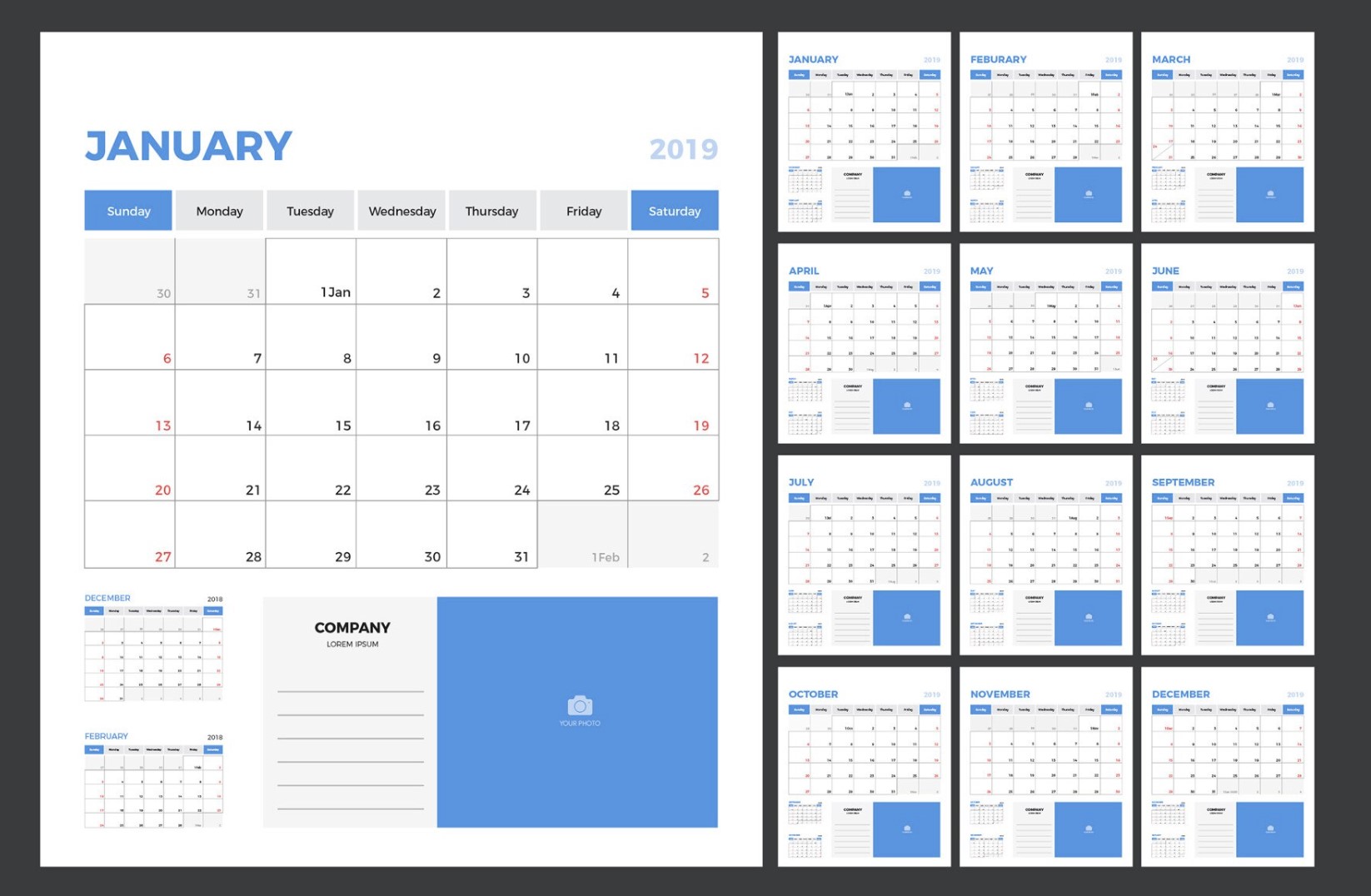
Focus on the essentials:
- Message theme or purpose (why this exists)
- Target audience (who actually needs it)
- Owner (one accountable person, not a group)
- Channel (where it will be delivered)
- Planned date (when it should land, not "sometime next week")
- Status (draft, review, approved, published)
Anything beyond this is optional and should earn its place.
How to structure ownership, timing, and audience clearly- Assign one owner per message to avoid diffusion of responsibility
- Group rows by audience so priorities are obvious at a glance
- Space messages realistically—stacking announcements kills engagement
- Leave breathing room for urgent or unplanned updates
Clarity here directly reduces follow-up questions and repeat messaging later.
Common mistakes teams make with spreadsheets- Turning the file into a dumping ground for ideas
- Tracking everything "just in case"
- Letting ownership default to "internal comms" for every message
- Never reviewing or cleaning up old entries
When spreadsheets get messy, teams abandon them—and go back to reactive posting.
The goal isn't to build a perfect calendar.
It's to create a simple system your team will still be using three months from now.
If the spreadsheet helps people plan, coordinate, and stay aligned, it's doing its job.
Step 4: When a Visual, Collaborative Tool Makes More Sense
Spreadsheets are great—until they aren't.
As internal communication grows more complex, there's a point where rows and columns stop scaling.
More contributors, more audiences, more channels, more dependencies. This is usually when teams start looking at something like an AgilityPortal communications calendar—not because it's trendy, but because visibility and coordination start to matter more than simplicity.
This shift tends to happen naturally. You don't plan for it. You feel it.
Signs spreadsheets are starting to break down
- Too many people editing the same file at once
- Version confusion ("Which tab is the latest?")
- Difficulty filtering by audience, owner, or priority
- Leadership wants a high-level view without digging through rows
- Dependencies between messages aren't obvious
When these show up, friction creeps in—and friction kills follow-through.
Why visual, collaborative tools work better at this stage
A visual board-style setup changes how teams interact with planning:
- Shared visibility so everyone sees what's coming without asking
- Filters and views by audience, channel, owner, or priority
- Clear ownership, reducing "I thought someone else was handling that"
- Status-based workflows that show progress at a glance
The impact is measurable. Studies consistently show that teams using shared, visual planning tools experience 20–25% faster execution on cross-functional work, mainly because fewer updates are missed and less time is spent clarifying status.
How teams structure boards without creating chaos
The biggest risk with visual tools is overengineering.
The teams that succeed keep it boring:
- One board for planning, not ten
- Clear stages (planned → drafting → review → scheduled → live)
- Limited custom fields—only what's actively used
- One owner per message, always
If it takes training to understand the board, it's already too complex.
Warning signs you're overcomplicating it
- Endless custom fields "for later"
- Multiple boards for the same audience
- Automation that no one trusts
- Planning discussions moving back to email or chat
When that happens, the tool becomes the work instead of supporting it.
The goal of switching to a visual calendar isn't sophistication—it's clarity. If the tool makes planning easier, faster, and more transparent, it's doing its job.
If it adds friction, go simpler. Tools should serve communication, not steal attention from it.
Step 5: Separating Internal, External, and Client Messaging
One of the fastest ways to destroy clarity is mixing audiences.
When internal updates, external marketing, and client-facing messages live in the same place, priorities blur and the wrong people start seeing the wrong information at the wrong time. This is exactly why a dedicated client calendar template matters.
Here's what usually happens in growing organisations: client work shouts the loudest. External campaigns have deadlines, revenue attached, and senior visibility.
Internal comms quietly gets pushed aside, delayed, or squeezed in "when there's time." Over time, employees feel out of the loop, and leadership wonders why alignment keeps slipping.
The fix isn't more content—it's separation with intention.
Why mixing audiences kills clarity- Internal messages get delayed to make room for client deadlines
- Employees receive contextless updates copied from external comms
- Sensitive information gets over-sanitised or over-shared
- Teams stop trusting internal channels as a reliable source
Research shows that employees are 3× more likely to disengage from internal communication when messages feel irrelevant or obviously repurposed from external marketing. That's a trust issue, not a formatting one.
Simple rules for separating calendars without duplicating effortYou don't need three completely different systems.
You need clear boundaries:
- Use a dedicated content calendar template for internal audiences only
- Treat external planning (campaigns, launches, promotions) separately
- Link calendars at a theme level, not a message level
- Never copy-paste external messaging directly into internal channels
This keeps intent clear while still allowing alignment.
Where overlap is acceptable—and where it's dangerousSome overlap is healthy. Blind duplication is not.
Acceptable overlap
- Product launches (internal first, external second)
- Company milestones that employees should hear before clients
- Strategic priorities that need consistent framing
Dangerous overlap
- Marketing language reused internally without context
- Client announcements landing internally at the same time
- Internal decisions explained using external positioning
This is where many teams go wrong by forcing internal comms to mirror a 2025 marketing calendar template.
Marketing calendars are built for attention and conversion. Internal calendars are built for understanding and execution. Different goals, different rules.
When you separate calendars properly, internal comms stops competing with client work and starts supporting it. Employees get clarity earlier, leaders spend less time repeating themselves, and communication finally feels intentional instead of reactive.
If internal messages keep getting bumped "until next week," that's not a resourcing issue—it's a calendar design problem.
Step 6: Connecting Internal Comms to Broader Content Planning
Internal communication falls apart when it lives in a bubble.
Messages get planned in isolation, sent without context, and quickly forgotten. That's why connecting internal comms to a broader content calendar template isn't a "nice to have"—it's how you make messages stick.
This doesn't mean copying marketing. It means aligning intent.
Why internal communication shouldn't live in isolationWhen internal comms is planned separately from everything else:
- Employees hear about initiatives after they've already launched externally
- Product updates feel random instead of purposeful
- Leaders repeat the same messages in meetings because nothing landed the first time
Studies show that employees are up to 40% more likely to understand and act on information when messages are reinforced across connected touchpoints rather than delivered as one-off announcements. Alignment matters.
How updates, leadership messages, and campaigns should alignYou don't need more messages—you need smarter sequencing.
- Internal teams should hear before external audiences
- Leadership messages should frame why things matter, not just what is happening
- Campaigns should be previewed internally so teams understand context and impact
When people see how updates connect, they stop treating comms as noise and start treating it as signal.
Avoiding the "content for content's sake" trapOne of the biggest mistakes teams make is filling the calendar just to stay busy.
Watch for these red flags:
- Weekly posts with no clear action or takeaway
- Messages sent because "it's been quiet"
- Content that exists only to prove comms is active
If a message doesn't change understanding, behaviour, or decision-making, it probably doesn't need to go out.
Creating consistency without flooding employeesConsistency isn't about frequency—it's about rhythm.
- Group related messages instead of drip-feeding updates
- Use predictable cadences so people know what to expect
- Leave space between major announcements to avoid overload
- Repeat key messages intentionally, not accidentally
Research consistently shows that over-communicating reduces retention, not improves it. People remember clear, well-timed messages—not constant updates.
When internal comms connects cleanly to broader planning, employees stop feeling like information is being thrown at them.
Instead, communication starts to feel coordinated, intentional, and worth paying attention to—which is exactly the point.
Read this article: : Top 6 AI-Powered Project Management Tools To Use In 2023
Step 7: Planning Ahead Without Locking Yourself In
Planning ahead is smart. Locking yourself into decisions months in advance is not.
This is where many teams trip up—especially when they treat internal communication planning the same way they treat a 2025 marketing calendar template.
Marketing calendars are designed for campaigns, launches, and fixed deadlines. Internal comms lives in a very different reality. Priorities shift. Leadership decisions change. External events force sudden updates. If your calendar can't bend, it breaks.
Why rigid long-term calendars fail in fast-moving organisations
- Business priorities change faster than planned messages
- Leadership decisions override pre-scheduled content
- "Important" updates become irrelevant by the time they're published
- Teams lose confidence in the calendar and stop trusting it
Studies show that organisations with overly rigid planning cycles are 30–40% slower to respond to change, largely because communication plans lag behind reality. In 2026-style organisations—hybrid, distributed, constantly adapting—that delay is costly.
Plan themes, not fixed messages
High-performing teams don't plan exact wording months out. They plan intent.
- Themes like "strategy alignment," "change readiness," or "operational clarity"
- Broad objectives instead of pre-written announcements
- Flexibility to adapt tone and detail closer to delivery
This gives you direction without boxing you in.
What should be locked vs what should stay flexible
Not everything needs the same level of commitment.
Lock these in:
- Cadence (weekly updates, monthly leadership messages)
- Compliance or regulatory communications
- Known milestones (company events, reporting cycles)
Keep these flexible:
- Messaging details
- Supporting content
- Channels and formats
- Timing within a defined window
This balance keeps the calendar credible without making it fragile.
How smart teams review and adapt quarterly
The most effective calendars aren't set once a year—they're reviewed regularly.
- Quarterly reviews to reset priorities
- Remove messages that no longer serve a purpose
- Adjust cadence based on engagement and feedback
- Realign themes with business direction
Teams that do this consistently report higher trust in internal communication and fewer "we already told you that" moments from leadership.
Planning ahead should create confidence, not constraint. If your calendar can adapt as fast as your organisation does, it's doing exactly what it's supposed to do.
Step 8: Free Template – A Calendar Teams Will Actually Use
Most templates look good in theory and fall apart in practice. Too complex, too rigid, or clearly designed by someone who doesn't actually run internal comms day to day. That's exactly why this internal comms calendar template free is built to be practical first and polished second.
This isn't another generic company calendar template that tries to cover every possible scenario. It's designed for real teams juggling priorities, approvals, and last-minute changes without losing control.
What's included in the template
The structure is intentionally lightweight, so it supports planning instead of slowing it down:
- Clear message purpose and audience fields
- Single owner per item (no shared responsibility confusion)
- Simple status tracking from planning to publish
- Space to flag leadership or compliance-sensitive messages
It gives you the bones of a proper employee communication calendar without forcing you into unnecessary detail.
Who this template is best suited for
This works especially well for:
- Small to mid-sized organisations building structure for the first time
- Growing teams replacing ad-hoc planning with something repeatable
- Internal comms or HR teams supporting multiple departments
- Organisations that need clarity without heavy tooling
If your current setup lives in emails, chats, or someone's head, this will feel like an immediate upgrade.
How to customise it without breaking the structure
The biggest mistake teams make with templates is over-customising too early. Start simple, then adapt:
- Add columns only when there's a clear need
- Keep ownership singular, even if execution is shared
- Avoid merging it into a broader corporate communications calendar too quickly
- Review monthly and remove anything that isn't being used
If a column doesn't help decisions or execution, it doesn't belong.
Clear next steps for implementation
Don't overthink rollout. Momentum matters more than perfection.
- Share the template with key stakeholders
- Populate the next 30–60 days only
- Agree on ownership and review cadence
- Use it actively before refining anything
Teams that do this consistently see faster alignment and fewer last-minute scrambles. The goal isn't to build the perfect calendar—it's to build one that people actually trust and use.
If your current planning system requires constant explanation, this template will feel refreshingly boring. And that's exactly why it works.
9. Final Checklist: Is Your Internal Comms Calendar Doing Its Job?
Before you move on, it's worth pressure-testing your setup.
A calendar that exists isn't the same as a calendar that works. This quick checklist helps you spot gaps before they turn into confusion, missed messages, or disengaged teams.
Use it honestly.
- Clear ownership - Every message should have one accountable owner. If responsibility is shared or unclear, execution slows and things slip through the cracks.
- A defined purpose for every entry - Each item should answer a simple question: what should people know, decide, or do after this? If there's no clear outcome, it's probably noise.
- A realistic cadence - Too much communication overwhelms people. Too little creates uncertainty. The right rhythm feels predictable, not intrusive.
- A review rhythm built in - Calendars shouldn't run on autopilot. Regular check-ins (monthly or quarterly) keep plans aligned with what's actually happening in the business.
- A feedback loop from employees - If you're not listening, you're guessing. Comments, questions, engagement signals, and direct feedback should shape what stays, what changes, and what stops.
If you can tick all five, your internal comms calendar is doing its job.
If not, that's your roadmap for improvement.
The goal isn't perfection—it's clarity, trust, and consistency people can rely on.
Turn Your Internal Comms Calendar Into a System That Actually Works
Turn Your Internal Comms Calendar Into a System That Actually Works
Reading about better internal comms is one thing. Running it day to day is another.
Most teams know what they should be doing—plan ahead, align stakeholders, avoid last-minute chaos—but their tools make it harder, not easier. Spreadsheets break.
Ownership gets blurred. Priorities clash. And internal communication slowly becomes reactive again.
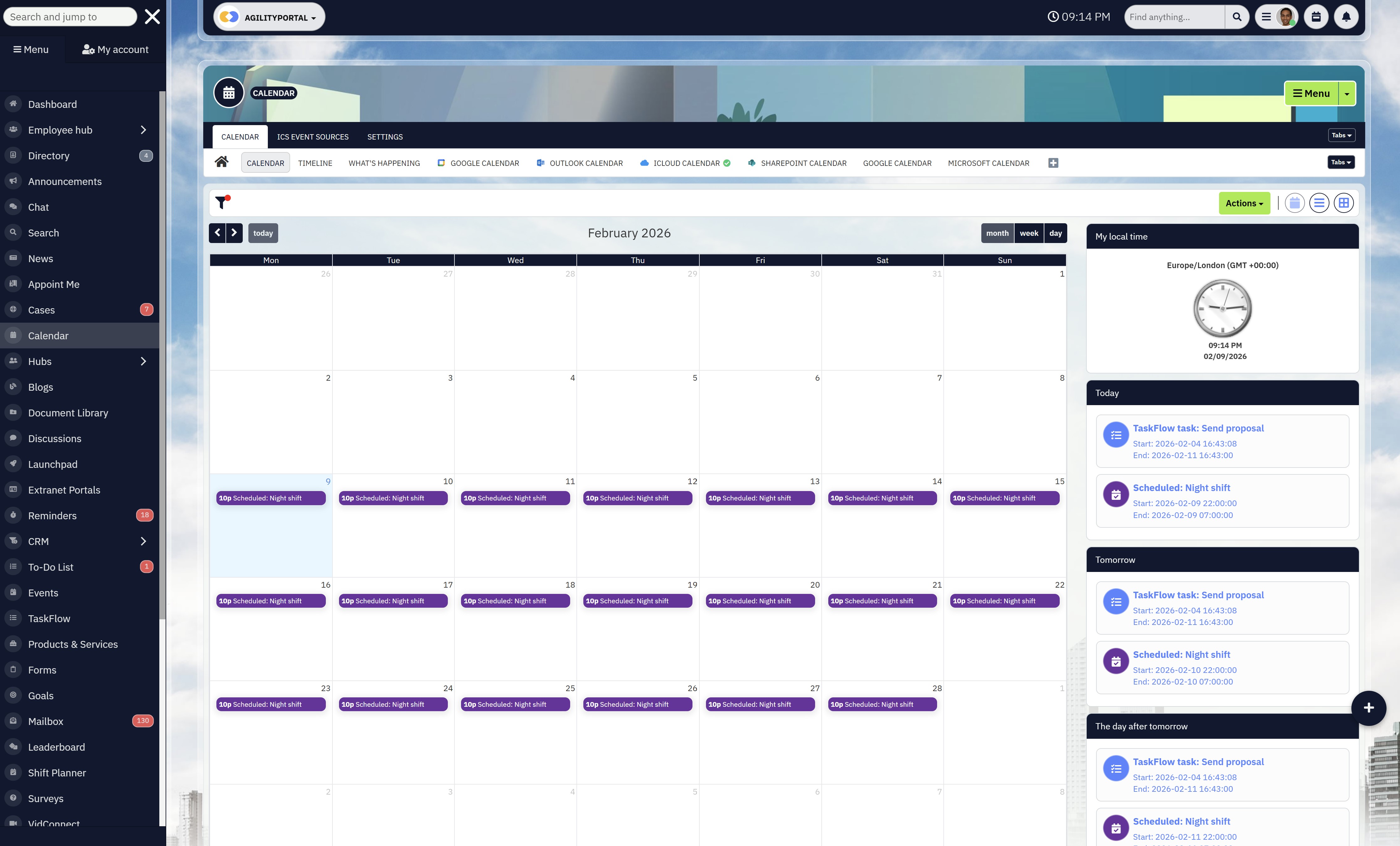
That's exactly what the AgilityPortal Calendar is built to fix.
AgilityPortal gives you a centralised, outcome-driven internal comms calendar that helps teams move from planning to execution without friction:
- Plan internal communication around real business priorities, not just dates
- Assign clear ownership so nothing falls between teams
- Keep leadership, HR, and Ops aligned in one shared view
- Adapt quickly when priorities shift—without rebuilding your calendar
- Reduce noise while improving clarity and follow-through
This isn't a marketing calendar repurposed for internal use. It's a calendar designed specifically for internal communication, coordination, and execution—built into a broader digital workplace your teams already use.
If internal comms still feels like chasing approvals, juggling tools, or explaining the plan every week, it's time to stop managing calendars and start running a system.
👉 Book a demo and see how AgilityPortal makes internal communication easier to plan, easier to run, and easier to trust.
Frequently Asked Questions: Internal Comms Calendars
What is an Internal Comms Calendar?
An Internal Comms Calendar is a planning tool that maps out what internal messages are shared, when they're delivered, and who they're for. It helps teams avoid last-minute communication, reduce noise, and keep employees aligned with what actually matters.
What is an Internal Comms Calendar Template?
An Internal Comms Calendar Template is a reusable structure—usually a spreadsheet or board—that standardises how internal communication is planned. Instead of reinventing the wheel every month, teams use a template to maintain consistency, ownership, and timing.
Is there a free Internal Comms Calendar Template I can use?
Yes. Many teams start with an internal comms calendar template free because it removes friction. A good free template should include message purpose, audience, owner, channel, timing, and status—nothing more unless it earns its place.
What's the best format for an internal communications calendar template?
For most organisations, an internal communications calendar template excel is the fastest and easiest way to get started. It's familiar, flexible, and easy to share with leadership. As teams grow, some move to visual tools, but spreadsheets still work surprisingly well.
What's the difference between a communication calendar and a content calendar?
A communication calendar template focuses on who needs to know what and when. A general content calendar often focuses on publishing volume. Internal comms needs the former—clarity, timing, and relevance—not just more content.
Can I use Google Sheets for an internal comms calendar?
Yes. Many teams adapt a content calendar template Google Sheets for internal communication because it allows collaboration and version control. Just be careful not to overload it with unnecessary fields.
Are Notion or Airtable good for internal comms planning?
Tools like Notion or an airtable communications calendar work well but what works better is AgilityPortal calendar once multiple teams contribute or visibility becomes critical. They're best used after alignment is clear—tools won't fix unclear ownership or purpose.
How is a comms schedule different from an internal comms calendar?
A comms schedule usually focuses on dates and channels. An internal comms calendar goes further by tying messages to outcomes, audiences, and ownership. Scheduling is tactical; the calendar is strategic.
Should internal comms use the same calendar as marketing or social media?
No. Internal communication shouldn't be forced into a social media campaign calendar template or marketing timeline. While themes can align, internal comms has different goals—understanding, execution, and trust, not clicks or conversions.
Do client communications need a separate calendar?
Yes. A dedicated client calendar template prevents internal messages from being deprioritised by external deadlines. Mixing audiences is one of the fastest ways to create confusion and delay internal alignment.
Can I manage an internal comms calendar entirely in Excel?
Absolutely. Many teams successfully run their entire content calendar on Excel, especially when starting out. The key is keeping it simple and reviewing it regularly so it doesn't turn into a dumping ground.
What makes an internal comms calendar actually work?
Three things:
- Clear ownership for every message
- Purpose before timing
- Regular review and adjustment
Without those, even the best internal comms calendar template will quietly fail.
Most Popular Posts

Effective communication among team members is vital for the productivity and success of any organization. Surprisingly, 60% of companies lack a long-term internal communication strategy, which p...


Businesses thrive on communication for efficiency, productivity and accomplishment. When the right information is passed from the right designation in the organization, it promotes positivity an...
Categories
Blog
(2918)
Business Management
(363)
Employee Engagement
(221)
Digital Transformation
(189)
Growth
(139)
Intranets
(133)
Remote Work
(63)
Sales
(52)
Collaboration
(46)
Customer Experience
(29)
Culture
(29)
Knowledge Management
(28)
Project management
(28)
Leadership
(20)
Comparisons
(9)
News
(1)

Related Posts

What Is Portal Software? Have you ever wondered why so many businesses struggle with disconnected systems, scattered documents, outdated intranets, and poor communication between teams? Most organisations today rely on dozens of different tools...

What happens when your systems suddenly stop working in the middle of a busy workday? For growing businesses, downtime is no longer just a technical problem — it is a direct threat to productivity, customer trust, revenue, and daily operations. ...

Despite organisations investing heavily in collaboration platforms, employee apps, and hybrid work technology, many businesses still struggle with disconnected communication, low employee engagement, and poor workforce visibility. According to ...

The communication champion role is a valuable addition to any business. In a large organization, communication champions should be numerous, forming a communication network. They keep track of information and assist others in better collaborating, wo...

Featured
In today's fast-paced hybrid work environment, staying connected isn't just nice—it's necessary. With more than 80% of employees now working remotely at least part of the time, the demand for intuitive, powerful collaboration tools has never be...


Jill Romford
I am a digital nomad, lover of exploring new places and making friends.
I love to travel and I love the internet. I take pictures of my travels and share them on the internet using Instagram.
Traveler, entrepreneur, and community builder. I share my insights on digital marketing and social media while inspiring you to live your fullest life.
Ready to learn more? 👍
One platform to optimize, manage and track all of your teams. Your new digital workplace is a click away. 🚀
Free for 14 days, no credit card required.