
Insight Blog
Agility’s perspectives on transforming the employee's experience throughout remote transformation using connected enterprise tools.
25 minutes reading time
(5051 words)
The #1 Reason Web Intranet Implementations Fail (And How to Define Your Business Needs Before It’s Too Late)

The #1 Reason Web Intranet Implementations Fail (And How to Define Your Business Needs Before It’s Too Late)
Most web intranet projects fail due to poor business alignment. Learn how to define clear business needs before implementation and avoid costly mistakes.
The #1 Reason Web Intranet Implementations Fail (And How to Define Your Business Needs Before It’s Too Late)

Most companies don't fail because the technology is broken.
They fail because they rush into a web intranet project without defining the real business problem it's supposed to solve.
And the data backs this up.
Research from McKinsey shows that nearly 70% of digital transformation initiatives fail, largely due to poor alignment and unclear objectives.
70%
failure rate
Research from McKinsey shows that nearly 70% of digital transformation initiatives fail, largely due to poor alignment and unclear objectives.
Source: McKinsey
Gartner has also reported that over 60% of digital workplace projects underperform, not because of bad tools, but because employees don't adopt them consistently.
20–25%
of the workweek
Studies suggest employees spend 20–25% of their workweek searching for information — that’s roughly one full day every week lost to misalignment.
Source: Industry research findings
Even more alarming?
Studies suggest employees spend 20–25% of their workweek searching for information. That's one full day every week lost to misalignment.
Now ask yourself honestly:
Are you implementing a platform to solve a measurable problem — or because leadership said it's time for an upgrade?
Budgets get approved. Vendors run polished demos. Features look impressive. But six months later, usage drops. Engagement stalls. Leadership starts asking hard questions.
Here's the uncomfortable truth: if you can't clearly define what success looks like before launch, you're already increasing your risk of becoming another failed statistic.
This isn't about technology. It's about clarity, ownership, and business alignment. And if you don't get that right upfront, no amount of features will save the investment.
Key Takeaways
- Enterprise collaboration software must reduce security, compliance, and operational risk as teams scale, not introduce new blind spots.
- Disconnected tools create hidden productivity loss, with employees spending significant time searching for information across systems.
- A true business collaboration platform connects communication, documents, tasks, and context in one governed environment.
- Advanced capabilities like contextual search, analytics, mobile access, and role-based permissions separate platforms from basic tools.
- Enterprises outgrow standalone collaboration tools quickly; long-term success depends on governance, adoption, and scalability.
The Real Reason Intranet Projects Fail: Misalignment, Not Technology
Let's clear something up straight away.
Most organizations don't struggle because they don't understand how does intranet work from a technical standpoint. IT teams know how to deploy it. Vendors know how to configure it.
The infrastructure usually runs fine.
The failure happens somewhere else.
McKinsey research shows that over 70% of change initiatives fail, primarily due to poor execution alignment — not because the tools don't function.

70%+
change failure rate
McKinsey research shows that over 70% of change initiatives fail, primarily due to poor execution alignment — not because the tools don’t function.
Source: McKinsey & Company
Gartner similarly reports that a majority of digital workplace initiatives underperform due to unclear ownership and undefined success metrics.
In other words, the technology works. The strategy doesn't.
Here's the pattern:
- IT focuses on technical deployment and integrations
- HR focuses on engagement and culture
- Internal Comms focuses on announcements
- Leadership assumes adoption will happen automatically
Everyone is working hard — but no one is aligned around measurable business outcomes.
No clear KPIs.
No defined ownership.
No accountability structure.
So when adoption drops, nobody knows who's responsible.
Here's where it gets uncomfortable.
Once budget has been approved and time has been invested, organizations fall into sunk cost bias. No one wants to admit the strategy was flawed.
So instead of fixing alignment issues, teams add more features… more content… more noise.
But adding more doesn't fix misalignment.
Technology initiatives fail not because of poor tools, but because of unclear ownership and undefined success metrics
As Gartner's digital workplace research highlights
That's the difference between deployment and transformation.
If you want this to succeed, stop asking only how the platform functions. Start asking how it connects to measurable business impact
Start Here: Define the Business Problems You're Actually Solving

Define the Business Problems You're Actually Solving
Before you even look at features, integrations, or dashboards, stop and ask yourself something more important:
What problem are we actually trying to fix?
This is where most projects quietly go off track.
Teams get excited about functionality, but they never slow down to define the operational gaps driving the investment.
Ask yourself honestly:
- Are employees wasting time trying to find policies, procedures, or updates?
- Is onboarding inconsistent across departments or locations?
- Are frontline teams disconnected from company news and leadership updates?
- Are managers manually sending repetitive updates through email or chat?
- Is compliance documentation scattered across shared drives and inboxes?
If you can't point to a clear business pain, you're not building a solution — you're deploying software.
And software without a defined purpose becomes noise.
Practical Exercise: The One-Page Alignment Test (Expanded)
This isn't paperwork. It's a reality check.
If you can't answer these properly, you're not ready to implement anything yet.
#1. Current Pain — Be Brutally Specific
This is where most teams stay vague.
"Communication is poor."
"Employees can't find information."
"Engagement is low."
Those are symptoms — not defined problems.
You need operational detail.
Ask:
- Where exactly is the breakdown happening?
- Which teams are affected?
- How often does it occur?
- What does it cost in time or money?
Examples of specific pain:
- Sales reps are using outdated pricing documents because updates are buried in email threads.
- New hires are asking the same onboarding questions repeatedly because documentation is fragmented.
- Site managers rely on WhatsApp groups for critical updates, creating compliance risk.
- HR policies exist in multiple versions across shared drives.
The more specific you get, the harder it is to ignore — and the easier it becomes to solve.
Psychological trigger here: clarity creates urgency. When leadership sees quantified pain, it becomes real.
2. Measurable Impact — Translate Pain into Business Risk
Now connect the dots.
Pain alone doesn't unlock budget. Impact does.
You need to show how the problem affects:
- Productivity
- Revenue
- Risk exposure
- Employee retention
- Operational efficiency
For example:
- If employees spend 30 minutes per day searching for information, multiply that by headcount and salary cost.
- If onboarding takes 90 days instead of 60, what's the cost of delayed productivity?
- If compliance documents are scattered, what's the audit exposure?
- If frontline staff feel disconnected, what's the turnover rate — and what does replacing them cost?
When you quantify impact, you shift the conversation from "nice to have" to "strategic necessity."
This is where leadership leans forward.
3. Desired Outcome — Define What Success Actually Looks Like
Here's where most implementations collapse.
Teams launch without defining success.
Instead, define improvement targets like:
- Reduce internal email volume by 25%
- Cut onboarding ramp time by 20%
- Increase frontline engagement scores by 15%
- Achieve 80% monthly active usage across departments
- Centralize 100% of policy documentation in one governed system
Notice something?
Every one of those can be measured.
If success isn't measurable, it's subjective. And subjective success never survives executive scrutiny.
Psychological trigger here: control. Clear targets reduce uncertainty and make leadership feel in control of the investment.
4. Owner Responsible — The Make-or-Break Factor
This is the uncomfortable one.
If everyone owns it, no one owns it.
You need:
- A named executive sponsor
- A cross-functional steering group
- A content governance lead
- An adoption owner
- Someone accountable for reporting metrics
Without ownership:
- Content becomes outdated
- Adoption slows
- Managers stop reinforcing usage
- The platform turns into a document graveyard
Ownership drives behavior.
And behavior drives adoption.
Why This Matters More Than You Think
Implementation doesn't fail overnight.
It fails quietly.
Usage drops gradually.
Content becomes stale.
Employees revert to email or chat.
Leadership assumes the system "just isn't working."
But the platform isn't the issue.
Lack of clarity is.
If you take the time to define pain, impact, outcomes, and ownership before configuration begins, you dramatically reduce the risk of becoming another statistic.
And that's the difference between launching software… and building something that actually changes how your organization works.
Map Business Goals to Platform Capabilities
This is the step most organizations rush through — and it's usually where things begin to unravel.
Instead of asking, "What features does the platform have?" you need to ask, "What business outcome are we trying to drive?"
If you launch with every module switched on, you don't create value — you create noise. Employees don't need more tools. They need clearer workflows.
The goal is alignment.
Here's how that looks in practice:
| Business Goal | Platform Capability | Success Metric |
| Faster onboarding | Learning hub + structured content | Reduced time-to-productivity |
| Reduced email overload | Centralized announcements & updates | Drop in internal email volume |
| Better frontline access | Mobile-first interface | Increase in daily active users |
| Stronger company culture | Recognition & engagement tools | Improved engagement scores |
Notice the order.
You don't start with features.
You start with outcomes.
Faster Onboarding
If new hires take 90 days to reach productivity, that's expensive. Align your learning modules, document libraries, and onboarding checklists to reduce ramp time.
Measure:
- Time until independent task completion
- Manager feedback ratings
- Training completion rates
If those numbers don't move, your configuration isn't working.
Reduced Email Overload
If employees complain about inbox fatigue, centralizing updates in one governed channel should be the goal.
Track:
- Reduction in internal broadcast emails
- Open rates on centralized announcements
- Engagement with internal updates
If employees still default to email threads, you haven't changed behavior.
Better Frontline Access
Deskless teams often feel disconnected. A mobile-first rollout isn't a feature decision — it's an operational one.
Measure:
- Monthly active users from frontline teams
- Login frequency by location
- Engagement with shift-based announcements
If adoption isn't happening at the edge of your organization, alignment is missing.
Stronger Culture
Recognition systems, peer shout-outs, and engagement tracking only work if they're tied to cultural goals.
Measure:
- Participation rates
- Department-level engagement comparisons
- Retention trends
Culture improves when behavior is reinforced — not when features exist.
Here's the psychological shift that changes everything:
Stop asking, "What can the platform do?"
Start asking, "What behavior are we trying to change?"
AgilityPortal, for example, includes structured content delivery, analytics dashboards, recognition systems, and mobile access — but those tools only drive value when configured against measurable business targets.
Without alignment, features create complexity.
With alignment, they create momentum.
And momentum is what separates a successful rollout from another underused system.
Involve Stakeholders Early (Or Expect Resistance)
Here's the hard truth: resistance doesn't show up after launch. It starts the moment key stakeholders feel excluded.
If you treat implementation as an IT project, it will fail culturally.
If you treat it as a communications initiative, it will fail technically.
If you treat it as "HR's tool," it will never gain operational traction.
You need alignment across functions — early.
Who Must Be Involved (And Why It Matters)
- HR (Engagement & Policy) - HR cares about culture, onboarding, compliance, and employee experience. If they're not aligned, policies won't stay updated and onboarding flows will fragment. That's when confusion creeps in.
- IT (Security & Integrations) - IT ensures data security, access control, SSO, and integration with existing systems. If they're brought in late, you'll hit technical blockers that slow momentum — and confidence drops fast.
- Operations (Workflow Impact) - Operations leaders understand how work actually gets done. If the platform doesn't fit into real workflows, employees will revert to old habits within weeks.
- Internal Communications (Content Governance) - Without a clear publishing structure, content becomes chaotic. Duplicate announcements, outdated documents, inconsistent messaging — all of it erodes trust.
- Leadership (Accountability & Sponsorship) - This is the big one.
If executives don't visibly support the rollout, employees interpret it as optional. And optional tools don't get used.
Advisory Tip: Run Workshops Before Vendor Demos
Most companies do demos first.
That's backwards.
Before you even speak to vendors, run cross-functional alignment sessions. Get stakeholders in a room (or virtual call) and ask uncomfortable but necessary questions:
- What does success look like in six months?
- What measurable outcomes must improve?
- What behaviors are we trying to change?
- What current tools or processes will this replace?
- Who owns adoption metrics?
If those answers are unclear, a demo will only distract you with features instead of focusing you on outcomes.
The Psychological Reality
People resist what they don't help shape.
When stakeholders are involved early:
- They feel ownership.
- They advocate internally.
- They defend the project when friction appears.
When they're excluded:
- They question decisions.
- They hesitate to promote usage.
- They quietly revert to old systems.
And here's the uncomfortable statistic: research consistently shows executive sponsorship is one of the strongest predictors of digital initiative success. Without it, adoption drops sharply after the initial launch spike.
Launch enthusiasm fades quickly.
Visible leadership reinforcement sustains behavior.
If you want long-term adoption, don't just align systems — align people.
Define Adoption Strategy Before Launch
Most teams think launch = success.
Wrong.
Launch is exposure. Adoption is behavior change.
And behavior change does not happen automatically just because a new platform exists.
If you don't design adoption deliberately, employees will explore it for a week… then drift back to email, shared drives, and chat threads.
That's how silent failure begins.
What Real Adoption Actually Requires
1. Role-Based Onboarding
Not everyone uses the system the same way.
- Executives need visibility dashboards.
- Managers need team communication and reporting tools.
- Frontline staff need quick mobile access to updates and resources.
- HR needs structured content and policy distribution.
If everyone gets the same generic introduction, most users won't understand how it benefits their role.
When people don't see relevance, they disengage.
2. Clear Content Governance
If no one owns content, it becomes outdated fast.
You need:
- Named content owners per department
- Review cycles for policies and announcements
- Clear publishing permissions
- Archiving rules for old material
Without governance, trust erodes. And once employees lose trust in accuracy, they stop using the platform.
3. Recognition & Behavioral Reinforcement
Adoption improves when usage is visible and rewarded.
This doesn't mean gamification for the sake of it. It means reinforcing the behaviors you want:
- Managers posting updates centrally instead of emailing
- Teams collaborating within shared spaces
- Employees engaging with official announcements
Recognition drives repetition. Repetition builds habit.
Habit builds long-term adoption.
4. Reporting Dashboards
You cannot manage what you don't measure.
You need visibility into:
- Active users (not just registered users)
- Engagement trends by department
- Content performance
- Search behavior
- Drop-off points
Surface-level metrics like login counts don't tell the full story. You need usage depth, not vanity numbers.
5. Continuous Feedback Loops
Adoption isn't a one-time push. It's ongoing optimization.
Build mechanisms for:
- Pulse surveys
- Sentiment tracking
- Department-level feedback
- Quarterly usage reviews
If you wait a year to assess performance, you've waited too long.
Preventing Silent Failure
Here's what silent failure looks like:
- Logins happen, but interaction drops.
- Content exists, but it's rarely referenced.
- Managers revert to old communication habits.
- Employees stop checking updates.
On the surface, everything looks "live."
Underneath, adoption is collapsing.
AgilityPortal's engagement analytics and sentiment tracking are designed to measure real behavior patterns — not just logins — giving leadership visibility before underperformance becomes irreversible.
Because once employees disengage completely, regaining trust is significantly harder.
Adoption isn't automatic.
It's engineered.
Avoid These Costly Implementation Mistakes
Most failed rollouts don't collapse because of one dramatic error.
They fail because of small, preventable mistakes that compound over time.
Each one creates friction. Combined, they almost guarantee underperformance.
Let's break them down properly.
1. Turning On Every Feature at Once
It's tempting.
You've invested in a powerful platform. You want to showcase everything — dashboards, recognition tools, document libraries, analytics, surveys, collaboration spaces — all live on day one.
But more features ≠ more value.
When users log in and see too many options without clear structure, cognitive overload kicks in. Instead of exploring, they disengage.
Better approach:
- Launch with core priorities only.
- Align features to defined business goals.
- Expand functionality in phases.
Momentum builds from clarity, not complexity.
2. Not Assigning Content Owners
If no one owns the content, it will decay.
Policies go outdated. Announcements become inconsistent. Duplicate files appear. Departments publish conflicting information.
And once employees lose trust in accuracy, they stop relying on the system.
Every major section needs:
- A named owner
- A review schedule
- Clear publishing permissions
- Archiving standards
Governance isn't bureaucracy. It's protection against chaos.
3. No Training for Managers
Managers are the adoption multiplier.
If they don't model the behavior, their teams won't either.
What often happens?
- Managers continue emailing updates.
- They ignore dashboards.
- They don't reinforce usage in meetings.
Employees follow leadership behavior, not launch emails.
Training managers first creates:
- Behavioral consistency
- Clear expectations
- Cultural reinforcement
If managers aren't confident using it, adoption stalls fast.
4. No Mobile Optimization for Deskless Staff
Frontline and field teams are often the most disconnected — and the most overlooked.
If access isn't seamless on mobile:
- Updates get missed.
- Engagement drops.
- Communication gaps widen.
Deskless employees won't log into a desktop portal after a 10-hour shift. If it isn't accessible in their workflow, it won't be used.
Accessibility isn't a feature. It's an adoption requirement.
5. No KPI Tracking
This is the silent killer.
Without measurable KPIs:
- You don't know what success looks like.
- You can't prove ROI.
- You can't spot declining engagement early.
Track:
- Monthly active users
- Engagement by department
- Content performance
- Search behavior trends
- Onboarding completion rates
If you only measure logins, you're measuring surface activity — not meaningful usage.
Why These Mistakes Matter
None of these errors seem catastrophic on their own.
But together, they create friction:
- Confusion
- Lack of trust
- Behavioral inconsistency
- Executive doubt
And once leadership starts questioning ROI, recovery becomes much harder.
Avoiding these mistakes doesn't require more budget.
It requires discipline, clarity, and accountability.
That's what separates a successful rollout from another underused system quietly collecting dust.
How to Present Your Business Case to Leadership
If you walk into an executive meeting talking about features, integrations, or UI improvements, you've already lost the room.
Leadership doesn't invest in tools.
They invest in outcomes.
Your job isn't to explain functionality. It's to translate operational friction into measurable business impact.
Here's how to frame the conversation properly.
1. Lead with Risk Reduction
Executives think in terms of exposure.
If policies are scattered across shared drives…
If compliance documents aren't version-controlled…
If knowledge lives in inboxes when employees leave…
That's operational risk.
Position the initiative as a way to reduce:
- Compliance breaches
- Audit failures
- Data inconsistency
- Knowledge loss from employee turnover
When information isn't centralized or governed, the business is vulnerable. That's not a technology problem — it's a risk management issue.
Risk mitigation commands attention.
2. Quantify Productivity Gains
Now move to time and money.
Research consistently shows employees spend 20–25% of their workweek searching for information or clarifying context. That's essentially one full day every week.
Multiply that by:
- Headcount
- Average salary
- Total work hours
Suddenly, inefficiency has a price tag.
If better information access reduces search time by even 10–15%, the productivity return can be significant.
Executives respond to numbers.
Translate lost time into financial impact. That reframes the conversation from "platform investment" to "efficiency recovery."
20–25%
of the workweek
Research consistently shows employees spend 20–25% of their workweek searching for information or clarifying context — that’s essentially one full day every week lost to misalignment.
Source: Industry research findings
3. Connect to Employee Retention
Turnover is expensive.
If employees feel disconnected, unsupported, or overwhelmed by fragmented communication, engagement drops. And disengagement increases attrition risk.
Frame the impact around:
- Faster onboarding
- Clearer communication
- Greater visibility from leadership
- Recognition and feedback mechanisms
Replacing an employee can cost anywhere from 30% to 200% of their salary depending on role level. Even a small improvement in retention creates meaningful savings.
Retention isn't a soft metric. It's financial leverage.
4. Highlight Data Visibility & Reporting
Executives want insight.
If leadership can't see:
- Engagement trends
- Adoption rates
- Content performance
- Department-level participation
They're operating blind.
Position the initiative as a way to provide structured reporting, measurable KPIs, and operational transparency.
When decision-makers gain visibility into communication effectiveness and workforce engagement, it shifts from guesswork to informed strategy.
And informed strategy reduces uncertainty.
Stop selling a platform.
Start presenting:
- Reduced risk
- Recovered productivity
- Improved retention
- Actionable data
Executives don't approve projects because they like features.
They approve investments when they see measurable ROI and reduced exposure.
Frame it that way — and the conversation changes completely.
Step-by-Step Implementation Framework
If you want this to work long term, you need structure.
Not excitement.
Not feature overload.
Not a flashy launch email.
Structure.
Here's a practical four-phase framework that reduces risk and increases adoption.
Phase 1 – Business Alignment
This is where most projects either set themselves up for success… or quietly sabotage themselves.
Define the Problems
Be specific.
What operational friction are you solving?
- Information scattered across systems?
- Slow onboarding?
- Email overload?
- Disconnected frontline teams?
- Lack of visibility for leadership?
If you can't clearly define the problem, the solution will drift.
Clarity at this stage prevents regret later.
Define KPIs
What will success look like in numbers?
Examples:
- Reduce internal email volume by 25%
- Increase monthly active users to 80%+
- Cut onboarding ramp time by 20%
- Improve engagement scores by 15%
If it isn't measurable, it isn't accountable.
KPIs create focus — and focus prevents feature sprawl.
Assign Ownership
This is non-negotiable.
You need:
- An executive sponsor
- A project lead
- Content owners per department
- An adoption owner
- A reporting owner
If everyone owns it, no one owns it.
Ownership drives accountability. Accountability drives results.
Phase 2 – Configuration
Now — and only now — do you start configuring.
Enable Only Priority Modules
Resist the urge to activate everything.
Start with what directly supports your defined goals.
Leave secondary features for later phases.
Less complexity = faster adoption.
Customize Dashboards by Department
Different roles need different views.
- Executives need high-level visibility.
- Managers need team updates and reporting.
- Frontline staff need fast access to relevant information.
- HR needs governance and engagement insights.
Relevance increases usage. Generic dashboards reduce it.
Integrate With Existing Systems
The platform should fit into existing workflows — not compete with them.
Integrate with:
- HR systems
- SSO
- Document storage
- Communication tools
If employees have to "switch context" too often, they'll revert to old habits.
Friction kills adoption.
Plan for Performance & Network Scalability
Most organizations focus on features but overlook infrastructure.
If your intranet is expected to support heavier internal search queries, real-time dashboards, media libraries, and multi-site access, the underlying network architecture matters.
This includes:
- Bandwidth capacity
- Latency across locations
- Load balancing strategy
- Edge performance for remote offices
- Core routing infrastructure
For larger or distributed environments, enterprise routing hardware — such as platforms built around core routing solutions like MX304 juniper — can play a critical role in ensuring stable throughput and low-latency performance.
If the network layer isn't prepared for increased internal traffic, you'll see:
- Slow search responses
- Dashboard timeouts
- Media buffering
- Frustrated users
And once performance feels unreliable, adoption declines rapidly.
Performance isn't just a technical consideration.
It's a user experience issue.
Don't Overlook the Access Layer
It's not just about core routing.
If your organization has high device density — busy offices, media-heavy content, analytics dashboards — the access layer matters too.
That's where you'll hear IT teams discussing access refreshes, such as deploying a Juniper EX4400 48F switch to maintain stable internal performance across high-traffic environments.
Without proper switching capacity at the edge:
- Internal search slows down
- Dashboards lag
- Media delivery becomes inconsistent
- User frustration increases
Infrastructure stability isn't just a backend concern — it directly affects user trust and adoption.
Phase 3 – Launch & Adoption
This is where many teams think the job is done.
It's not. This is where the real work begins.
Train Managers First
Managers are behavioral multipliers.
If they model usage:
- Teams follow.
- Communication shifts.
- Habits change.
If they ignore it:
- Adoption collapses quietly.
Train managers before company-wide rollout.
Communicate Value Clearly
Don't announce features.
Explain benefits:
- What problem is being solved?
- How will daily work improve?
- What changes in behavior are expected?
Clarity reduces resistance.
Uncertainty increases it.
Monitor Engagement Analytics
Track:
- Active usage by department
- Content interaction rates
- Search behavior
- Drop-off trends
If engagement dips early, intervene quickly.
Waiting six months to review adoption is too late
Phase 4 – Optimization
Successful implementation isn't static. It evolves.
Review Adoption Monthly
Look at trends:
- Are certain teams disengaging?
- Are specific modules underused?
- Is content becoming stale?
Early visibility prevents silent failure.
Adjust Based on Usage Data
Refine:
- Navigation
- Content structure
- Training approach
- Governance model
Optimization is continuous, not reactive.
Expand Modules Gradually
Once core adoption is strong:
- Introduce additional capabilities
- Launch new workflows
- Expand recognition or analytics features
Expansion should follow stability — not replace it.
This isn't about launching software.
It's about engineering behavior change.
If you follow these four phases — alignment, configuration, adoption, optimization — you dramatically reduce the risk of becoming another stalled initiative.
Structure beats enthusiasm every time.
Why AgilityPortal Is the Ideal Partner for Successful Intranet Implementation
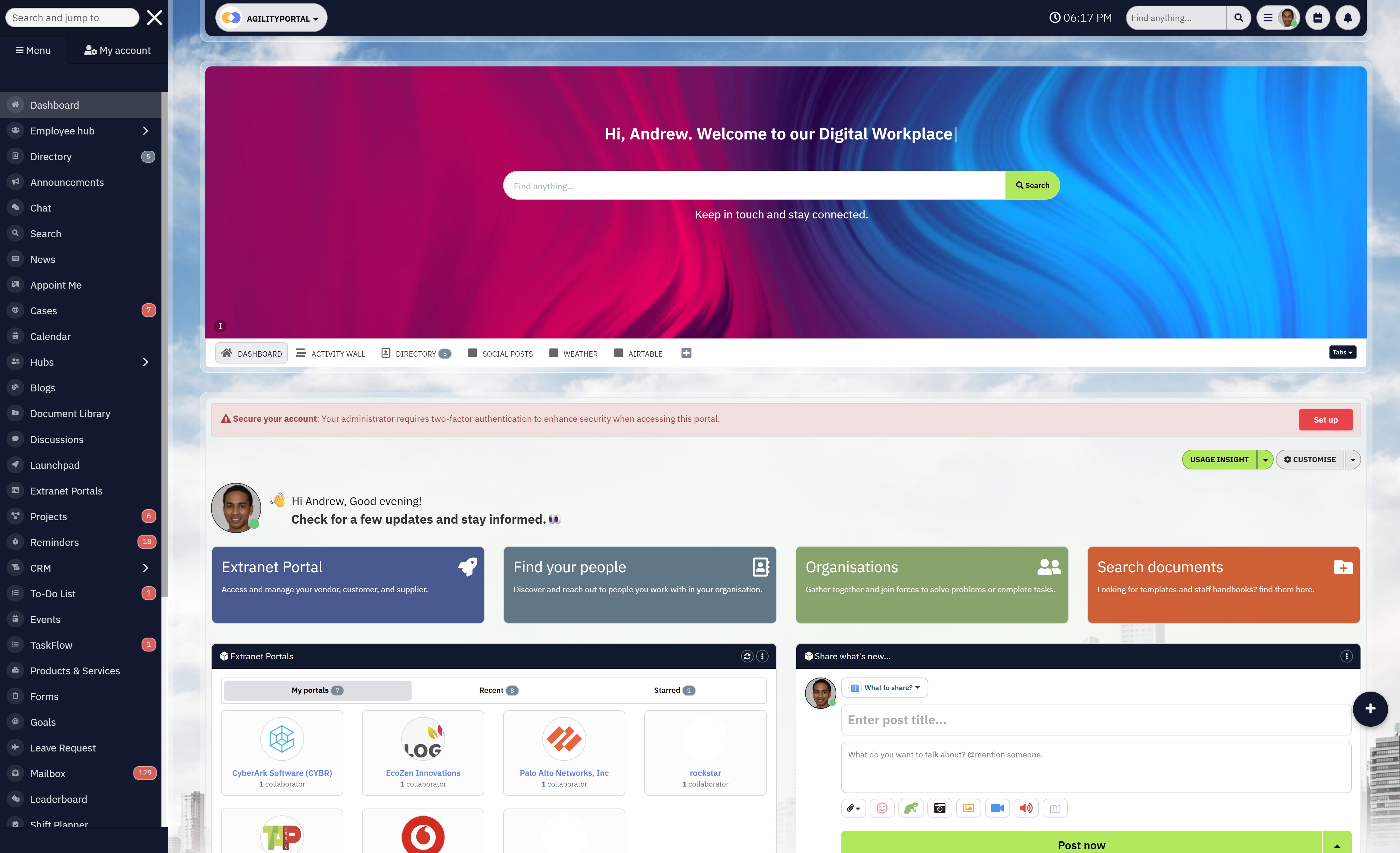
Why AgilityPortal Is the Ideal Partner for Successful Intranet Implementation
Rolling out an intranet isn't just a technical project — it's an organizational change initiative.
And that's exactly why so many implementations struggle. The software may work perfectly, but without alignment, structure, and guidance, adoption slows and value never fully materializes.
AgilityPortal is designed to be more than just a platform. It's supported by a team that works alongside your organization to ensure rollout success from day one.
Before configuration even begins, the focus is on clarifying business objectives, defining measurable KPIs, and mapping features to real operational outcomes.
Instead of turning on every module at once, the implementation approach prioritizes what delivers immediate impact — whether that's improving onboarding, centralizing communication, or increasing frontline engagement.
The team helps establish governance models, assign content ownership, configure role-based dashboards, and build a clear adoption strategy. Managers are equipped to lead by example, and leadership gains visibility through structured reporting and engagement analytics.
AgilityPortal also supports scalability across office-based, frontline, and multi-site environments with mobile-first access, deep Microsoft and Google integrations, recognition tools, and secure governance controls.
Most importantly, support doesn't stop at launch. Ongoing optimization reviews, usage analysis, and strategic guidance ensure the platform evolves as your organization grows.
AI Summary
- Most intranet initiatives fail not because of technology limitations, but due to poor alignment, unclear objectives, and lack of ownership.
- McKinsey research shows nearly 70% of digital transformation and change initiatives fail primarily due to execution misalignment.
- Employees spend 20–25% of their workweek searching for information or clarifying context — roughly one full day lost each week.
- Successful implementation requires defined KPIs, executive sponsorship, governance models, and structured adoption planning before launch.
- Performance infrastructure, network scalability, and cross-site stability directly affect user experience and long-term engagement.
- Long-term success depends on measurable business outcomes and sustained behavior change — not feature rollout alone.
Most Popular Posts

Effective communication among team members is vital for the productivity and success of any organization. Surprisingly, 60% of companies lack a long-term internal communication strategy, which p...


Businesses thrive on communication for efficiency, productivity and accomplishment. When the right information is passed from the right designation in the organization, it promotes positivity an...
Categories
Blog
(2946)
Business Management
(366)
Employee Engagement
(222)
Digital Transformation
(190)
Growth
(142)
Intranets
(134)
Remote Work
(63)
Sales
(53)
Collaboration
(47)
Customer Experience
(30)
Culture
(29)
Knowledge Management
(28)
Project management
(28)
Leadership
(20)
Comparisons
(9)
News
(1)

Related Posts
![Best Free LMS Platforms for Employee Training + Online Learning in 2026 [Expert Picks]](http://agilityportal.io/images/easyblog_articles/1756/b2ap3_thumbnail_Best-Free-LMS-Platforms-for-Employee-Training--Online-Learning-in-2026-.jpg "Best Free LMS Platforms for Employee Training + Online Learning in 2026 [Expert Picks]")
Employee training has changed a lot over the last few years. More businesses are now managing remote teams, hybrid workers, and distributed employees across different locations, which means traditional classroom training simply doesn't work the...

Most people don't realize it, but businesses use some form of a Schedule of Reinforcements every single day — whether it's employee bonuses, praise from a manager, sales commissions, promotions, or even simple recognition during team meetings. ...

AI-assisted software development is rapidly changing how modern businesses build software, and it's happening much faster than many companies expected. From AI coding tools that generate code suggestions in seconds to intelligent testing automation a...

Healthcare teams are under more pressure than ever right now. Between staff shortages, rising patient expectations, admin overload, and longer wait times, many clinics and healthcare organizations are struggling to keep up. That's exactly...

Remote work has completely changed how businesses operate, but it has also created a growing problem many companies did not fully expect: workforce compliance. As more organizations hire employees across different cities, states, and even count...


Jill Romford
I am a digital nomad, lover of exploring new places and making friends.
I love to travel and I love the internet. I take pictures of my travels and share them on the internet using Instagram.
Traveler, entrepreneur, and community builder. I share my insights on digital marketing and social media while inspiring you to live your fullest life.
Ready to learn more? 👍
One platform to optimize, manage and track all of your teams. Your new digital workplace is a click away. 🚀
Free for 14 days, no credit card required.