Insight Blog
Agility’s perspectives on transforming the employee's experience throughout remote transformation using connected enterprise tools.
23 minutes reading time
(4572 words)
What Is AI Brand Visibility—and How Do You Increase It in ChatGPT? & The Best GEO Agencies for Better AI Brand Visibility

What Is AI Brand Visibility—and How Do You Increase It in ChatGPT? And 5 of Best GEO Agencies for Better AI Brand Visibility
Learn what AI brand visibility means, how brands appear in ChatGPT, and how to improve visibility using trusted GEO strategies and tools.
What Is AI Brand Visibility—and How Do You Increase It in ChatGPT? And 5 of Best GEO Agencies for Better AI Brand Visibility

Am sure you know that people aren't just searching anymore — they're asking AI.
Instead of typing short queries into Google, users are now going straight to tools like ChatGPT to ask full questions, compare options, and decide who they should trust.
ChatGPT alone has surpassed 100 million weekly active users, and studies show a growing share of professionals now use AI as a first stop for research, not a backup.
Google has even reported that over 40% of younger users prefer conversational search over traditional results, which signals a real shift in behaviour.
When an AI tool explains a topic or recommends an approach, it's shaping brand perception whether your website is clicked or not.
Brands that appear consistently feel established; brands that don't might as well not exist.
When an AI tool explains a topic or recommends an approach, it's shaping brand perception whether your website is clicked or not.
Brands that appear consistently feel established; brands that don't might as well not exist.
This is where AI brand visibility comes in — not as a replacement for SEO, but as the next layer of discoverability, trust, and influence in how decisions are actually being made today.
In this article, we'll break down what AI brand visibility actually means, how tools like ChatGPT decide which brands to mention or ignore, what genuinely improves visibility versus what's a waste of time, and how free approaches compare to paid tools.
We'll also look at how to measure AI visibility realistically and finish by highlighting the five best GEO agencies that might be able to help improve your brand's presence in AI-driven search the right way.
● Key Takeaways: AI Brand Visibility
- AI brand visibility is about whether your brand is understood, trusted, and referenced by AI tools — not where you rank.
- Tools like ChatGPT shape perception early in the decision journey, often before users ever visit a website.
- Consistent mentions across credible third-party sources help AI systems confidently include your brand in answers.
- AI visibility rewards clarity, authority, and real expertise — not keyword stuffing or volume publishing.
- Free approaches like strong content, reviews, and expert mentions build the foundation for long-term AI visibility.
- AI visibility tools help with measurement and analysis, but they cannot replace trust or create authority.
- Brands that treat AI visibility as a long-term credibility strategy outperform those chasing short-term tactics.
Read this article: : Top 6 AI-Powered Project Management Tools To Use In 2023
The Impact of AI on Traditional Search Engines Like Google
AI hasn't killed traditional search engines — but it has changed how and when people use them.
For years, platforms like Google were the default starting point for almost any question.
Today, that starting point is increasingly an AI interface. Users now ask tools like ChatGPT to explain topics, compare options, and summarise decisions before they ever open a browser tab.
Industry data shows that a growing percentage of users treat AI as a pre-search filter, meaning by the time they reach Google, they're no longer exploring — they're validating or buying.
This shift matters because AI compresses the discovery journey.
Traditional search encourages scanning multiple links, reading different perspectives, and forming an opinion over time. AI does the opposite. It collapses dozens of sources into a single answer, which means fewer clicks, fewer brand touchpoints, and far less room for unknown players to compete on equal footing.
If your brand isn't part of the information AI systems already trust, it doesn't matter how well your page is optimised — you may never enter the conversation at all.
From Google's side, the response has been defensive and evolutionary. AI Overviews, generative summaries, and conversational results are designed to keep users inside the search experience instead of losing them to standalone AI tools.
But this also reduces organic visibility for many sites.
Multiple studies now show declining click-through rates on informational queries, even when rankings stay the same. In plain terms, ranking isn't what it used to be, because users are getting answers without needing to click.

Search engines and AI tools are moving in the same direction — they prioritise brands people already trust. If your content and reputation don't demonstrate real expertise, no amount of optimisation will make you visible long term.
Neil Patel, CEO Ubersuggest
The real takeaway isn't that SEO is dead — it's that SEO alone is no longer enough.
Traditional search engines still matter for demand capture, but AI increasingly controls demand formation.
Brands that understand this shift are adapting by building authority beyond keywords: stronger thought leadership, clearer positioning, credible mentions, and real-world trust signals that AI systems can recognise and reuse.
Those that don't risk becoming invisible long before a search result ever loads.
AI Visibility Meaning

AI Visibility Meaning
At its core, ai visibility meaning is about whether your brand exists in the knowledge layer AI tools rely on — and how confidently they describe it.
That visibility comes from two things working together: consistent brand recognition across credible sources, and strong authority signals that clearly explain what you do. AI systems don't browse the web like humans.
They absorb patterns. Brands that show up clearly and consistently in trusted contexts are easier for AI to reference, while vague or rarely mentioned brands fade into the background.
This is also why AI tools don't mention every company in a category.
They surface brands that are well-defined through reviews, long-form explanations, expert commentary, and third-party comparisons — not slogans or promotional noise.
Most importantly, AI visibility is not ranking. There are no positions to win and no shortcuts to game.
Either your brand fits naturally into an AI-generated answer, or it doesn't, and that fit is earned through real expertise and trust built outside the AI itself.
- AI visibility is about whether your brand exists in trusted AI knowledge sources and how clearly it's understood
- Visibility is driven by consistent recognition and strong authority signals, not marketing claims
- AI systems rely on patterns from credible content, not manual brand discovery
- Reviews, expert content, and third-party comparisons matter more than slogans
- AI visibility is not ranking — there are no positions, pages, or quick wins
- Brands show up in AI answers by earning trust across the wider web, not by using hacks
How ChatGPT and AI Tools See Brands

How ChatGPT and AI Tools See Brands
To understand how visibility works, it helps to know how AI tools actually form answers.
Systems like ChatGPT don't browse the web in real time the way a human does. At a high level, they rely on a combination of trained knowledge (patterns learned from large amounts of public, licensed, and human-created content) and, in some cases, live retrieval from trusted sources.
What matters for brands is not insider access or special optimisation tricks, but whether your brand shows up clearly and consistently in the information these systems recognise as reliable.
This is why consistent brand mentions across the web matter so much.
When a brand appears repeatedly in credible contexts — industry articles, product comparisons, expert commentary, reputable blogs, and business reviews — AI systems can form a stable understanding of what that brand does and where it fits.
Sporadic mentions, press releases with no substance, or content that contradicts itself creates uncertainty, and AI systems are designed to avoid uncertainty wherever possible.
Reviews and authoritative content play an outsized role here.
AI tools tend to trust information that is explained, validated, and echoed by third parties, not just claimed by the brand itself.
A thoughtful comparison, a detailed case study, or a balanced chatgpt visibility review that discusses strengths and limitations sends a much stronger signal than dozens of thin promotional posts.
Expert sources, in particular, help anchor a brand to a specific problem space, making it easier for AI to reference it naturally in explanations.
The flip side is uncomfortable but important: silence often equals invisibility.
If a brand has little meaningful content, few credible mentions, or no external validation, AI tools have very little to work with. In those cases, the brand isn't actively "excluded" — it simply doesn't register strongly enough to be included.
That's why AI visibility is less about chasing exposure and more about building a clear, trustworthy footprint that AI systems can confidently recognise and reuse.
What Influences ChatGPT Visibility (And What Doesn't)
There's a lot of noise around how to "get into" ChatGPT. Most of it is wrong.
Visibility in AI tools isn't something you trick your way into — it's something you earn over time through clarity, credibility, and consistency.
The sooner you accept that, the faster you stop wasting effort on tactics that don't move the needle.
What Actually Helps- Clear brand positioning - AI tools struggle with vague brands. If it's not obvious who you're for, what problem you solve, and how you're different, you're harder to reference. Brands with sharp positioning — clear category, clear audience, clear use case — are much easier for AI systems to place into an answer without uncertainty.
- Authoritative long-form content - Depth matters. Detailed guides, explainers, and opinionated long-form content help establish context and expertise. This is the kind of material AI systems learn from and reuse. Short, shallow posts written just to "exist" don't carry enough signal to be trusted.
- Trusted third-party mentions - Independent validation is one of the strongest signals there is. Mentions in respected publications, expert blogs, comparison articles, and industry resources help anchor your brand outside your own website. AI systems place far more weight on what others say about you than what you say about yourself.
- Transparent reviews and comparisons - Balanced reviews — including limitations — are a positive signal, not a negative one. A brand that shows up in thoughtful comparisons feels real and credible. This is especially true when those reviews come from third parties rather than your own marketing pages.
What Doesn't Work (Despite What You've Heard)
- Keyword spam - Repeating phrases or stuffing pages with variations doesn't help AI visibility. It usually does the opposite. AI systems are designed to detect low-quality or manipulative patterns and avoid them.
- Fake PR blasts - Mass-distributed press releases with no substance rarely build trust. If the same announcement appears on dozens of low-quality sites with no context, it adds noise, not authority.
- Thin AI-generated blogs - Publishing large volumes of generic, AI-written content is one of the fastest ways to dilute your brand signal. If there's no original insight, expertise, or clarity, there's nothing for AI systems to confidently reuse.
- Trying to "prompt engineer" your way into mentions - You can't force tools like ChatGPT to mention your brand by asking the right question often enough. Prompts don't train models, and repetition doesn't equal recognition. Visibility comes from the underlying data and trust signals, not from clever wording.
If a tactic is about shortcuts, manipulation, or volume over value, it won't work.
If it's about clarity, authority, and real-world trust, it probably will. AI visibility rewards the same brands that would stand up to expert scrutiny — just faster and more ruthlessly.
Free vs Paid Paths to ChatGPT Visibility
When people talk about improving visibility in ChatGPT, it often sounds like there's a secret tool or paid shortcut involved.
In reality, most brands see their first real gains without spending anything at all.
Paid tools can help later — but only once the foundations are already in place.
ChatGPT Visibility (Free Approaches)
The most reliable way to improve chatgpt visibility free is to focus on clarity and substance.
AI tools respond best to brands that explain what they do clearly, go deep on their subject matter, and show real expertise rather than surface-level marketing.
Long-form guides, practical explainers, and opinionated thought leadership pieces all help AI systems understand where your brand fits and why it matters.
External validation is just as important. High-quality backlinks from relevant publications, industry blogs, and respected platforms reinforce credibility far more than self-published content alone.
Community discussions and expert commentary also play a role.
When your brand is referenced naturally in forums, professional networks, podcasts, or expert articles, it adds context and legitimacy that AI systems are more comfortable reusing.
None of this is fast, but it works because it aligns with how AI evaluates trust.
You're not trying to "get noticed" — you're making your brand easier to understand and safer to mention.
When an AI Visibility Tool Makes Sense
An ai visibility tool can be useful once you've built some baseline presence.
These tools typically focus on monitoring where your brand appears in AI-generated answers, tracking mentions over time, and benchmarking your visibility against competitors.
They're good at surfacing patterns, gaps, and changes that would be difficult to spot manually.
Where these tools help most is scale and analysis.
If you're managing multiple markets, products, or content streams, tools can save time and provide directional insight.
Where they don't help is strategy.
No tool can define your positioning, create authority, or manufacture trust. If the underlying signals aren't there, a dashboard will simply confirm that invisibility.
The practical rule is simple: build authority first, then use tools to measure and refine it — not the other way around.
Read this article: : Top 6 AI-Powered Project Management Tools To Use In 2023
The 5 Best GEO Agencies for Earning Better AI Brand Visibility
Generative Engine Optimisation (GEO) isn't about ranking pages — it's about earning inclusion in AI-generated answers.
That means helping AI tools understand who you are, what you're trusted for, and when it's safe to mention your brand.
The agencies below stand out because they understand that difference.
They focus on authority, entity clarity, and credible third-party signals, not recycled SEO tactics with a new label.
#1. SC
Best for: Teams that want explicit LLM visibility, not vague "AI SEO" promises
SC is built specifically around LLM visibility, and that focus shows.
Their GEO program starts by creating brand-mention traction on sites that AI tools already pay attention to, rather than spreading low-quality links across the web.
The underlying philosophy is simple and correct: AI favors brands it believes people genuinely trust, and that trust is earned through contextual mentions in vetted publications.
What sets Spacebar apart is clarity.
Their services are packaged into concrete tiers (5, 10, or 25 mentions), with a transparent process from research through outreach and delivery.
On the LLM side, their work includes prompt-based audits (how your brand shows up in tools like ChatGPT or Perplexity today), restructuring pages for machine readability, and tightening entity definitions so models can reference the brand with confidence.
They frame LLM SEO as earning mentions in answers, not chasing static rankings — which is exactly the mindset shift most teams need.
One limitation: Not designed for very early-stage brands with no existing footprint to build on.
#2. Siege Media
#2. Siege Media
Best for: Content-driven brands that want proof, not theory
Siege Media doesn't just talk about GEO — they publish results.
In a widely cited Mentimeter case study, they documented 124,000 ChatGPT sessions in six months and 3,400 conversions in a single month, driven by bottom-funnel, comparison-style content that AI tools naturally summarise and cite.
That same program added 4.8 million impressions to Siege-produced content.
Siege has also analysed 193 sites and found that ChatGPT referrals are increasing month over month, with a 25.6% rise in June 2025 alone.
At that pace, AI-driven referrals could rival organic traffic within a few years. Whether or not every brand follows that curve, Siege provides board-level evidence that GEO belongs in a serious growth strategy.
One limitation: Best suited to brands willing to invest heavily in high-quality, long-form content.
#3. iPullRank
Best for: Large, complex, or enterprise websites
If your site is large, JavaScript-heavy, or constrained by compliance requirements, iPullRank is in a league of its own.
Their Relevance Engineering framework blends AI, embeddings, information retrieval, content strategy, and UX to influence whether brands appear across generative surfaces like AI Overviews and conversational search.
Their public writing goes deep into passage-level relevance, vector similarity, and semantic coverage — the mechanics that actually govern whether an LLM cites a source at all.
Recent case studies show real-world impact, such as removing hundreds of weak posts to improve sitewide semantic clarity.
As a result, iPullRank has become a frequent reference point in enterprise GEO audits.
One limitation: Overkill for small sites or teams without the resources to implement technical change
#4. Quoleady
#4. Quoleady
Best for: SaaS companies that want visibility proof before committing
Quoleady combines topical authority content, hands-on editorial link building, and LLM-specific hygiene (including llms.txt) to ensure brands are present where third-party sources get cited.
What's refreshing is how specific they are about results.
They publicly reference brands like Loopy Loyalty, PassKit, and Expandi appearing in ChatGPT answers for category terms, along with SaaS clients showing up across hundreds or thousands of keywords in Google AI Overviews.
They also document how they track LLM referrals and structure pages so AI tools can reuse and cite them, which makes their approach easy to evaluate before engagement.
One limitation: Less suitable for non-SaaS or highly regulated industries.
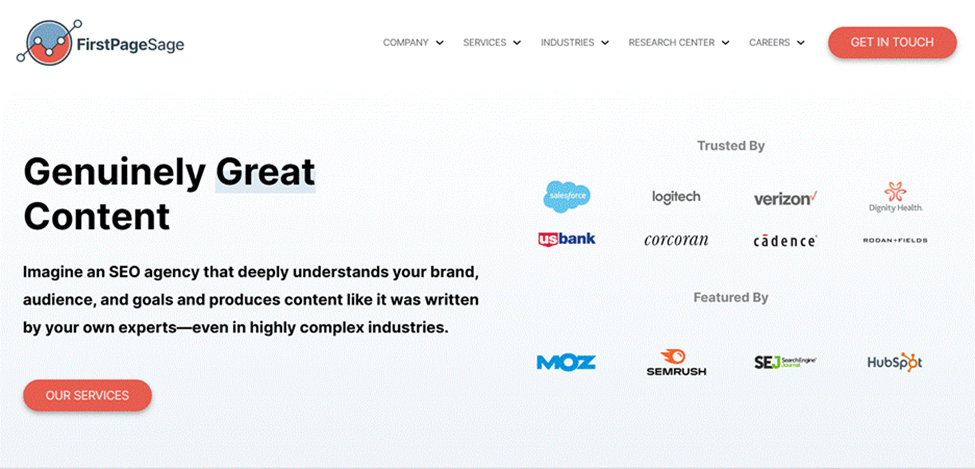
#5. First Page Sage
#5. First Page Sage
Best for: B2B brands that win through authority and thought leadership
First Page Sage approaches GEO through long-term credibility rather than tactical optimisation.
Their strength lies in building executive-level thought leadership, deep industry explainers, and authoritative narratives that AI tools can safely reference when explaining complex topics.
This works particularly well in B2B, professional services, and high-consideration categories where trust matters more than volume.
Their approach aligns naturally with how AI tools surface brands: not as "the best option," but as the most credible voice in a space.
One limitation: Slower payoff compared to more tactical GEO programs.
How to Choose the Best GEO Agency
- Ask for LLM-specific visibility checks. You want prompt-based audits across ChatGPT, Perplexity, and Gemini before work begins and again quarterly. Spacebar formalizes this as part of onboarding, and iPullRank includes it in Relevance Engineering diagnostics.
- Prioritize third-party presence. GEO isn't just publishing more. You need frequent brand-mentions on reputable, previously cited sites, which Spacebar and Quoleady explicitly optimize for.
- Demand proof. Siege's Mentimeter program shows LLM traffic and conversions, not vibes. Bring that standard to every proposal.
- Keep SEO foundations alive. Every credible roundup (and Spacebar's own LLM SEO primer) says the quiet part out loud: GEO works best on top of strong SEO. The goal shifts from ranking to being cited, but the groundwork still matters.
Common Mistakes Brands Make With AI Brand Visibility
Most AI brand visibility problems don't come from lack of effort — they come from misapplied effort.
Teams reuse old SEO playbooks, assume AI works the same way, and then wonder why nothing sticks.
The brands that struggle longest are usually doing more work, not better work.
Mistake #1: Treating AI Visibility Like Old-School SEO
Ranking pages, chasing keywords, and optimising for clicks made sense when search engines controlled discovery.
AI tools don't work like that. They don't care about page position or keyword density.
They surface brands they understand and trust.
If your strategy still revolves around "ranking higher," you're optimising for the wrong system.
Mistake #2: Publishing Volume Instead of Value
More content does not mean more visibility.
Flooding your site with thin posts — especially low-effort AI-generated ones — usually dilutes your signal. AI systems favour clarity and authority.
Repetitive or shallow content creates noise, not trust. In practice, a few strong pieces outperform dozens of weak ones.
Mistake #3: Ignoring Reviews and Off-Site Reputation
This is a major blind spot. AI tools care far more about what others say about you than what you say about yourself.
If your brand lacks credible third-party validation — reviews, expert commentary, comparisons, or independent mentions — AI has little reason to reference you confidently.
Mistake #4: Expecting Instant Results
AI visibility compounds over time. One article, one mention, or one tweak rarely changes anything on its own.
Brands chasing quick wins often quit just as trust signals start to accumulate.
The brands that succeed treat AI visibility as a long-term credibility play, not a campaign.
The Real Pattern Behind Every Mistake
Every one of these issues comes back to the same thing: trust. AI brand visibility isn't earned through hacks, speed, or volume.
It's built through consistency, clarity, and reputation over time.
Brands that focus on long-term authority don't just show up more often — they show up in the right contexts, for the right reasons.
Measuring AI Brand Visibility Without Chasing Ghosts
Measuring AI brand visibility is where a lot of teams lose the plot.
Dashboards multiply, metrics pile up, and suddenly you're tracking everything except what actually matters.
The goal here isn't to "prove" AI visibility exists — it's to understand whether your brand is becoming easier for AI to recognise and reference.
What You Can Measure (And Should)
There are a few signals that are genuinely useful when tracked consistently:
- Brand mentions in AI-generated answers - Are you appearing at all? Are mentions becoming more frequent or more specific over time?
- Sentiment and context - How is your brand described when it does appear? Neutral, positive, cautious, or authoritative matters more than raw count.
- Source quality behind mentions - Are AI references clearly tied to credible articles, expert content, or trusted publications — or vague, low-quality sources?
- Trend direction - Month-over-month movement is more important than any single snapshot.
These indicators help you understand whether trust and clarity are accumulating.
What You Shouldn't Obsess Over
This is where most teams go wrong:
- Exact mention counts - AI outputs aren't stable rankings. A brand appearing three times instead of five doesn't mean progress reversed.
- Daily fluctuations - AI responses vary by phrasing, context, and model updates. Micro-changes are noise.
- "Share of AI voice" charts - These often look impressive but rarely map to real business impact.
If a metric changes constantly but doesn't influence decisions, it's not helping you.
Why Qualitative Signals Matter More Than Vanity Metrics
The most meaningful improvements in AI brand visibility are often qualitative before they're quantitative.
You'll notice things like:
- AI explanations becoming more accurate about what you do
- Your brand being used as an example rather than a footnote
- Clearer association with a specific category or use case
These shifts indicate understanding — and understanding always comes before frequency.
If AI tools describe your brand correctly and confidently, visibility usually follows.
How to Sanity-Check Visibility Claims From Vendors
This part matters more than most teams realise.
When a vendor claims they've "boosted AI visibility," ask:
- Where exactly does the brand appear?
- In what context is it mentioned?
- Which sources are being reused or cited?
- Would this still matter if the chart disappeared?
If the answers rely heavily on proprietary scores, opaque graphs, or one-off screenshots, be cautious.
Real AI visibility improvements show up as clearer brand understanding across multiple prompts and scenarios, not just prettier dashboards.
The Practical Takeaway
Treat AI brand visibility measurement like brand health, not rankings.
Look for clarity, consistency, and trust signals improving over time.
If your brand is easier for AI to explain today than it was six months ago, you're moving in the right direction — even if the numbers don't look dramatic yet.
That mindset keeps you focused on progress instead of chasing ghosts.
Wrapping up
If there's one idea to take away from all of this, it's that AI brand visibility follows real authority.
AI tools don't invent trust — they reflect it.
Brands that show up consistently in AI-generated answers are usually the ones that have already done the hard work: clear positioning, credible content, and recognition beyond their own website.
It's tempting to look for shortcuts, especially when AI feels new and opaque.
But just like search, visibility in AI systems rewards long-term thinking. Quick tactics, thin content, or "AI hacks" might create the illusion of progress, but they rarely last.
The brands that win are the ones that invest steadily in expertise, clarity, and reputation, even when results aren't immediate.
It also helps to reset expectations around tools.
AI platforms and visibility tools don't create reputation — they amplify what already exists. If the underlying signals are strong, AI will reflect that strength.
If they're weak or inconsistent, no tool can paper over the gap. Used correctly, tools help you measure, refine, and scale what's working — not replace the fundamentals.
The calm truth is this: you don't need to chase AI to be visible in it.
Focus on being genuinely useful, credible, and well-understood in your space, and AI visibility tends to follow. Not overnight, and not by accident — but predictably, and for the right reasons.
Most Popular Posts

Effective communication among team members is vital for the productivity and success of any organization. Surprisingly, 60% of companies lack a long-term internal communication strategy, which p...


Businesses thrive on communication for efficiency, productivity and accomplishment. When the right information is passed from the right designation in the organization, it promotes positivity an...
Categories
Blog
(2986)
Business Management
(376)
Employee Engagement
(223)
Digital Transformation
(192)
Growth
(143)
Intranets
(137)
Remote Work
(63)
Sales
(53)
Collaboration
(48)
Customer Experience
(30)
Culture
(29)
Knowledge Management
(28)
Project management
(28)
Leadership
(20)
Comparisons
(9)
News
(1)

Related Posts

Recruitment challenges remain one of the biggest obstacles to growth for deep tech companies in 2026. As demand for AI engineers, data scientists, robotics specialists, semiconductor experts, and biotech researchers continues to rise, organizat...

The rise of artificial intelligence is transforming the way SEO professionals research keywords, analyze competitors, monitor rankings, and optimize content. According to a 2024 HubSpot survey, more than 64% of marketers already use AI tools in...

The DEI maturity model represents a structured approach to assessing and enhancing diversity, equity, and inclusion within corporate environments. This model serves as a crucial framework for organizations aiming to not only diversify their wor...

If you've ever managed relationships with partners, distributors, resellers, suppliers, or clients, you've probably experienced the frustration of searching through endless email threads, outdated spreadsheets, and scattered documents just to find a ...

We all know that Fund management plays a critical role in the success of any partner program. Whether you're managing marketing development funds (MDF), co-marketing budgets, partner incentives, rebates, training initiatives, or broader partner ...


Jill Romford
I am a digital nomad, lover of exploring new places and making friends.
I love to travel and I love the internet. I take pictures of my travels and share them on the internet using Instagram.
Traveler, entrepreneur, and community builder. I share my insights on digital marketing and social media while inspiring you to live your fullest life.
Ready to learn more? 👍
One platform to optimize, manage and track all of your teams. Your new digital workplace is a click away. 🚀
Free for 14 days, no credit card required.